 Snohomish
 Exterior Work in Ferndale Has to Answer to the Weather First
Ferndale sits in a stretch of Whatcom County where the exterior of a house does real work every single day. Homes here deal with a steady drift of salt-tinged marine air, rain that rarely falls straight down, and stretches of shade and dampness long enough to grow moss on almost anything that holds still. None of that is unusual for this part of Washington, but it means an exterior contractor who treats Ferndale like generic Pacific Northwest territory is going to make choices that don't hold up. We work this area regularly enough to know which failures repeat and which materials and details actually prevent them.
This page covers what we see on Ferndale homes and how our four core services — siding, roofing, windows, and decks — are built around this specific climate rather than a national average.
What Ferndale's Climate Actually Does to a House
Salt Air and Marine Exposure
Even set back from open water, homes in this part of Whatcom County pick up a steady dose of salt-laden air. Salt accelerates corrosion in fasteners, flashing, hinges, and lower-grade trim, and it breaks down cheap finishes faster than a drier inland climate would. Any material or hardware choice that doesn't account for that corrosion risk tends to show its age early.
Wind-Driven Rain
Rain in this region comes in sideways more often than people expect. Wind pushes moisture into lap joints, trim seams, window flanges, and deck ledger connections — places that a straight-down rain would never reach. A product or installation detail that would perform fine in a calmer, drier climate can still fail here specifically because it was never tested against rain moving horizontally.
A Long Moss and Mildew Season
Mild temperatures, plenty of shade from trees and neighboring structures, and consistent moisture add up to a moss and mildew season that can run most of the year on north-facing walls and shaded roof slopes. Porous materials or anything that holds water against a substrate becomes a growth surface, usually starting in places you can't see from the street.
Siding: Why We Only Install James Hardie in This Area
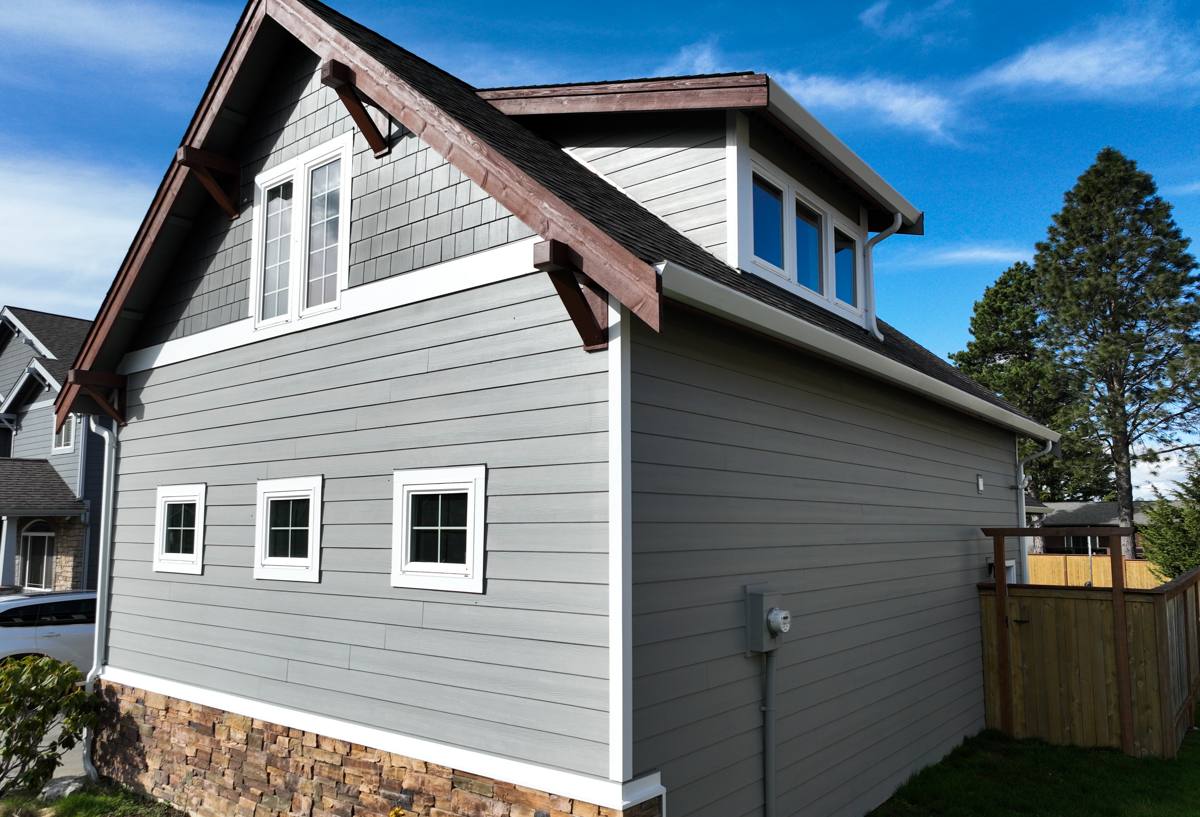
We used to offer more siding options. We narrowed to one system — James Hardie fiber cement — because of what we kept finding on tear-offs and service calls in exactly this kind of climate, not because of a supplier relationship or a marketing angle.
- Non-combustible core: fiber cement doesn't feed a fire the way wood-based siding products can, which matters for household safety and for insurance underwriting.
- Factory-applied ColorPlus finish: the color is baked on under controlled conditions instead of brushed on in the field, so it resists fading and moisture intrusion far longer than site-applied paint.
- Climate-engineered HZ formulations: Hardie's HZ5 product line is built specifically for regions with sustained moisture exposure and freeze-thaw cycling, which describes coastal Whatcom County well.
- Dimensional stability: fiber cement doesn't swell, cup, or warp the way engineered wood siding can after repeated wet-season moisture cycles.
- A strong transferable warranty: when the installation follows spec, Hardie backs the product with one of the more robust warranty structures in the industry.
We don't install LP SmartSide, vinyl, Cemplank, Allura, primed spruce, or cedar. Every one of those products has a legitimate place in the market and plenty of homeowners are happy with them. But we made a professional judgment call: in a climate that combines this much sustained moisture with salt exposure, standardizing on one system we trust completely is worth more than offering a cheaper option that quietly shifts maintenance risk back onto the homeowner over the following decade.
Correct installation matters as much as the material. That means proper fastening patterns, correct clearances from grade and roofline, properly lapped and sealed joints, and house wrap and flashing details that work with the siding rather than fighting it. A good material installed carelessly will still fail early — we treat installation detail with the same seriousness as the material spec.
Roofing for Whatcom County's Wet, Mossy Conditions
Roofs in Ferndale take on the same moss and moisture pressure as siding, plus the added stress of standing water risk in valleys and around penetrations if flashing details are wrong. A roof system here needs ventilation that actually moves air, underlayment rated for extended wet exposure, and flashing at every chimney, vent, and valley that's sealed to shed sideways-driven rain, not just water falling straight down. Shaded, north-facing roof planes are usually the first place moss takes hold, and once moss roots into a shingle mat it starts lifting edges and trapping moisture underneath — a slow failure that's easy to miss until it's already causing leaks.
Windows That Hold Up to Wind and Marine Air
Window failures in this climate are rarely about the glass — they're about the flange, the flashing tape, and the sill pan underneath. Wind-driven rain finds any gap in that sequence, and salt air accelerates corrosion in cheap hardware and weep systems over time. We flash every window opening with a sill pan and properly lapped flashing tape so water that does reach the opening drains back out instead of tracking into the wall cavity. Frame material matters too — some materials handle sustained damp exposure and salt air better than others over a 15-to-20-year window.
Decks Built for Year-Round Exposure
A deck in Ferndale sits directly under the same rain and moss pressure as the roof, but with the added complication of a horizontal surface that holds water instead of shedding it, and a ledger connection that's one of the most common sources of hidden rot on older homes. We pay particular attention to ledger flashing, joist protection, and decking material choice, since a deck surface that stays damp for long stretches through the fall and winter is exactly the kind of surface moss and mildew take over first.
What a Ferndale Job Actually Looks Like
Every project starts with a walk of the exterior, not a quote pulled from a square-footage formula. We're looking for the things a climate like this actually breaks: soft trim, hidden moisture at penetrations, moss buildup that's hiding a wet substrate underneath, and any prior repair work that was patched instead of properly flashed. From there we scope the actual work needed, not an upsell list.
What to Expect From a Local Crew
- A written scope that specifies materials, flashing details, and warranty terms — not just a total price
- Site protection for landscaping and neighboring surfaces during tear-off and install
- Daily cleanup, especially with fiber cement dust and cut waste
- A final walkthrough before the job is called complete
- Warranty paperwork registered in your name, not left for you to chase down later
Cost Factors Worth Understanding Before You Get Quotes
Exterior project costs in this area swing on a handful of predictable factors. Knowing them ahead of time makes it easier to compare quotes that actually mean the same thing.
| Factor | Why It Moves the Price |
|---|---|
| Existing substrate condition | Hidden rot or moisture damage found during tear-off adds repair scope beyond the original estimate |
| Home height and access | Multi-story sections, steep roof pitches, and tight lot access change staging and labor time |
| Flashing and trim detail | Homes with more window openings, dormers, or roof transitions require more flashing work per square foot |
| Material line and finish | Hardie's product lines and ColorPlus color options carry different price points than field-painted alternatives |
| Tear-off vs. overlay | Full removal of old material costs more upfront but avoids trapping moisture behind a new layer |
A quote that comes in noticeably lower than the others is worth a second look at what it's actually including — skipped flashing details or thinner underlayment show up as savings today and a service call in a few years.
Maintenance That Actually Matters in This Climate
Fiber cement siding and a correctly installed roof, windows, and deck cut down on maintenance significantly compared to more porous materials, but nothing in this climate is entirely maintenance-free. A short seasonal routine catches most problems while they're still cheap to fix.
- Check north-facing and shaded siding and roof areas for early moss growth each fall
- Clear gutters and downspouts before the heavy fall rains start
- Inspect deck ledger and joist areas for soft spots or staining, especially after winter
- Look at caulking and sealant joints around windows and trim yearly — these age faster than the materials around them
- Rinse siding and decking periodically to keep organic buildup from taking hold
Why a Local Crew Matters
A contractor who works Whatcom County regularly already knows which details fail here and builds them into every bid without being asked. That's different from a crew working from a generic checklist that doesn't account for salt air corrosion, sideways rain, or a moss season that runs most of the year. We're not guessing at what Ferndale's climate does to a house — we're building around what we've already seen it do.
If you're weighing siding, roofing, window, or deck work on a Ferndale home, we're glad to walk the property and give you a straightforward, no-pressure estimate — just fill out the form below.