 Snohomish
 Why Ferndale Roofs Take More Punishment Than Inland Homes
Ferndale sits close enough to saltwater and open water crossings that homes here deal with a roofing environment inland Whatcom County properties don't. Salt-laden air moves through regularly and settles on every exposed metal surface on a roof — nail heads, flashing, drip edge, vent stacks. Add wind-driven rain off the water and a long stretch of mild, wet months where moss and algae have nothing but time to spread, and you've got three separate stresses working on the same roof at once. A shingle roof built to a generic spec handles one of those. Ferndale needs one built for all three.
Salt Air and Corrosion
Salt air isn't a cosmetic problem — it's a corrosion problem. Standard electro-galvanized fasteners and flashing can start showing surface rust well before the shingles themselves are due for replacement. Once a fastener head corrodes and loses its seal, water has a path straight into the roof deck, and you won't see it from the ground — it shows up later as a stain on a ceiling or a soft spot in the sheathing. This is why the hardware matters as much as the shingle brand. We spec corrosion-resistant fasteners and flashing on Ferndale roofs — stainless or heavier-coated options where it counts, particularly at ridges, valleys, and anywhere metal stays permanently exposed to weather. It costs a little more up front. It's cheaper than a deck repair five years in.
Driving, Wind-Driven Rain
Shingles shed water well when it's falling straight down. Wind-driven rain off open water doesn't fall straight down — it comes in at an angle, works under shingle tabs, and pushes into laps, valleys, and anywhere two roof planes or a roof and a wall meet. On a well-built roof, the shingles are the first line of defense, not the only one. The underlayment and flashing system underneath is what actually keeps water out when it's coming in sideways: self-adhering, waterproof membrane at eaves, valleys, and penetrations; properly lapped synthetic underlayment everywhere else; step flashing and counter-flashing at every wall intersection, chimney, and skylight. Shortcuts here — reused old flashing, underlayment stapled instead of properly lapped — show up as leaks in exactly the storms the roof was supposed to handle.
A Long Moss Season
Whatcom County's wet season runs long, and shaded, north-facing, and tree-covered roof sections stay damp for months at a stretch — exactly what moss and algae need to take hold. Moss doesn't just look bad; it lifts shingle edges as it grows, holds moisture against the shingle surface, and accelerates granule loss. Left alone long enough, it shortens the life of an otherwise sound roof. Some of this gets addressed at installation — copper or zinc-impregnated shingle strips near the ridge on shaded roofs release trace metal ions with every rain and slow regrowth. The rest is upkeep: periodic soft-washing (never pressure washing, which strips granules) and keeping gutters and valleys clear so water doesn't sit.
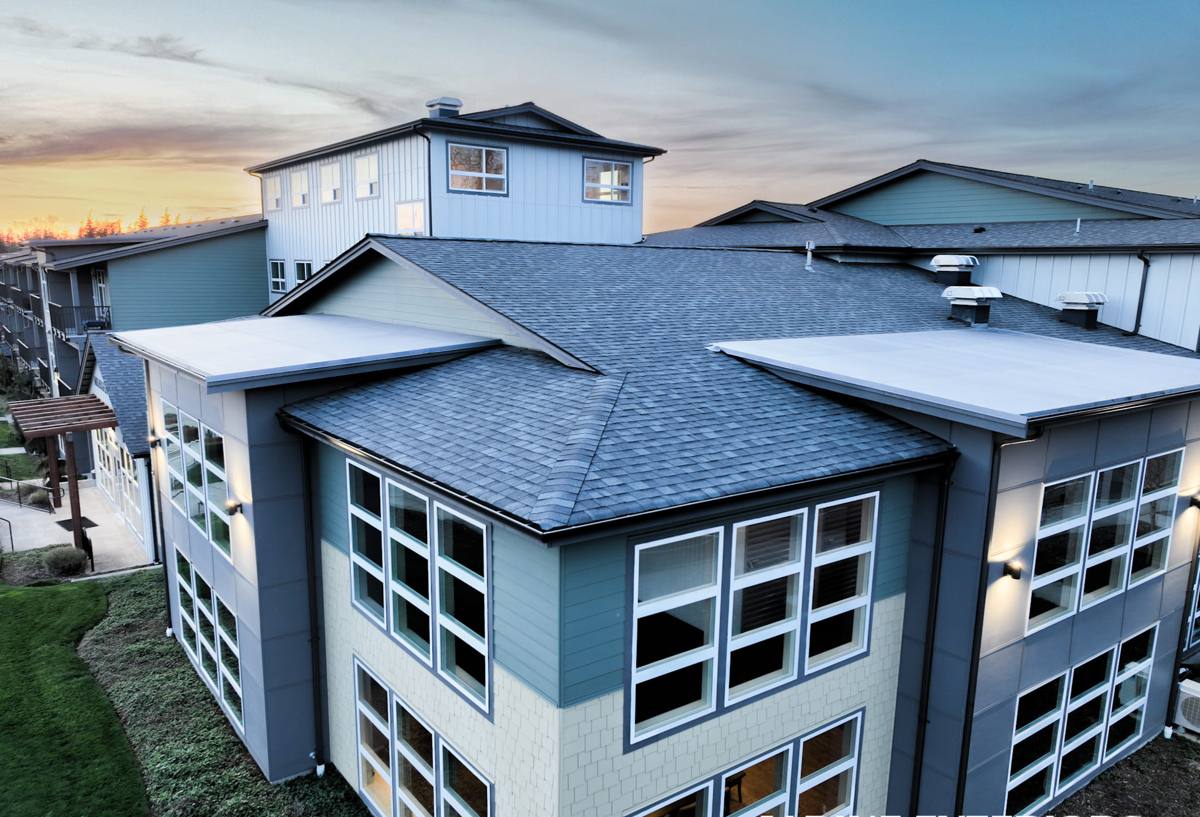
What Goes Into a Correctly Built Asphalt Shingle Roof Here
A correct install in Ferndale isn't a different shingle — it's a different system underneath it. Here's what we consider non-negotiable on a coastal Whatcom County home:
| Component | Standard Build | What We Use in Ferndale |
|---|---|---|
| Fasteners | Standard galvanized nails | Corrosion-resistant fasteners rated for coastal exposure |
| Underlayment | Felt or basic synthetic | Full synthetic underlayment, self-adhering membrane at eaves and valleys |
| Flashing | Reused or minimal new flashing | New step and counter-flashing at every wall and penetration |
| Ventilation | Whatever's already there | Balanced intake and exhaust, checked and corrected |
| Moss control | None | Zinc or copper strips on shaded, north-facing slopes |
None of this shows up in a picture of the finished roof. It's the difference between a roof that looks fine for two years and one that's still tight in fifteen.
Choosing a Shingle Tier for a Coastal Home
Three-tab, architectural (dimensional), and premium designer shingles all shed water the same way when they're new. The differences that matter here show up over time: architectural shingles are heavier and layered, and generally hold up better to wind and impact than three-tab — which matters when weather is coming off open water rather than just falling straight down. Premium designer shingles add more dimension and a heavier profile still, at a higher material cost. For most Ferndale homes, architectural shingles are the practical middle ground: enough durability for the climate without paying for features a modest coastal home doesn't need. We'll walk you through the real tradeoffs for your roof rather than upselling a tier you don't need.
Why Ventilation Matters As Much As the Roofing Material
A shingle roof over a poorly ventilated attic traps warm, moist air against the underside of the deck. In a climate that's already damp most of the year, that trapped moisture condenses, soaks into the sheathing, and creates the kind of slow rot you don't notice until a shingle nail loses its grip or a soft spot appears underfoot. Balanced ventilation — enough intake at the eaves and exhaust at the ridge — keeps air moving through the attic year-round, which protects the deck from underneath while the roofing system protects it from above. We check existing ventilation on every re-roof and correct it if it's undersized, blocked, or unbalanced, rather than just shingling over the problem.
Our Process, Start to Finish
- On-site inspection and honest estimate. We look at the whole roof — deck condition, ventilation, flashing, moss and moisture history — not just the shingles, and give you a written scope before any work starts.
- Tear-off and deck check. Old roofing comes off down to the deck, and we inspect the sheathing for soft spots or rot before anything new goes down. Problems get flagged and priced before we cover them up, not discovered after.
- Underlayment and flashing. Self-adhering membrane at eaves, valleys, and penetrations; synthetic underlayment everywhere else; new flashing at every wall, chimney, and vent.
- Shingle installation. Installed to manufacturer spec for nailing pattern and exposure, with moss-control strips added on shaded slopes.
- Ventilation correction. Intake and exhaust checked and adjusted to keep the attic properly balanced.
- Cleanup and walkthrough. Site swept, magnetic nail sweep for the yard and driveway, and a walkthrough so you know exactly what was done and what to watch for going forward.
Best Time of Year to Reroof in Ferndale
Asphalt shingles need dry, moderate temperatures to seal properly — the adhesive strip on the back of each shingle activates with warmth and won't bond the same way in cold, wet conditions. That makes the drier stretch of the year the right window for a full tear-off and reroof here, and we schedule around it rather than fighting the weather. That said, a damaged or leaking roof doesn't wait for good scheduling — if you've got active water intrusion in the middle of moss season, we'll tarp and stabilize the situation regardless of time of year, then plan the permanent fix for the next dry window.
Signs Your Ferndale Roof Needs a Closer Look
Some of these you can catch from the ground; others need someone on the roof to confirm.
- Dark streaking or green-black growth on north-facing or shaded slopes
- Granules collecting in gutters or at downspout outlets
- Shingle edges that look lifted, curled, or cupped
- Rust staining running down from flashing, vents, or nail heads
- Daylight visible through the attic roof deck, or damp insulation below it
- Moss thick enough to hold a footprint or visibly raise the shingle line
Any one of these is worth a look before it becomes a bigger repair. None of them mean an automatic full replacement — sometimes it's a flashing fix or a moss treatment, not a new roof.
What Drives the Cost of a Ferndale Re-Roof
| Factor | Why It Matters |
|---|---|
| Roof size and pitch | More surface area and steeper slopes mean more material and labor time |
| Number of layers to remove | Tearing off an existing layer or two adds labor before any new roofing goes on |
| Deck condition | Soft or rotted sheathing found at tear-off needs replacement before shingles go down |
| Flashing and penetrations | Chimneys, skylights, and multiple roof planes each need their own flashing detail |
| Shingle tier | Three-tab, architectural, and premium designer shingles differ in material cost and labor |
| Access | Steep sites, limited driveway access, or tall roofs affect staging and safety setup |
Most Ferndale re-roofs land in a broad mid-range once these factors are known, and the only way to give you a real number is to see the roof. We'd rather walk it with you and quote what's actually there than guess over the phone.
Why a Crew That Already Works Ferndale Matters
A roofer who only sees a Ferndale roof occasionally treats it like any other job. A crew that works this area regularly already knows which slopes hold moss longest, how fast salt air chews through unprotected metal, and which flashing details actually hold up against wind-driven rain off the water. That knowledge changes what gets specified before the first shingle goes down — not something added after a callback. It also matters for response time. When a wind event or a heavy rain finds a weak spot, a crew already working in Whatcom County can get out to look at it faster than one dispatching from across the region. That's not a small thing when water is actively getting into a roof deck.
Warranty: What's Actually Covered
A shingle roof carries two separate warranties, and it's worth understanding the difference before you sign anything.
- Manufacturer material warranty — covers defects in the shingle itself. Doesn't cover installation errors, and prorated coverage typically drops over time.
- Workmanship warranty — covers the installation: flashing, underlayment, nailing pattern, ventilation work. This is what protects you if a leak traces back to how the roof was put together, not a defect in the shingle.
We stand behind our workmanship separately from whatever the shingle manufacturer covers, and we'll walk you through both in plain terms before the job starts — not buried in fine print after.
If your Ferndale roof is showing moss, rust staining, or you just want an honest read on where it stands, we're glad to come take a look. The estimate is free, there's no pressure attached to it, and you'll get a straight answer either way — use the form below to get started.