 Snohomish
 Siding, Built for the Way Bothell Weather Actually Behaves
Bothell sits in that in-between zone typical of the greater Puget Sound area — close enough to open water and low-lying wetlands that homes deal with sustained damp air for months at a time, but far enough inland that wind-driven rain still finds its way into every gap, seam, and nail hole a siding installer left loose. Add a tree canopy that shades a lot of rooflines and north-facing walls for a good part of the year, and you get the two things that shorten a siding system's life faster than almost anything else: prolonged moisture contact and moss.
We work on homes throughout this part of the region, and the pattern repeats itself house after house. Whatever siding a home was built with in the 1980s, 90s, or early 2000s is usually the first thing showing its age — not the roof, not the windows. Siding takes the direct hit from splashback, gutter overflow, and moss creep because it's the material with the most exposed surface area and the least attention paid to it after installation day.
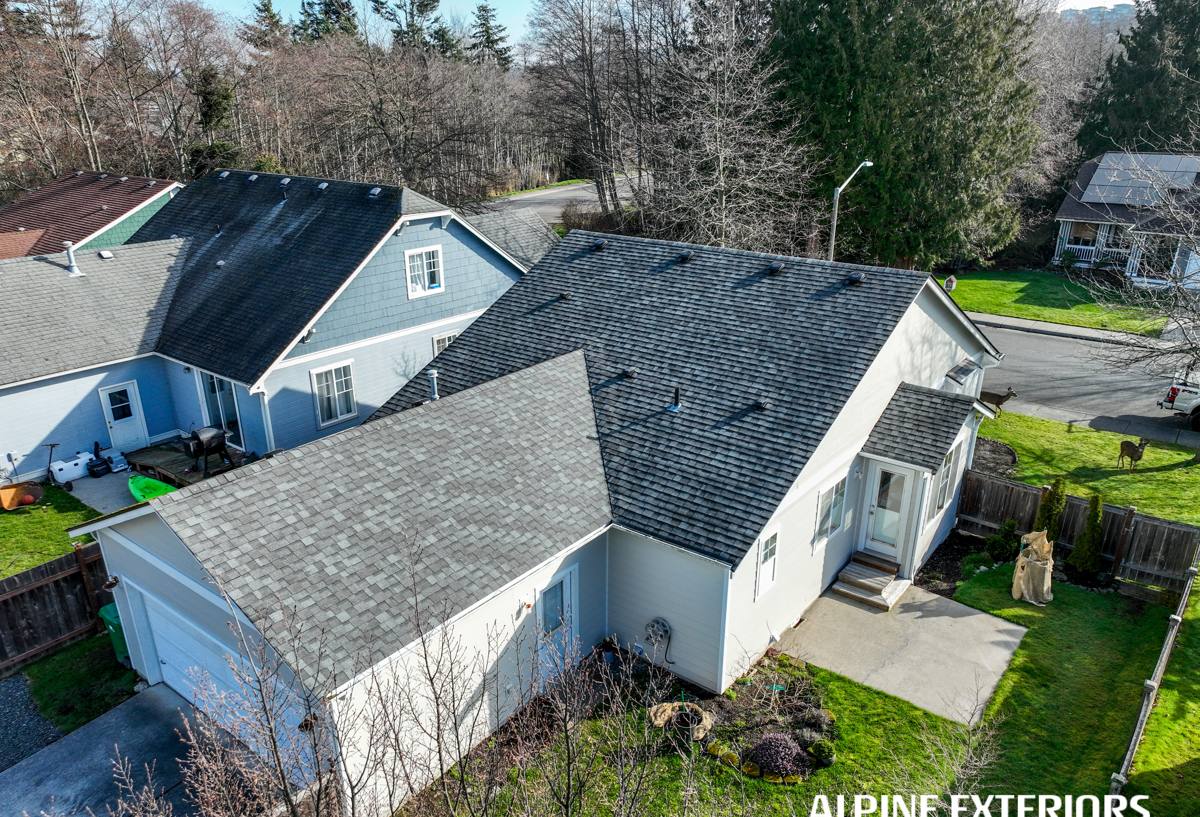
What Local Homes Are Up Against
Sustained Dampness, Not Just Rainfall Totals
It's not the number of rainy days that wears out siding — it's how long a wall assembly stays wet between dry-outs. Shaded lots, tight side yards between houses, and landscaping planted close to the foundation all slow down drying time. Siding materials that handle occasional rain fine can still fail early if they never get a real chance to dry out between storms.
Moss and Organic Growth
Moss doesn't just grow on roofs here — it colonizes north-facing siding, especially anywhere shaded by mature trees or a neighboring structure. Once moss and algae establish themselves on a porous or absorbent surface, they hold moisture directly against the material, which accelerates rot in wood-based products and speeds up coating failure on anything with a painted finish.
Wind-Driven Rain at Seams and Penetrations
Storms coming off the water don't fall straight down — they push rain sideways into lap joints, corner boards, and anywhere siding meets a window, door, or deck ledger. Poor flashing detail or caulk-dependent seams are where those storms find their way behind the cladding, which is often where the real damage starts, out of sight.
Why We Standardized on One Product
We install James Hardie fiber cement siding exclusively. We don't offer LP SmartSide, vinyl, Cemplank, Allura, primed spruce, or raw cedar as alternatives, and that's a deliberate decision, not a limitation of what we're capable of installing. After years of servicing and replacing siding in this climate, the failure patterns we kept seeing pointed to the same root causes: engineered wood products that swell and delaminate at cut edges and seams once moisture gets in, vinyl that can't handle direct impact or extreme temperature swings without cracking or warping, and cedar or primed wood siding that demands a maintenance schedule most homeowners don't have time to keep up with.
James Hardie fiber cement is made from cement, sand, and cellulose fiber. It doesn't absorb water the way wood-based products do, it won't warp or swell at the seams, and it's non-combustible — a meaningful factor anywhere in Washington given wildfire smoke seasons and defensible-space concerns that have crept into home insurance conversations statewide. It also holds paint and factory finish far more stably over time than wood substrates, which matters enormously in a climate that never really lets a house dry out completely.
What Each Alternative Gets Right — and Where It Falls Short Here
| Product | What It Does Well | Where It Struggles Locally |
|---|---|---|
| Vinyl siding | Low upfront cost, no painting required | Cracks in cold snaps, fades, can't handle impact, seams flex and gap over time |
| LP SmartSide | Lighter weight, easier to install, engineered strand strength | Wood-based core swells at cut edges and joints if moisture gets behind it |
| Cedar / primed spruce | Natural look, real wood grain | Needs recurring refinishing, prone to rot and moss colonization in shade |
| Cemplank / Allura (fiber cement) | Similar core material to Hardie, non-combustible | Different factory finish and warranty structure than what we standardized install and service on |
| James Hardie fiber cement | Non-combustible, dimensionally stable, factory ColorPlus finish, engineered HZ product lines, strong transferable warranty | Higher material cost than vinyl; installation quality still matters — it isn't foolproof if rushed |
James Hardie's Climate-Engineered Product Lines
James Hardie makes region-specific formulations under its HZ5 designation for areas that see freeze-thaw cycles and sustained wet weather — which describes this part of Washington well. The company's ColorPlus Technology bakes the finish on at the factory under controlled conditions, rather than relying on a field-applied coat of paint that has to cure correctly on-site in whatever weather shows up that week. That factory finish is a meaningful advantage in a climate where field-applied paint jobs often don't get the dry window they need to cure properly.
Hardie's lap siding, board-and-batten panels, and shingle-style products all give homeowners real design flexibility without stepping outside a product line engineered specifically to hold up in wet, moss-prone climates.
How Installation Quality Changes Everything
Fiber cement siding is only as good as the install behind it. We see plenty of houses where the material choice was right, but a rushed installation crew skipped critical steps — and the siding failed early anyway. The things that matter most:
- Correct nailing pattern and fastener depth — over-driven nails crack the board and create entry points for water
- Proper flashing at every window, door, and penetration, installed shingle-style so water sheds outward rather than in
- Adequate clearance at the bottom of the wall — siding installed too close to grade, decking, or roofing wicks moisture straight up into the board
- Correct joint treatment at butt seams, sealed and backed per manufacturer spec, not just caulked and left
- A drainage plane behind the siding that actually lets bulk water out instead of trapping it against the sheathing
Any one of these done wrong can undercut even the best material. That's why we treat installation spec as non-negotiable, not a place to save time.
Beyond Siding: Full Exterior Scope
We handle roofing, windows, and decks alongside siding, because these systems don't fail independently — they fail together. A roof that's shedding water onto a wall below, a window that's not flashed correctly into the siding plane, or a deck ledger cut into the wall assembly without proper waterproofing will undermine even a brand-new fiber cement installation. When we're on a property for a siding project, we look at the whole envelope, not just the walls, because the leak that shows up two years later is usually traceable to a detail at one of those intersections.
Why a Local Crew Matters Here
A crew that works this specific stretch of the Puget Sound region day in and day out has already seen how moss establishes on north walls, where wind-driven rain tends to find weak details, and how long a wall assembly actually needs to dry between storms before the next coat of caulk or paint will hold. That local pattern recognition shows up in small decisions — where to add extra flashing, which walls need a closer look at drainage, how tight to keep seams given the freeze-thaw swings we get in the coldest stretches of winter. It's the difference between a crew installing to a generic spec sheet and one installing for the house that's actually in front of them.
What a Siding Project Typically Involves
Assessment
We start by inspecting the existing siding, sheathing, and any visible moisture damage, paying particular attention to north-facing and shaded walls where moss and slow-drying conditions do the most damage over time.
Scope and Product Selection
We walk through Hardie's plank, panel, and shingle profiles and colors, and talk through where flashing or drainage details need attention based on the specific exposure of each wall.
Installation
Old siding comes off, sheathing gets inspected and repaired as needed, a proper drainage plane goes in, and Hardie siding goes on to manufacturer spec — nailing pattern, clearances, flashing, and joint treatment all included, not treated as optional extras.
Final Walkthrough
We walk the finished exterior with the homeowner, checking seams, trim, and any transitions to roofing, windows, or decking that were part of the scope.
Quick Checklist: Signs Your Siding Needs a Closer Look
- Visible moss or dark streaking on north- or shade-facing walls
- Soft or spongy spots when pressed, especially near the bottom of walls
- Paint that's peeling, bubbling, or has stopped holding a finish
- Visible gaps or separation at seams and corner boards
- Warping, bowing, or panels that no longer sit flat against the wall
- Water stains on interior walls near exterior corners or window trim
If you're seeing any of that on a home in the Bothell area, or you're just planning ahead for a replacement, we're happy to take a look. The estimate is free, there's no pressure, and you'll walk away with a straight answer about what your walls actually need — fill out the form below to get started.