 Snohomish
 Lake Stevens Sits in a Tough Spot for Exterior Materials
Lake Stevens homes deal with a specific mix of conditions that a lot of siding, trim, and roofing products simply aren't built for over the long haul. You've got the lake itself adding humidity and fog to the immediate shoreline neighborhoods, a heavy tree canopy in the older, established parts of town that keeps shade and moisture pinned against north- and west-facing walls, and the broader marine weather pattern that moves in off Puget Sound and blankets the whole Snohomish County corridor with long stretches of driving, sideways rain from fall through spring. None of that is dramatic on any given day. It's the accumulation — months of damp, low-light conditions, year after year — that wears exteriors down faster than homeowners expect.
We're based in Snohomish and work this whole corridor regularly, so Lake Stevens isn't a stretch assignment for us — it's a normal part of the route. That matters more than it sounds like it should, and we'll get into why further down.
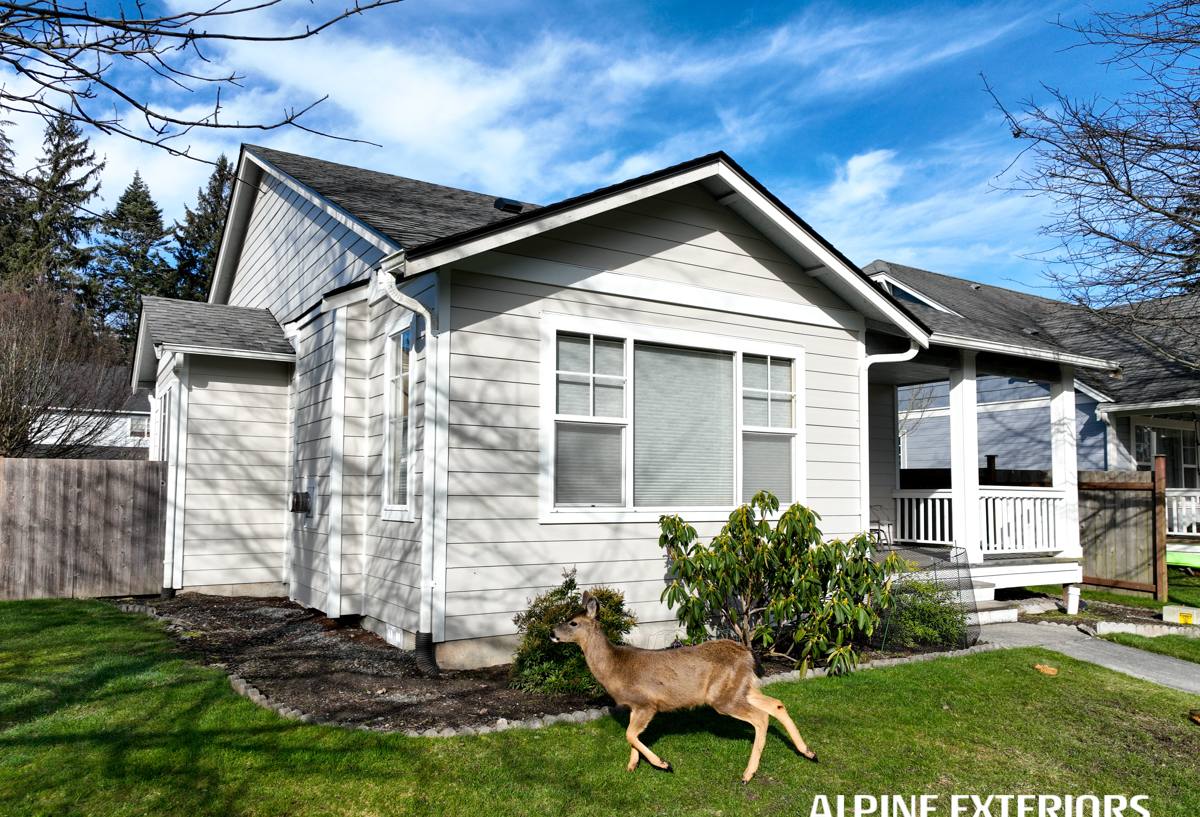
What This Climate Actually Does to a House
Moss and Mildew Have a Long Runway
Because temperatures rarely swing to extremes here and moisture sticks around for so much of the year, moss and mildew get an unusually long season to establish themselves. Shaded siding, especially anything facing north or tucked under mature trees, can stay damp for days after a storm passes. Materials that absorb water or that rely on paint film to keep water out are the first to show streaking, soft spots, and moss creep along seams and butt joints.
Driving Rain Finds Weak Points
Wind-driven rain doesn't fall straight down — it gets pushed sideways into laps, seams, and trim intersections. Any siding system with poor water management at those joints will eventually let moisture behind the cladding, where it can sit against sheathing and framing without anyone noticing until there's a soft spot or a stain on an interior wall.
Freeze-Thaw Cycling, Even Here
Snohomish County doesn't get brutal winters, but it does get enough freeze-thaw cycling — cold snaps followed by rain and thaw — to stress any material that has already absorbed moisture. Wood-based products are the most vulnerable to this because trapped water expanding and contracting inside the material accelerates rot from the inside out.
Why We Install Only James Hardie Fiber Cement
We made a deliberate decision as a company to install one siding system — James Hardie fiber cement — and to stop offering the alternatives that used to be standard in this trade: vinyl, LP SmartSide, Cemplank, Allura, primed spruce, and cedar. That wasn't a marketing decision. It came out of watching how different materials actually perform after ten, fifteen, twenty years in exactly the kind of climate Lake Stevens sits in.
Non-Combustible Composition
Hardie siding is fiber cement — a mix of cement, sand, and cellulose fibers — which means it doesn't burn the way wood-based or vinyl products can. Wildfire smoke and ember exposure have become a more regular late-summer concern across Western Washington in recent years, and non-combustible cladding is one of the few exterior upgrades that meaningfully reduces that risk.
Engineered for This Specific Climate
Hardie's HZ5 product line is engineered for regions like ours that see extended wet seasons and moderate freeze-thaw activity. It's a different formulation than what's shipped to hot, dry climates, and it's built to resist moisture absorption and hold paint adhesion under exactly the conditions Lake Stevens throws at a house for most of the year.
Factory-Applied ColorPlus Finish
Instead of field-applied paint, Hardie's ColorPlus finish is baked on at the factory under controlled conditions, which gives it better UV resistance and adhesion than most site-painted finishes. In a climate where siding stays wet for long stretches, finish integrity is one of the biggest factors in how long a paint job actually lasts before it needs attention.
A Warranty Backed by the Manufacturer
James Hardie backs its products with a strong, transferable limited warranty on the material itself, separate from our own workmanship warranty on the installation. That two-part structure — manufacturer warranty on the product, contractor warranty on the labor — is worth understanding before you sign anything, no matter who you hire.
How Hardie Compares to the Alternatives
We don't install these other products anymore, but homeowners in Lake Stevens still get quoted on them, so it's worth laying out honestly where each one stands.
| Material | Moisture Behavior in Wet Climates | Fire Rating | Long-Term Maintenance |
|---|---|---|---|
| James Hardie fiber cement | Engineered HZ5 line resists moisture absorption; dimensionally stable when wet | Non-combustible | Low — factory finish holds color and film integrity for years |
| Vinyl siding | Doesn't absorb water itself, but seams and laps can let moisture behind the panel with no way for it to dry out | Combustible; can warp or melt near heat sources | Low upfront, but can fade, crack, and become brittle over time |
| LP SmartSide / engineered wood | Treated to resist moisture, but any breach in the treated layer exposes the wood core to rot | Combustible | Moderate — depends heavily on caulking and paint upkeep at seams |
| Cedar / primed spruce | Natural wood; absorbs and releases moisture, prone to swelling, checking, and rot in shaded, damp areas | Combustible | High — regular refinishing and moisture monitoring required |
Every one of these products has legitimate strengths in the right application. Vinyl is inexpensive and low-maintenance on paper. Engineered wood and cedar have a warmth and texture some homeowners really want. But when we weighed those strengths against how each material actually holds up through a Snohomish County wet season, year after year, fiber cement was the only one we were comfortable standing behind as our sole product.
More Than Siding: Roofing, Windows, and Decks
Siding doesn't work in isolation. A house is a system, and the same rain and moisture load that stresses siding also puts pressure on the roof, window flashing, and any exterior deck structure. We handle all four — siding, roofing, windows, and decks — because a lot of the failures we get called out to fix start at one of those transition points: where roofing meets a wall, where a window is flashed into the siding plane, or where a deck ledger board attaches to the house. Addressing siding without checking those intersections is how new siding ends up with the same water problems in a few years.
Windows and Flashing
When we replace siding, we inspect window flashing and re-flash as needed rather than just trimming new siding around old, possibly compromised flashing. It's a small extra step during a siding job that prevents a much bigger repair later.
Decks
Deck ledger connections are a common weak point on lake-adjacent homes, where the deck often gets more direct rain exposure. We make sure ledger flashing and deck-to-house connections are sound whenever we're already working on that section of the exterior.
What a Local Crew Means for a Lake Stevens Job
We're a Snohomish-based crew, and Lake Stevens is close enough that it's a regular part of our service area rather than an occasional trip. That has a few practical effects on a project:
- We already know the general microclimate differences between shoreline lots, wooded lots, and open lots in this area, which informs product selection and detailing.
- We can get to a job site quickly if weather changes mid-project or if a follow-up question comes up after installation.
- We're pulling permits and coordinating inspections with the same local jurisdictions repeatedly, so there's no learning curve on paperwork or code specifics.
- Warranty service isn't a logistics problem — we're not driving in from out of the area to honor a callback.
None of that replaces the fundamentals of a well-run job — clear scope, good materials, correct installation — but it does mean fewer surprises and faster response when something needs attention.
Our Installation Process
Correct installation matters as much as the product choice itself. Fiber cement siding installed with the wrong fastener pattern, insufficient clearance at grade, or poor flashing detail will underperform no matter how good the material is. Here's the general sequence we follow on a siding project:
- On-site inspection of existing siding, sheathing condition, and trouble spots (moss growth, soft areas, flashing gaps).
- Removal of old siding and inspection of the weather-resistive barrier and sheathing underneath, with repairs made before new material goes on.
- Installation of house wrap or building paper per manufacturer specification, with proper overlap and taping at seams.
- Flashing installation and correction at windows, doors, and roof-to-wall transitions.
- Hardie panel or lap installation following manufacturer-specified fastener spacing, clearances from grade and roofing, and joint treatment.
- Trim, caulking at appropriate joints only (not as a substitute for proper flashing), and final cleanup.
That third step — checking what's under the old siding — is often where we find the real story on an older Lake Stevens home. A house can look fine from the street and still have sheathing damage from years of moisture working its way in behind failing siding or bad flashing.
Cost Factors to Expect
Every home is different, but a few factors consistently move the price on a Lake Stevens siding project:
| Factor | Why It Affects Cost |
|---|---|
| Sheathing condition | Rot or damage found after tear-off requires repair before new siding can go on, which isn't always visible until the old siding is off |
| Home size and complexity | More corners, dormers, and trim detail mean more labor and material cutting |
| Siding profile chosen | Lap siding, panel siding, and shingle-style Hardie products vary in material and labor cost |
| Access and lot conditions | Steep lots, tight setbacks near the water, or heavy landscaping can slow staging and installation |
| Scope beyond siding | Bundling window flashing repair, trim replacement, or deck ledger work with a siding project is more efficient than doing it separately later |
We give homeowners a real, itemized number after walking the property — not a phone estimate — because the sheathing condition and site access variables above genuinely can't be judged accurately without seeing the house.
Living With Fiber Cement Siding Long-Term
One of the appeals of Hardie siding in this climate is how little it asks of homeowners over time. It doesn't need to be re-caulked and repainted on the schedule that wood siding does, and it holds up to the moss and mildew pressure of a shaded, damp lot far better than absorbent materials. That said, no exterior product is maintenance-free. A periodic rinse to keep organic growth from establishing on shaded elevations, prompt attention to any gutter or drainage issue that's dumping extra water onto a wall, and keeping vegetation trimmed back from siding all go a long way toward getting the full lifespan out of the material.
If you're weighing a siding, roofing, window, or deck project on a Lake Stevens home, we're happy to come take a look and give you a straightforward, no-pressure estimate — no obligation, just an honest read on your home's condition and what it would take to address it.