 Snohomish
 Clearview sits in that in-between zone that a lot of Snohomish County communities share — not quite small-town Snohomish, not quite the denser suburbs closer to Everett, but a mix of wooded lots, ranch homes on acreage, and newer construction tucked along the corridors that connect them. It's a good place to own a house, and it's also a place where the exterior of that house works harder than most homeowners realize. Between the moisture that sits under tree cover for months at a time and the wind-driven rain that comes through in fall and winter storms, the siding, trim, and roofline on a Clearview home are under near-constant low-grade attack. Most of the damage doesn't show up as a dramatic failure. It shows up as soft trim boards, a green tint creeping up the north wall, and paint that needs redoing every few years instead of every decade.
We're a local exterior contractor working siding, roofing, windows, and decks throughout the Snohomish area, and Clearview is part of our regular service territory. This page walks through what we actually see on homes out here, how we approach siding replacement and exterior work for this specific kind of property, and why we install one product — James Hardie fiber cement — instead of offering a menu of options.
What Clearview's Climate Does to a House
Western Washington weather gets talked about in general terms — "it rains a lot" — but the specifics matter more than the generality. A few things are particularly relevant to homes in and around Clearview:
Tree Cover and Moss
A lot of Clearview properties sit on wooded or partially wooded lots, which is a big part of the area's appeal but also means shaded north and east-facing walls that rarely get direct sun. Those surfaces stay damp longer after every rain event, and in a region where rain is the default weather for a good chunk of the year, that's a long window of sustained moisture exposure. Moss and algae take hold on surfaces that don't dry out, and once established, they hold even more water against the wall behind them. On wood-based siding products, that's a slow but steady path toward rot at seams, butt joints, and anywhere caulking has started to fail.
Driving Rain and Wind Exposure
Storms coming off the Sound don't just drop rain straight down — wind pushes it sideways into wall assemblies, especially on homes with less overhang protection or on more exposed lots. Driving rain finds every weak point in a siding system: unsealed laps, nail penetrations that weren't caulked, trim-to-siding transitions that were installed loose. Over years, that's how water gets behind the cladding and into sheathing, even on a house that looks fine from the curb.
Seasonal Humidity Swings
Between damp winters and warmer, drier summers, siding materials go through repeated cycles of swelling and drying. Products that absorb moisture — untreated wood, some engineered wood composites — expand and contract with those cycles, which stresses paint film, joints, and fasteners over time. Fiber cement doesn't behave that way, which is a big part of why it holds up better here than it does in drier climates where the case for it is less urgent.
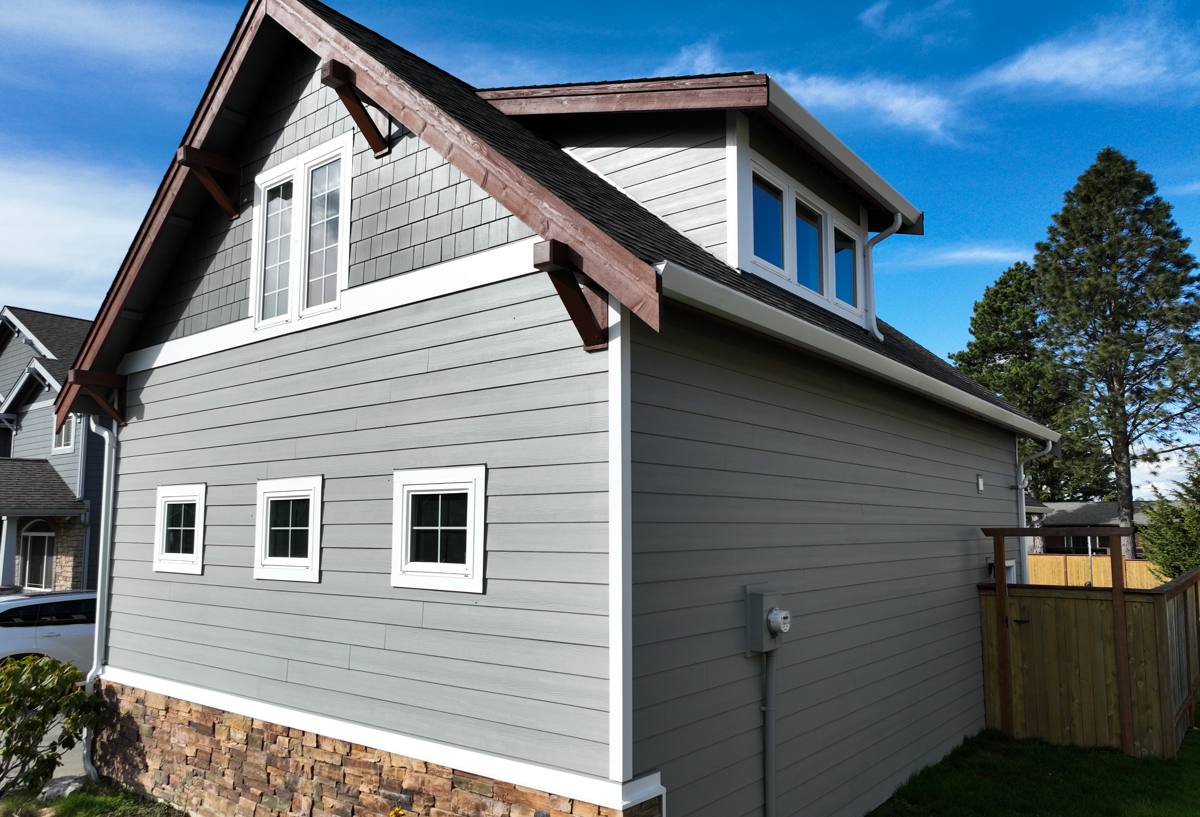
How This Shows Up on Clearview Homes
When we inspect a home out this way, the patterns are pretty consistent:
- Soft or delaminating trim boards around windows and at corner boards, especially on shaded sides
- Moss and algae staining concentrated on north-facing and tree-shaded walls
- Paint failure — peeling, bubbling, or chalking — happening faster than the paint manufacturer's stated repaint interval
- Caulk joints that have shrunk, cracked, or pulled away, leaving gaps at siding seams and trim transitions
- Visible warping or cupping on lap siding, particularly near ground level or downspout discharge points
- Fascia and rake boards showing rot before the siding field itself does, since they take the brunt of roof runoff
None of that is unusual for the Pacific Northwest. It's just the reality of what exterior materials face out here, and it's exactly what should drive the choice of what goes back on the house.
Why We Only Install James Hardie
We used to get asked to quote vinyl, LP SmartSide, and other engineered wood products alongside Hardie. We stopped offering those options — not because they're worthless products in every climate, but because we don't think they hold up to the standard we want to put our name on in a region like this one. Here's the honest breakdown of why:
Fiber Cement vs. the Alternatives
| Material | Moisture Behavior | Fire Rating | Typical Longevity Here |
|---|---|---|---|
| Vinyl siding | Doesn't absorb water, but panels warp/buckle with heat and can allow water behind them at seams | Combustible, can melt/deform | 15-25 years before fading, warping, or brittleness sets in |
| LP SmartSide / engineered wood | Wood-strand core is moisture-sensitive; edge swelling and delamination are known failure points if seams aren't perfectly sealed | Combustible | Variable — heavily dependent on installation quality and ongoing maintenance |
| Cedar / primed spruce | Natural wood, absorbs and releases moisture constantly; needs consistent refinishing to hold up | Combustible | Shorter without disciplined repainting/resealing cycles |
| James Hardie fiber cement | Cement-based composition doesn't swell, rot, or support moss growth the way wood-based products do | Non-combustible | Built for 30+ year performance when installed to spec |
Vinyl's real weakness in a climate like this isn't the material itself so much as what happens at the seams and around penetrations, and how it looks after a decade or two of UV and temperature cycling — it can fade unevenly and become brittle. Engineered wood products can perform well when installation is flawless and maintenance never lapses, but that's a big "when," and moisture intrusion at cut edges or seams is a well-documented risk for the category, particularly in wet climates. Cedar and primed wood are honest, attractive materials, but they're also high-maintenance by design — they need repainting and resealing on a schedule that a lot of homeowners don't keep up with, and once that schedule slips, moisture gets in.
What James Hardie Gets Right for This Climate
James Hardie fiber cement is engineered specifically to resist the conditions that cause the most damage here:
- Non-combustible — it won't contribute fuel to a fire, which matters for insurance and for peace of mind
- Moisture-resistant composition — it doesn't swell, rot, or delaminate the way wood-based products can
- ColorPlus factory finish — a baked-on finish that holds color and resists the chalking and peeling that field-applied paint is prone to in wet climates
- HZ5 product engineering — Hardie's cold- and moisture-climate formulation, built for regions like the Pacific Northwest
- Strong transferable warranty — backed by the manufacturer, which matters if you sell the home before the siding's functional life is over
It's not a magic material — no siding is maintenance-free, and Hardie still needs proper caulking, flashing, and periodic washing to perform the way it's designed to. But it starts from a much stronger baseline for a climate that punishes moisture-sensitive materials, and that's the entire reason we standardized on it instead of offering a menu of options with very different long-term outcomes.
Our Approach to Siding Work in Clearview
Every property here is a little different — lot size, tree cover, sun exposure, and how exposed the home is to wind all change what we recommend and how we sequence the work. A few things stay consistent regardless of the specific house:
- We start with an inspection, not a sales pitch. We look at what's actually happening on the walls, trim, and roofline before we talk about replacement scope.
- We check what's underneath. Existing water damage to sheathing or framing needs to be addressed before new siding goes up — covering a moisture problem doesn't fix it.
- We install to Hardie's spec, including proper clearances, fastening patterns, and joint treatment — this is where a lot of the long-term performance difference between a good installation and a mediocre one actually comes from.
- We coordinate with roofing, trim, and drainage where needed, since siding failures on shaded, wooded lots are often connected to gutter and roof runoff issues, not just the siding material itself.
Roofing, Windows, and Decks — The Same Standard
Siding doesn't work in isolation, and neither do we. A roof that's shedding water properly, gutters that are actually moving it away from the foundation, windows that are flashed and sealed correctly, and a deck built to handle standing moisture all work together with the siding to keep a Clearview home dry. When we're on-site for a siding project, we're looking at the whole exterior system, not just the walls — and we handle roofing, window replacement, and deck construction and repair as part of that same standard of work.
Why a Local Crew Matters Here
Exterior work in this region isn't generic. A crew that mostly works drier climates doesn't have the same instinct for where water collects on a shaded lot, how much clearance to leave at grade on a property with heavy tree cover, or why a particular corner of a house always fails first. We work in Snohomish County conditions every week, which means we're not guessing about how a product or an installation detail will actually hold up three or five or ten winters from now — we're building on what we've already seen play out on homes like the ones in Clearview.
What to Look for If You're Getting Quotes
Whether you end up working with us or someone else, a few questions are worth asking any contractor bidding exterior work in this climate:
- Do they inspect for existing moisture damage before quoting, or just measure and price?
- Are they installing to the manufacturer's documented specification, including fastener type and placement, or working from general habit?
- Do they address drainage and flashing details, or only the visible cladding?
- Can they explain why they recommend a specific product for your specific lot conditions — sun exposure, tree cover, wind exposure — rather than a one-size-fits-all pitch?
- Is the warranty backed by the manufacturer, the installer, or both, and what does it actually cover?
If your Clearview home's siding is showing moss staining, soft trim, or paint that's failing ahead of schedule, we're happy to take a look and give you a straight assessment — no pressure, no upsell script. Reach out for a free estimate and we'll walk the property with you and talk through what we're actually seeing.