 Snohomish
 Siding Replacement Built for Ferndale's Climate
Ferndale sits close enough to the water that salt air is a daily fact of life for the homes here, not an occasional nuisance. Add in the long stretches of driving rain that roll through every fall and winter, plus a moss season that seems to start earlier and last longer each year, and you have a climate that is genuinely hard on exterior siding. Homes in this part of Whatcom County don't fail because homeowners neglected them — they fail because the siding installed on them was never built for this combination of moisture, salt, and organic growth in the first place.
This page covers what siding replacement actually involves for a Ferndale home: what the climate demands, what a correct installation looks like, and how our process works from first look to final walkthrough. We install James Hardie fiber cement siding exclusively, and we'll explain why that matters for a house in this specific environment.
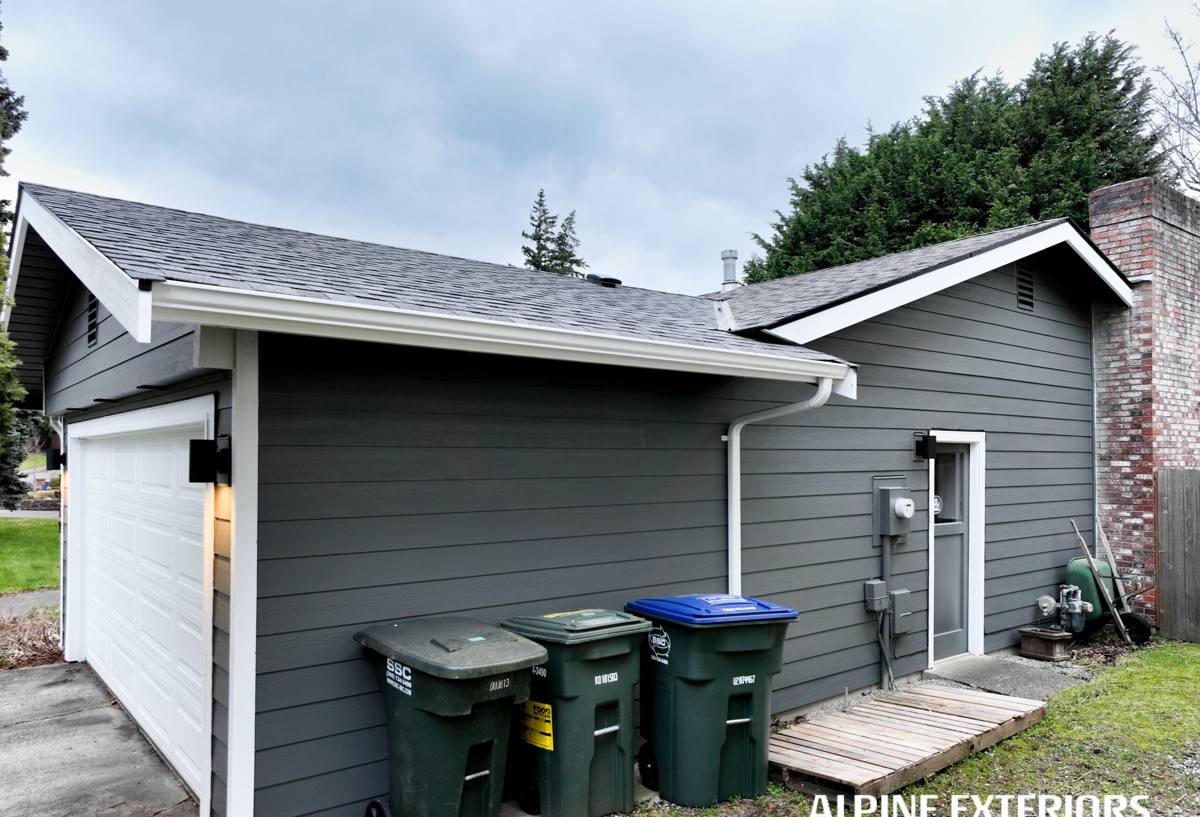
What Salt Air, Rain, and Moss Actually Do to Siding
Salt Air
Airborne salt is corrosive and it's persistent. It settles into seams, fasteners, and any exposed edge of siding material, and over years it accelerates the breakdown of finishes that aren't formulated to resist it. Paint film chalks and fades faster near the water. Untreated or under-primed wood fibers absorb moisture more readily once salt has broken down a surface coating. None of this happens overnight — it's a slow, cumulative process that shows up as premature fading, peeling, and soft spots five to ten years before a homeowner expects to be dealing with siding problems.
Driving Rain
Ferndale doesn't just get rain — it gets wind-driven rain that hits siding at an angle instead of simply running down it. That matters because it pushes water into laps, joints, and butt seams that are designed to shed water falling straight down, not water being forced sideways and upward by gusts. Any gap in flashing, any siding product that swells or shrinks with moisture, and any caulk joint that's failed becomes an entry point. Once water gets behind siding, the sheathing and framing underneath are what actually pay the price.
Moss and Organic Growth
Constant dampness plus shade from mature trees is a recipe for moss, algae, and mildew on any siding surface that holds moisture. Wood-based products are especially vulnerable because moss doesn't just sit on the surface — given enough time and enough moisture retention, it contributes to surface breakdown. Even on products that resist rot, a moss-covered wall is an ongoing maintenance headache and, for many homeowners, an ongoing embarrassment on the street-facing side of the house.
Why This Combination Is Harder Than It Looks
Any one of these three factors — salt, rain, moss — is manageable on its own. The problem in Ferndale is that all three are present at the same time, year-round, and they compound each other. Salt-damaged finish gives rain more surface area to penetrate. Trapped moisture from driving rain gives moss more time and material to grow on. Moss holds moisture against the siding longer than an open, sun-exposed wall would. A siding product that's only tested or rated for one of these conditions is going to struggle here.
This is the core reason we don't install every product on the market. Some materials handle rain well but chalk badly in salt air. Some resist moss but require paint maintenance that most homeowners fall behind on within a few years. We install James Hardie fiber cement because it's engineered as a system to hold up against all three conditions together, not just the one that's easiest to market around.
What a Correct Siding Replacement Involves
Replacing siding correctly is not just pulling off old boards and nailing up new ones. In a climate like this, the work that happens before the new siding goes up matters as much as the siding itself.
- Full tear-off and inspection: Old siding comes off completely so the sheathing underneath can be checked for rot, soft spots, or existing moisture damage — problems that are invisible until the old siding is gone.
- Sheathing repair: Any damaged sheathing gets replaced before anything new goes on. Installing new siding over compromised sheathing just hides a problem that will resurface.
- Weather-resistive barrier: A proper house wrap or weather barrier is installed to manage bulk water and vapor, with special attention to how it integrates with flashing at windows, doors, and roof lines.
- Flashing at every penetration: Windows, doors, hose bibs, vents, and any other wall penetration need correct flashing detail. This is the single most common failure point we find on older Ferndale homes — not the siding material itself, but missing or improperly lapped flashing.
- Correct fastening and clearances: Fiber cement has specific fastener spacing, nailing patterns, and ground-clearance requirements. Skipping these to save time is how manufacturer warranties get voided and how premature failures happen.
- Factory-finished panels: Using a factory-applied finish (ColorPlus) rather than field-painting removes one of the biggest maintenance burdens homeowners face in this climate — repainting exposed siding every few years.
Our Process, Start to Finish
1. On-Site Assessment
We walk the exterior with you, look at the current siding condition, check for signs of moisture intrusion around windows and at ground level, and talk through what we're seeing in plain terms.
2. Written Scope and Estimate
You get a clear, itemized scope — what's being removed, what's being repaired, what product and profile is going on, and what the timeline looks like. No vague allowances, no surprise change orders for things we should have caught during assessment.
3. Tear-Off and Sheathing Check
Old siding comes off in sections so the crew can inspect and address sheathing issues as they're found, rather than discovering a widespread problem after everything is already off the house.
4. Weather Barrier and Flashing
This is the step that determines whether your new siding lasts 30-plus years or develops problems in five. We don't rush this stage.
5. Hardie Installation
Panels, planks, or trim go on to manufacturer specification — correct fastener type, spacing, and clearances, with attention to how the product is engineered to perform in wet, coastal-influenced climates.
6. Final Walkthrough
We go around the house with you, point out details of the finished work, and make sure you know what maintenance (if any) is actually required going forward.
Why a Crew That Already Works Ferndale Matters
Siding installation is not identical everywhere in western Washington. A crew that mostly works drier inland areas can get away with shortcuts on flashing and clearances that simply don't hold up here. A crew that works Ferndale regularly knows which corners of a house take the worst of the driving rain, how much ground clearance actually matters given typical landscaping and drainage, and where moss tends to establish itself first on a north- or shade-facing wall. That familiarity shows up in the details — not in a sales pitch, but in where the flashing gets extra attention and how the bottom course is detailed above grade.
Comparing Approaches: What Homeowners Consider
| Approach | Upfront Cost | Maintenance in This Climate | Typical Concern |
|---|---|---|---|
| Repaint/patch existing siding | Lowest | High — repeats every few years | Doesn't address underlying moisture or rot issues |
| Vinyl replacement | Low-Moderate | Low, but can warp/fade and doesn't stop water at seams | Moisture can still get behind panels; limited lifespan in coastal wind |
| Wood-based or engineered wood siding | Moderate | High — coatings need renewal, vulnerable to moss/rot at seams | Moisture sensitivity is the core long-term risk |
| James Hardie fiber cement | Moderate-Higher | Low — factory finish, non-combustible, engineered for wet climates | Higher upfront investment, offset by longevity and warranty |
This table reflects general trade-offs, not guaranteed outcomes for every home — actual performance depends heavily on installation quality regardless of product chosen.
Why We Only Install James Hardie
We don't install every siding product on the market, and that's a deliberate choice, not a limitation of what we're capable of doing. Products like vinyl, engineered wood, or unfinished wood siding each have real strengths in the right application. But in a climate defined by salt air, sustained wind-driven rain, and long moss seasons, we've found that the long-term maintenance burden and moisture vulnerability of those products isn't something we're willing to put our name behind.
James Hardie fiber cement is non-combustible, holds its factory-applied ColorPlus finish far longer than field-applied paint, and its HZ5 product line is engineered specifically for climates like this one — harsh, wet, coastal-influenced conditions. It carries a strong, transferable warranty, which matters both for your own peace of mind and for resale value down the road. When installed correctly — and correct installation is most of the equation — it's the product we've seen perform best for homes dealing with exactly what Ferndale throws at a house year after year.
Signs Your Ferndale Home May Need Siding Replacement
- Visible fading or chalking, especially on walls facing the water or prevailing wind
- Soft or spongy spots when you press on siding near the ground or below windows
- Persistent moss or algae growth that returns within months of cleaning
- Bubbling, peeling, or cracking paint on wood-based siding
- Visible gaps at seams, corners, or around window and door trim
- Rising energy bills that suggest air or moisture infiltration through the wall assembly
If you're seeing two or more of these on your home, it's worth having someone take a real look rather than waiting for the problem to become obvious from the street.
If you're weighing a siding replacement in Ferndale, we're happy to take a look and walk you through what we see — no pressure, no obligation. Fill out the form below for a free estimate.