 Snohomish
 Arlington's Climate Is Harder on Siding Than It Looks
Arlington sits inland from the saltwater of the Salish Sea but still lives inside the same marine-influenced weather system that shapes the rest of Snohomish County. That means long stretches of low, gray drizzle from fall through spring, humidity that rarely drops off even between rain events, and a moss season that can run eight months or more on north-facing walls and shaded siding. Homes here don't get hit by any single dramatic storm as much as they get worn down by repetition — the same cycle of wet, damp, and slow-dry playing out week after week, year after year.
That slow grind is exactly what separates siding materials that look fine in a showroom from siding that actually holds up on a house. Wood-based products swell and shrink with every wet-dry cycle. Vinyl gets brittle and can warp when temperature swings are combined with sustained moisture exposure. Fiber cement, when it's the right formulation and it's installed correctly, doesn't play by those same rules. That's the whole reason we've built this company around one product line instead of offering a shelf full of options.
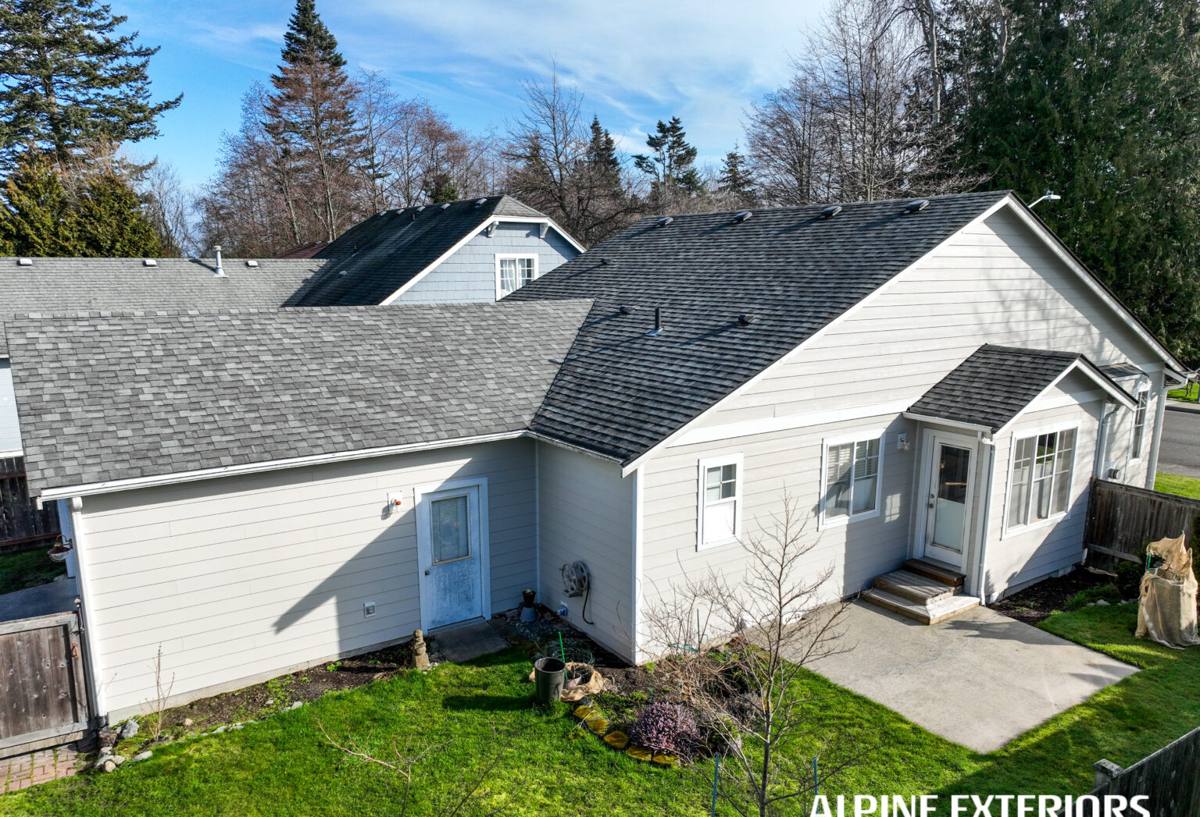
What We See on Arlington Homes
Working across this part of Snohomish County, a few patterns show up again and again on the homes we're asked to look at:
- Moss and algae staining concentrated on north and east-facing walls, especially under eaves with limited sun exposure
- Caulk failure at trim joints and window returns after repeated freeze-thaw and wet-dry cycling
- Swollen or delaminating panel edges on older wood composite siding where water found a way in years ago and never fully dried
- Paint that's holding up fine on south-facing walls but chalking and peeling on the shaded sides of the same house
- Gutters and downspouts overwhelmed during heavier rain events, throwing water directly onto lower wall sections
None of this is unique to any one neighborhood — it's what happens to exterior materials in a climate that stays damp more than it stays dry. The difference between a house that ages gracefully and one that needs a full re-side at year fifteen usually comes down to two things: what the siding is made of, and whether it was installed with this exact climate in mind.
Why We Only Install James Hardie
We get asked fairly often why we don't offer vinyl, LP SmartSide, or one of the other engineered wood or composite products. The honest answer is that we used to be open to more options, and what we kept seeing in the field — call-backs, moisture damage, warranty disputes — pushed us toward standardizing on one product we could stand behind completely.
Vinyl
Vinyl siding is inexpensive and low-maintenance in the sense that it doesn't need painting. But it's a thin plastic product that expands and contracts significantly with temperature swings, can crack in impacts, and tends to fade and become brittle with UV exposure over time. In a climate with our humidity levels, vinyl also does nothing to help manage moisture at the wall assembly — it's essentially a rain screen with gaps, not a structural exterior material.
Engineered Wood (LP SmartSide) and Other Composites
Engineered wood siding has real advantages — it's lighter than fiber cement and easier on installation crews. But it's still wood at its core, treated with resins and zinc borate to resist rot and insects. Any breach in the factory coating — a cut edge, a nail hole, a scratch during installation — creates a path for moisture to reach that wood substrate. In a climate where wall assemblies rarely get a long uninterrupted dry stretch, that's a real long-term liability, even with a good warranty on paper.
Why Fiber Cement Wins Here
James Hardie fiber cement is cellulose fiber, sand, and cement — it doesn't have organic material for moisture to feed on, and it's non-combustible. It holds paint and factory finish far more stably than wood or vinyl because it doesn't move with humidity and temperature the way those materials do. Hardie also engineers regional product lines specifically for climate zones like ours (HZ5 for the Pacific Northwest), which affects the moisture-resistance formulation baked into the board itself.
| Material | Moisture Behavior | Typical Maintenance | Our Position |
|---|---|---|---|
| Vinyl | Doesn't absorb, but doesn't manage wall moisture either; can warp | Low, but limited touch-up options if damaged | Not installed |
| LP SmartSide / engineered wood | Wood substrate vulnerable at cut edges and breaches | Periodic caulk/paint upkeep, watch for edge swelling | Not installed |
| Cedar / primed spruce | Natural wood movement, rot risk without diligent upkeep | Regular refinishing, high long-term labor cost | Not installed |
| James Hardie fiber cement | Non-organic, dimensionally stable, climate-engineered HZ5 formulation | Occasional wash, repaint on a much longer cycle with ColorPlus | What we install |
ColorPlus Finish and the Color Question
Most of the callbacks we hear about with painted siding — any material — trace back to the finish, not the board underneath. James Hardie's ColorPlus technology is a factory-applied, baked-on finish that's more consistent and more durable than field-applied paint, because it's cured under controlled conditions rather than sprayed or brushed on-site in whatever weather shows up that week. For a climate like ours, where a field-painted finish has to cure through unpredictable humidity, that factory process is a meaningful advantage. It also means touch-up paint is formulated to match precisely, and the color is backed by its own finish warranty separate from the substrate warranty.
How Our Process Works for Arlington Homes
Assessment
We start by walking the house — every elevation, not just the side that looks worn. We're checking for moisture intrusion at trim and penetrations, condition of the existing weather barrier if it's exposed during removal, and any rot or damage to sheathing that needs to be addressed before new siding goes up. Covering over an existing moisture problem is one of the most common ways a re-side job fails early.
Installation
Correct fastening, proper clearances at grade and roof lines, and correctly lapped and flashed penetrations matter more than the siding material itself. James Hardie publishes specific installation requirements by climate zone, and following them — not shortcuts, not "close enough" — is what actually determines whether a wall assembly performs over the next 30-plus years. This includes proper gapping at butt joints, correct nailing patterns, and using compatible trim and flashing details throughout.
Beyond Siding
We also handle roofing, windows, and decks, which matters because siding doesn't work in isolation. A roof that's shedding water onto a wall, a window that's not flashed correctly, or a deck ledger board tied into the wall assembly incorrectly can undermine even a perfectly installed siding job. Having one crew that understands how all four systems interact — rather than four separate contractors who never talk to each other — is a real advantage on a full exterior project.
What Drives Cost on an Arlington Project
| Factor | Why It Matters |
|---|---|
| Home size and wall complexity | More corners, dormers, and trim details mean more labor and material cuts |
| Existing siding removal and disposal | Tear-off adds labor; condition of sheathing underneath affects scope |
| Sheathing or moisture repair | Rot or water damage found during removal has to be fixed before new siding goes on |
| Board profile and color selection | Lap width, shake-style panels, and custom color options vary in material cost |
| Trim and accessory scope | Fascia, soffit, and trim board work bundled into the project affects total price |
| Access and site conditions | Sloped lots, tight setbacks, or landscaping can affect equipment and labor time |
We won't quote a number without seeing the house — anyone who does is guessing. But those are the real variables that move a bid up or down, and we walk through each one with homeowners during the estimate so there aren't surprises later.
Why a Local Crew Matters
Siding work isn't just about the product — it's about who's holding the nail gun and whether they understand the specific way water moves across a wall in this climate. A crew that works Snohomish County regularly knows what a wet spring does to an open wall assembly, how long moss takes to establish on a shaded elevation, and which details tend to fail first when they're rushed. That's not something you can fully replace with a warranty document from a manufacturer several states away. Local accountability — a crew that's still reachable, in the area, years after the job is done — is part of what you're actually buying when you hire for exterior work.
Caring for James Hardie Siding After Installation
- Rinse siding with a garden hose once or twice a year to keep pollen, dust, and early moss growth from building up — avoid high-pressure washing directly at seams
- Keep gutters clear so overflow doesn't run down wall sections repeatedly
- Trim back vegetation and tree limbs that keep a wall section shaded and damp longer than the rest of the house
- Inspect caulking at trim and penetrations every couple of years and touch up as needed
- Watch for any signs of moisture staining at the base of walls near grade, which can indicate a drainage or grading issue unrelated to the siding itself
Fiber cement doesn't need the kind of attention wood siding demands, but it's still an exterior surface living in a wet climate — a little routine care goes a long way toward protecting the finish over the decades it's designed to last.
Get an Estimate
If you're weighing a siding, roofing, window, or deck project on your Arlington home, we're happy to walk the property, look at what your current exterior is dealing with, and give you a straight answer about what it would take to do it right. The estimate is free, there's no pressure, and you'll get a clear explanation of why we recommend what we recommend.