 Snohomish
 Siding Work in Granite Falls: Building for the Foothills
Granite Falls sits where Snohomish County's lowlands give way to the Cascade foothills, along the South Fork Stillaguamish River and the start of the Mountain Loop Highway. That location gives the town a different exterior-wear profile than the flatter, more open parts of the county closer to Puget Sound. Homes here tend to sit under heavier tree canopy, see more rainfall as storms lift and cool coming off the mountains, and hold onto moisture longer in shaded, forested yards. We're based nearby in Snohomish and work in Granite Falls regularly, which means we've seen how differently a house ages here compared to a similar home closer to the water or out on open, sunnier ground.
We install siding, and we handle roofing, windows, and decks as well, treating the whole exterior as one connected system instead of four separate trades. On siding, we install James Hardie fiber cement exclusively. That's a professional standard, not a sales pitch, and it comes from watching how different siding materials actually hold up — or don't — in a climate like Granite Falls', where sustained dampness and shade do most of the damage over time.
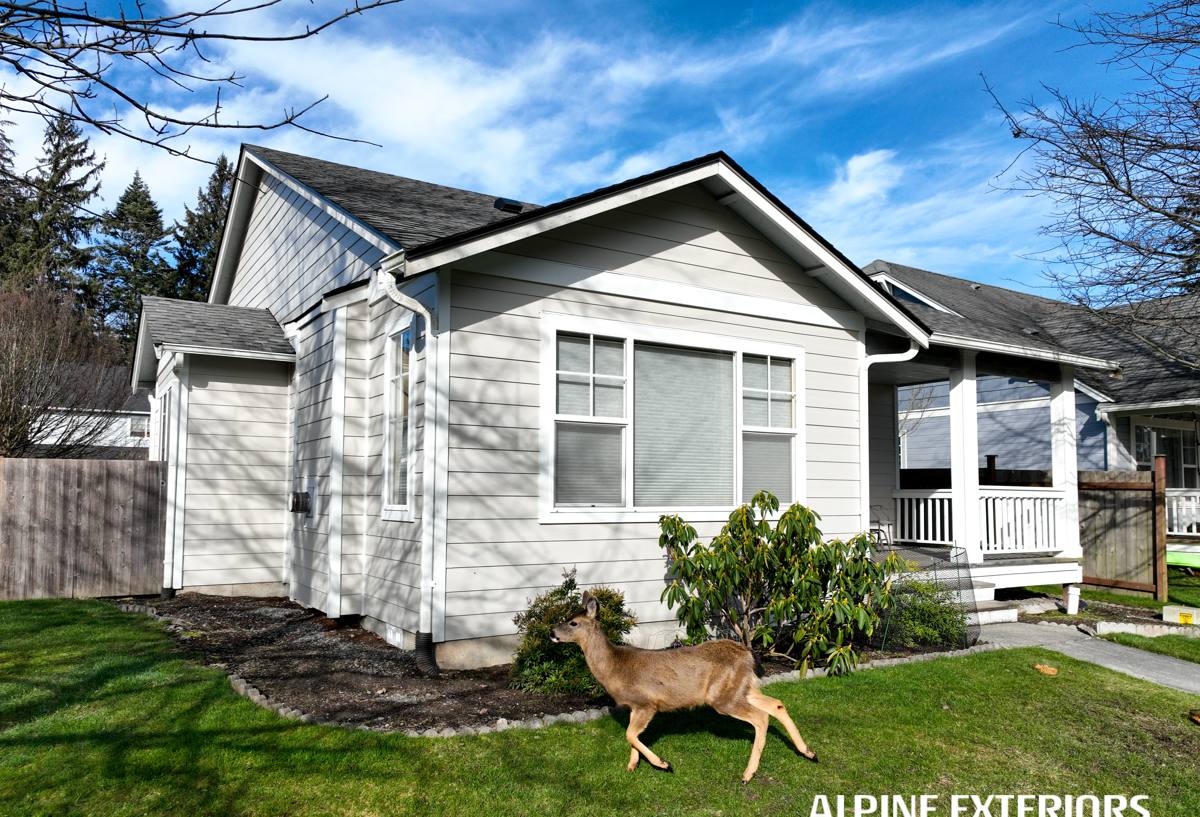
What Granite Falls' Climate Does to a House
Driving Rain Off the Foothills
Granite Falls catches more rain, on average, than the lowland parts of Snohomish County to the west, simply because of its position where the terrain starts climbing toward the Cascades. Storms tend to intensify slightly as they move up into the foothills, and wind can push that rain sideways into wall assemblies, window flashing, and roof-to-wall transitions rather than letting it fall straight down. That sideways-driven moisture is harder on a house than the same total rainfall would be in a calmer, drier spot, and it finds gaps that a less careful installation leaves behind.
Heavy Tree Cover and a Long Moss Season
Granite Falls lots tend to carry more mature evergreen canopy than newer, more open subdivisions closer to the freeway corridor. That shade keeps siding, trim, and roofing damp longer after every rain, and mild Pacific Northwest temperatures mean moss and algae rarely get a hard freeze to knock them back. On north-facing walls and heavily shaded lots, that combination adds up to a moss season that runs most of the year rather than a few wet months, and any material with surface porosity becomes a growth surface over time.
Inland Terrain, Not Coastal Salt Air
Some Snohomish County communities closer to Puget Sound deal with steady salt-laden air working against fasteners, trim, and finishes. Granite Falls, sitting well inland in the foothills, sees far less of that direct salt exposure. What it deals with instead is prolonged humidity, slower drying times under tree cover, and river-valley terrain that traps moisture on shaded walls longer than it would on an open, sun-exposed lot. The materials and installation details that matter most here are less about corrosion resistance and more about drainage, ventilation, and finishes that hold up to sustained dampness rather than intermittent salt spray.
Why We Only Install James Hardie Siding
We used to work with a wider range of siding products. We stopped, and the reason came from what we kept finding on tear-offs and service calls in shaded, high-moisture towns like Granite Falls — not from a supplier deal or a marketing angle.
- Non-combustible core: Fiber cement doesn't feed a fire the way wood-based siding products can, which matters for both safety and insurance considerations, and it's a real consideration for homes closer to forested land near the foothills.
- Factory-applied ColorPlus finish: The color is baked on under controlled factory conditions rather than brushed on in the field, so it holds its finish longer against fading, chalking, and the kind of sustained moisture exposure shaded lots see here.
- Climate-engineered HZ product lines: Hardie's HZ5 formulation is built for regions with sustained moisture and freeze-thaw cycling, which describes the Cascade foothills well, including the occasional cold snap Granite Falls sees that lowland Snohomish County doesn't.
- Dimensional stability: Fiber cement doesn't swell, cup, or warp the way engineered wood products can after repeated exposure to damp, shaded conditions over years of tree cover.
- Strong transferable warranty: Hardie backs the product with one of the stronger warranty structures in the industry, provided the installation follows their spec.
We won't install LP SmartSide, vinyl siding, Cemplank, Allura, primed spruce, or cedar. Each of those products has a place in the market and homeowners who are happy with them. But in a town where shade and sustained dampness are near-constant conditions for a large share of the housing stock, we've made a professional call to install one system we fully stand behind rather than offer something cheaper that quietly shifts maintenance risk onto the homeowner over time.
What Correct Installation Involves
Hardie siding performs the way it's supposed to only when it goes on correctly, and on a shaded, damp lot like many in Granite Falls, the installation details matter more than they would on an open, sun-drenched site. A few of the basics we won't skip:
- Rain screen gap: A small drainage cavity behind the siding lets any moisture that does get past the exterior surface drain and evaporate instead of sitting against the wall sheathing, which matters most on walls that rarely get direct sun to help them dry.
- Correct fastener spacing and type: Hardie specifies fastener placement and fastener type for a reason; loose spacing or the wrong fastener is one of the more common causes of early siding failure we see on tear-offs.
- Properly lapped house wrap and flashing: Every seam and penetration needs to shed water downward and outward, especially on walls that face uphill or catch runoff coming down through a wooded lot.
- Sealed butt joints and trim transitions: Open or poorly sealed joints are where moisture finds its way behind the siding first, and on a shaded wall it can sit there far longer before it dries.
None of this is exotic. It's the manufacturer's own installation spec, followed consistently rather than shortcut on the parts that are harder to see once the job is finished.
Roofing, Windows, and Decks in Granite Falls' Climate
Roofing
Roofs in Granite Falls deal with heavier rainfall totals than the county's lowland areas and often sit under partial tree cover that keeps them from drying quickly between storms. That means correct underlayment, properly lapped flashing at every penetration and wall transition, and ventilation that actually lets the attic and roof deck dry out. We treat those as baseline requirements, not upgrades, because a roof that skips them shows it within a few wet seasons rather than decades, and moss buildup on a shaded roof accelerates that timeline further.
Windows
A lot of exterior moisture problems actually start at the windows, even when the visible damage turns up somewhere else on the wall. Poorly flashed windows let wind-driven rain track down into the wall cavity, and by the time it shows as staining or soft trim, moisture has usually been getting in for a while. When we install or coordinate window work with a siding project, the flashing gets integrated into the whole wall assembly rather than treated as a standalone swap.
Decks
Decks in Granite Falls take on rain and standing moisture on horizontal surfaces that don't drain or dry as fast as a vertical wall does, and shaded decks under mature trees develop moss and slick surfaces quickly. Framing choices, fastener corrosion resistance, and board spacing all matter more here than on an open, sunny lot, because a deck built without them in mind tends to develop soft spots and slippery moss well ahead of schedule.
Cost Factors for Granite Falls Exterior Projects
| Project | What Drives Cost | Foothill Climate Consideration |
|---|---|---|
| Siding | Home size, tear-off vs. overlay, trim complexity | Substrate repair if moisture has already gotten behind existing siding on shaded walls |
| Roofing | Roof size, pitch, number of penetrations and valleys | Underlayment and ventilation quality against sustained rainfall and slower drying under tree cover |
| Windows | Number of openings, frame material, full-frame vs. insert replacement | Flashing integration to resist wind-driven and runoff-heavy moisture |
| Decks | Size, framing material, railing style | Drainage design and moss resistance for shaded, tree-covered lots |
These are general drivers, not a quote. Every home in Granite Falls sits under a slightly different amount of tree cover and at a slightly different point in the foothills, so we walk the property before putting a real number on the work. Two houses on the same road can need very different scopes once we're actually up on the roof or pulling old siding, which is also why we're cautious about phone or online estimates that skip that step entirely.
Timing an Exterior Project Around Granite Falls' Weather
The wettest, coolest stretch in Granite Falls typically runs from late fall through winter, and the town's foothill position tends to stretch that wet season a bit longer than it runs in lowland parts of Snohomish County. Spring and summer generally offer the driest, most stable working conditions for siding, roofing, and deck installation, which matters because fiber cement, underlayment, and framing materials all perform better when they can be installed and allowed to set up under dry conditions rather than between storm systems. That said, moisture damage doesn't wait for good weather, so a home showing active signs of water intrusion is worth addressing on its own timeline rather than holding out for the ideal season.
Signs a Granite Falls Home Needs Exterior Attention
- Moss or dark staining on siding or roof surfaces that comes back quickly after cleaning
- Soft or spongy siding, especially low on the wall, around window trim, or on shaded elevations
- Peeling paint or visible warping on north-facing or heavily shaded walls
- Missing, curling, or granule-shedding shingles on the roof
- Drafts, fogging, or visible gaps around window frames
- Soft boards or spongy footing on an older deck
- Persistent green or black staining on walls that stay shaded most of the day
Why a Local Crew Matters in Granite Falls
A crew that works across Snohomish County regularly, on siding, roofing, windows, and decks alike, sees how driving rain, heavy tree cover, and a long moss season actually behave on real Granite Falls houses over a full year, not just how a product performs on a spec sheet. That local experience shapes practical decisions on install day: which walls stay shaded and wet the longest, where extra drainage detail pays off, and which fastener and flashing choices are worth the extra time so a homeowner isn't dealing with a callback after the next stretch of foothill rain. Granite Falls' terrain isn't identical to the more open, lower-elevation parts of the county, and a crew that knows the difference builds accordingly instead of applying a generic approach.
Get a Free, No-Pressure Estimate
If your Granite Falls home needs new siding, a roof inspection or replacement, window work, or a deck built for this shaded, wet foothill climate rather than against it, we're glad to take a look and give you a straightforward, honest assessment. Reach out using the form below to schedule a free estimate — no pressure, no upsell script.