 Snohomish
 Why Siding Installation in Woodinville Is Different From a Textbook Job
Woodinville sits in the wetter, greener stretch of the Puget Sound region, and that shapes almost every decision that goes into a siding project here. Many lots carry heavy tree cover — conifers, big-leaf maples, and mature landscaping that shade large portions of a home's exterior for most of the day. Combine that shade with the region's long stretch of fall-through-spring rain, and you get siding that rarely gets a chance to fully dry out between storms. That's the exact condition that lets moss, algae, and mildew take hold, and it's the condition that punishes any siding product or installation detail that doesn't manage moisture well.
A siding job that would hold up fine in a dry inland climate can fail early here — not because the material is bad in general, but because it was never engineered for this much sustained dampness. When we quote a Woodinville project, we're not just measuring walls and picking a color. We're accounting for how much sun a wall gets, how close the tree line is, where water sheds off the roofline, and which sides of the house will stay damp longest into spring.
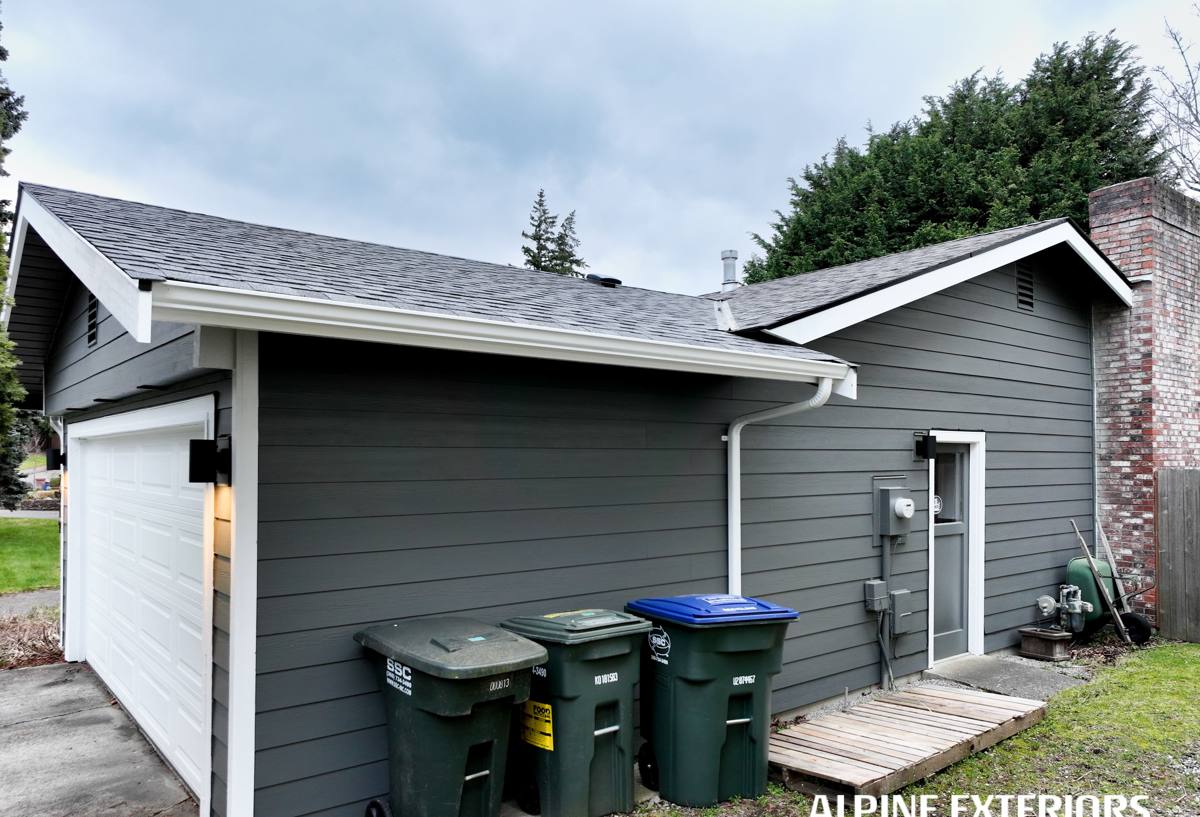
What Local Homes Are Up Against
The Puget Sound climate brings a specific combination of stressors that siding has to handle year after year:
- Sustained moisture exposure — long stretches of drizzle and driving rain, often with wind that pushes water sideways into wall assemblies rather than straight down.
- Shaded, slow-drying walls — tree cover common on Woodinville lots keeps north- and east-facing siding damp far longer than siding in full sun.
- A long moss and algae season — moisture plus shade equals organic growth that can start creeping onto siding surfaces and trim within a few years if the material and finish aren't up to it.
- Temperature swings — freeze-thaw cycles in winter that stress any siding material prone to swelling, cracking, or delaminating when it absorbs water.
None of this is unique to any one street or subdivision — it's the reality of building an exterior in this part of Washington. What changes house to house is how much shade a lot gets and how exposed the walls are to wind-driven rain, and both of those affect how a siding installation should actually be detailed.
What a Correct Siding Installation Actually Involves
Siding is a system, not just a panel screwed to the wall. A correct installation in this climate means getting every layer right:
Water Management Comes First
Before a single piece of siding goes up, the wall needs a properly lapped weather-resistive barrier, correctly flashed windows and doors, and a drainage plane that lets any moisture that gets behind the siding find its way back out instead of sitting against the sheathing. This is the part of the job nobody sees once it's finished — and it's also the part that determines whether the siding lasts 10 years or 40.
Clearances and Fastening
Siding needs proper clearance from grade, roof lines, decks, and other transitions so water doesn't wick up into the bottom edge of the panels. Fastener placement, spacing, and depth all matter — over-driven nails or the wrong fastener pattern can void a manufacturer's warranty and create entry points for moisture, regardless of how good the siding product itself is.
Trim, Caulking, and Transitions
Most siding failures don't start in the field of the wall — they start at the joints, corners, and penetrations. Correctly detailed trim and the right sealant at the right joints (and no sealant where it shouldn't be) is what keeps water out of the wall assembly over the long run.
Why We Install James Hardie Fiber Cement — and Nothing Else
We install James Hardie fiber cement siding exclusively. We don't install vinyl, LP SmartSide, Cemplank, Allura, or primed wood siding, and that's a deliberate standard, not a lack of options. Here's the honest reasoning behind it, specifically for a climate like ours:
- Moisture behavior — fiber cement doesn't swell, rot, or delaminate the way wood-based or engineered-wood products can when they stay damp for long stretches, which is a real risk on shaded Woodinville lots.
- Non-combustible material — fiber cement doesn't burn, which matters given the wildfire smoke and dry-summer risk Western Washington has seen more of in recent years.
- Factory-applied ColorPlus finish — the finish is baked on at the factory under controlled conditions, which holds up better against the region's UV and moisture cycling than field-applied paint, and it comes backed by its own finish warranty.
- Climate-engineered product lines — Hardie makes HZ5 and HZ10 products specifically engineered for different regional exposure levels, so the material can be matched to how much weather a given wall actually sees.
- A strong, transferable warranty — Hardie's warranty structure is built around correct installation, which is one more reason installation quality can't be an afterthought.
We're not going to claim the products we don't install are junk — vinyl, LP SmartSide, and the fiber cement alternatives all have legitimate uses and loyal customers elsewhere. Our position is narrower: for the moisture load and moss pressure that Puget Sound homes deal with, fiber cement done right is the product we're willing to put our name behind, and James Hardie is the manufacturer whose engineering, finish system, and warranty backing we trust enough to install exclusively.
Our Process for a Woodinville Siding Installation
- On-site assessment. We walk the property, note tree cover and sun exposure on each elevation, check for existing moisture damage, and measure for material.
- Product and line selection. Based on exposure, we recommend the right Hardie product line, plank width or panel style, and ColorPlus color or a field-finish option.
- Tear-off and inspection. Old siding comes off and the sheathing underneath gets inspected for rot or damage before anything new goes up — this step catches problems that would otherwise get sealed in behind new siding.
- Weather barrier and flashing. We install or repair the weather-resistive barrier and flash every window, door, and penetration correctly before siding starts.
- Installation to manufacturer spec. Fastening, clearances, and joint treatment follow Hardie's published installation requirements, which is also what keeps the manufacturer warranty intact.
- Trim, caulk, and final detail. Corners, transitions, and penetrations get finished with the right materials in the right places.
- Walkthrough. We go over the finished job with the homeowner before calling it done.
What We Commonly Find on Older Woodinville Siding
When we tear off existing siding on homes in and around Woodinville, a few patterns show up repeatedly: moss and algae staining concentrated on shaded north-facing walls, soft or delaminating trim near ground contact and roof transitions, and water staining on sheathing behind poorly flashed windows. None of these are unusual for the climate — they're the predictable result of years of moisture exposure meeting siding or installation details that weren't built for it. Catching this during tear-off, rather than after new siding goes up over it, is one of the most important parts of doing the job right.
What Affects the Cost of a Siding Installation
Every project is different, but the same handful of factors drive most of the cost variation we see on Woodinville homes:
| Factor | Why It Matters |
|---|---|
| Home size and number of stories | More wall area and taller walls mean more material, more labor, and more staging/scaffolding time. |
| Existing siding removal | Tear-off of old wood, vinyl, or damaged siding adds labor and disposal cost versus installing over new construction sheathing. |
| Sheathing repair | Rot or moisture damage found during tear-off needs to be repaired before new siding goes on — this is common on older homes with years of shaded, damp exposure. |
| Trim and architectural detail | Homes with more corners, dormers, and window/door trim take more time to flash and finish correctly. |
| Product line (HZ5 vs. HZ10) | Higher-exposure product lines cost more but are engineered for tougher moisture and climate conditions. |
| Finish choice | Factory-applied ColorPlus finish versus field-applied paint affects both material cost and long-term maintenance. |
Why Hiring a Crew That Already Works Woodinville Matters
A siding crew that regularly works in this part of Snohomish County already knows what to look for: which elevations of a house typically stay damp longest, how much tree cover to expect, and what shape the sheathing tends to be in on homes of a given age. That local pattern recognition shortens the assessment, sharpens the product recommendation, and avoids surprises mid-project. It also means the crew is familiar with the permitting expectations and inspection process for the jurisdictions covering this area, which keeps the project moving instead of stalling on paperwork nobody anticipated.
There's also a simple accountability argument: a contractor who's local and plans to keep working in this community has every incentive to install the job correctly the first time, because they're not disappearing to the next region when the warranty period starts.
A Pre-Project Checklist for Woodinville Homeowners
- Confirm the contractor is licensed and insured in Washington, and ask to see current documentation.
- Ask specifically what siding product and product line they're proposing, and why it fits your home's sun/shade exposure.
- Ask what happens if rot or moisture damage is found once old siding comes off, and how that's priced.
- Get the manufacturer warranty terms in writing, including what installation requirements must be met to keep it valid.
- Ask how they handle window, door, and roofline flashing — this is where most long-term failures start.
- Walk your property and note which walls stay shaded or damp longest — that context helps the estimate reflect your actual conditions.
Get a Straight Answer for Your Home
Every Woodinville property carries its own mix of sun, shade, and exposure, and that's exactly what a good siding estimate should account for — not a generic per-square-foot number. If you're weighing a siding replacement, we're happy to walk the property, look at what your current siding is doing, and give you a straightforward, no-pressure estimate for a James Hardie installation built for how this climate actually behaves. Use the form below to request one.