 Snohomish
 Why Monroe's Climate Is Hard on Siding
Monroe sits in the Skykomish/Snoqualmie valley corridor east of Snohomish, where Puget Sound's marine weather pattern collides with the foothills of the Cascades. That combination means more rain days per year than most of the country, long stretches of overcast humidity, and moisture that lingers in shaded siding cavities instead of drying out quickly. Add wind-driven rain during fall and winter storms, and siding here isn't just getting wet — it's getting wet at an angle, forced into laps, corners, and trim joints that a calmer climate would never test.
The other local reality is moss. Snohomish County's tree cover, north-facing exposures, and near-constant dampness give moss, algae, and mildew a long growing season — often eight months or more on siding that doesn't get direct sun. Wood-based products absorb that moisture and feed the growth from the inside. Vinyl sheds water but traps humid air behind it. Fiber cement, installed correctly, does neither — it doesn't feed organic growth and it's engineered to manage bulk water instead of hiding it.
None of this means Monroe homes need exotic materials. It means the material and the installation both need to be matched to what actually happens here, not to a national average.
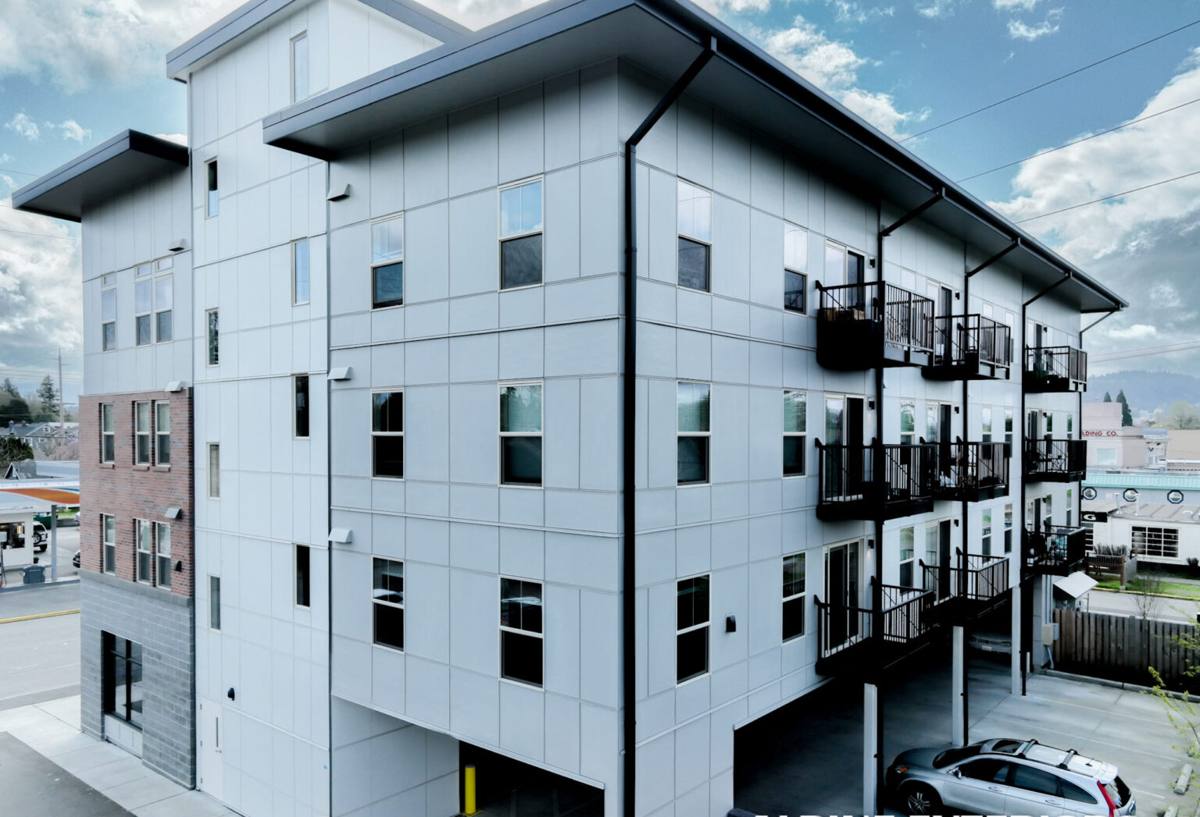
What Fiber Cement Siding Solves for Monroe Homeowners
Fiber cement is a mix of Portland cement, sand, and cellulose fiber, cured into a dense, dimensionally stable board. For a climate like ours, three properties matter most:
- It doesn't rot. Cellulose fiber inside the board is fully encapsulated in cement — there's no exposed wood grain for spores or moisture to colonize the way there is with cedar or primed spruce trim.
- It holds its shape. Wood siding expands and contracts with humidity swings; over years that movement opens up joints, cracks paint film, and lets water in. Fiber cement moves far less, so caulked joints and paint lines stay sound longer.
- It's non-combustible. Not a Monroe-specific rain concern, but relevant given wildfire smoke seasons the whole region has seen in recent summers — fiber cement doesn't contribute fuel to an exterior fire the way wood-based products do.
What fiber cement does not do on its own is guarantee a dry wall assembly. That comes down to installation, which is where most siding failures — on any brand — actually originate.
James Hardie: The Only Siding We Install
We install James Hardie fiber cement exclusively. We don't offer vinyl, LP SmartSide, Cemplank, Allura, or unfinished cedar and spruce, and we're upfront about why: those products all ask a homeowner to accept a trade-off we don't think holds up over a 20-30 year ownership window in this climate — whether that's a wood-based substrate that's vulnerable at cut edges, a factory finish that doesn't match Hardie's ColorPlus baking process, or a warranty structure that's thinner on paper.
Hardie isn't the cheapest board on the market, and we say that plainly rather than dance around it. What it buys is a fiber cement system engineered specifically for wet marine climates (the HZ5 line, covered below), a factory finish process that resists fading and chipping far better than field-applied paint, and a transferable warranty that actually means something if you sell the house. For a Monroe exterior that's going to face eight-plus months of damp weather every single year, we think that trade-off is the right one — and it's the only one we'll stand behind with our own labor.
What We Won't Do
We won't install a product and quietly hope the climate is gentle on it. If a homeowner wants vinyl or an engineered wood product, that's a legitimate choice for someone else's crew — we'd rather turn down the job than install something we don't believe will hold up on a Snohomish County roofline the way we'd want it to.
What a Correct Fiber Cement Installation Involves
Fiber cement's biggest weak point industry-wide isn't the board — it's the installation. Hardie's own technical bulletins are explicit about clearances, fastening, and flashing details, and skipping them is how a good product fails early.
Moisture Management Behind the Siding
Every installation starts with a water-resistive barrier (house wrap or building paper) and correctly lapped, integrated flashing at every window, door, and penetration. Siding is a rain screen, not a waterproof membrane — water that gets behind the boards needs a path back out, which means proper weep gaps, a drainage plane, and never trapping the wall assembly against a wet substrate.
Clearances That Actually Get Followed
Hardie specifies minimum clearances from grade, roofing, decks, and horizontal surfaces — typically several inches — to keep the bottom edge of the siding out of standing water and splash-back. On a lot with limited grade slope or a low deck ledger, meeting that clearance takes planning, not just installing to whatever gap happens to exist.
Fastening and Joint Treatment
Boards need to be fastened per the manufacturer's pattern (not "close enough"), with corrosion-resistant fasteners appropriate for a wet coastal climate. Butt joints get either a proper flashed shingle-lap detail or a rated sealant system — caulk alone at an unflashed joint is one of the most common failure points we see on other people's installs.
Cut-Edge Sealing
Factory ColorPlus finish covers the face and edges of the board at the plant, but any field cut exposes raw fiber cement. That cut edge has to be sealed with the manufacturer's touch-up product before the piece goes up — skipped on a rushed job, it becomes the first place moisture gets a foothold.
The HZ5 Product Line and Why It Fits Here
James Hardie engineers its siding by climate zone. HZ5 is formulated for regions with significant moisture exposure and freeze-thaw cycling — which describes Western Washington's wet, marine-influenced weather well. Compared to boards built for drier climates, HZ5 is formulated to resist moisture-related damage over time, which matters on a Monroe wall that may see rain more days than not for months on end.
| Feature | Why It Matters in Monroe |
|---|---|
| Climate-engineered HZ5 formulation | Built for wet, humid regions rather than a one-size-fits-all national board |
| ColorPlus factory finish | Baked-on finish resists fading and chipping better than field-applied paint exposed to constant damp |
| Non-combustible core | No fuel contribution during regional wildfire-smoke seasons |
| Dimensional stability | Minimal expansion/contraction keeps caulk joints and paint lines intact longer in a humid swing climate |
| Transferable limited warranty | Protects resale value on a home that may change hands within the coverage period |
Comparing the Real Costs
Homeowners comparing bids often look only at the sticker price. In a climate like ours, the more useful comparison is cost per year of expected service life, factoring in maintenance.
| Factor | Vinyl | Wood/Engineered Wood | James Hardie Fiber Cement |
|---|---|---|---|
| Upfront cost | Lowest | Mid | Mid-to-higher |
| Repainting needed | Never (color molded in, but fades/chalks) | Every 5-8 years typically | Rarely; ColorPlus finish is factory-cured |
| Moisture/rot risk in this climate | Low material risk, traps moisture behind panel | Higher — exposed wood grain absorbs water | Low — cement core doesn't rot or feed organic growth |
| Impact/fire resistance | Lower | Combustible | Non-combustible, better impact resistance |
| Typical warranty | Varies widely by brand | Often shorter, less transferable | Long-term, transferable limited warranty |
How Our Process Works
- Free on-site assessment. We walk the exterior, check current siding and sheathing condition, note grade clearances, roofline transitions, and any moisture damage already present.
- Detailed written estimate. Scope, product line, color, and a clear cost breakdown — no vague allowances.
- Prep and moisture check. Old siding comes off, sheathing gets inspected (and repaired if needed) before anything new goes up. We don't cover over rot.
- House wrap and flashing. Weather-resistive barrier and flashing integration at every penetration, done to spec before the first board is hung.
- Installation to manufacturer spec. Correct clearances, fastening pattern, cut-edge sealing, and joint treatment throughout.
- Final walkthrough. We review the finished work with you before calling the job done.
Maintenance in a Moss-Prone, Rainy Climate
Fiber cement is low-maintenance, not no-maintenance. In Monroe's environment, a short annual routine keeps siding performing the way it's designed to:
- Rinse siding annually with a garden hose (not a pressure washer aimed directly at joints or seams) to clear pollen, dirt, and early moss growth
- Trim back vegetation and tree limbs that keep siding shaded and damp for extended periods
- Check and clear gutters before the fall rains so overflow doesn't run down the wall
- Inspect caulked joints around windows and trim yearly; recaulk if you see cracking or gaps
- Look at the bottom courses near grade and decks for staining or spacing changes, which can signal a clearance issue
- Address any impact damage or chipped touch-up promptly so a cut edge doesn't sit exposed through a wet season
Why a Crew That Already Works Monroe Matters
Manufacturer specs are the baseline; local judgment is what makes them work on a specific lot. A crew that regularly works Monroe and greater Snohomish County already knows how to read a low-slope grade against a foundation, how to handle clearances on a home backed up to a wooded slope with limited sun exposure, and how local permitting and inspection expectations typically run. That familiarity shows up in the small decisions — where to add extra flashing, which elevations need tighter joint treatment because they take the worst of the weather — that a crew unfamiliar with the area might miss entirely.
It also matters after the install. A local, established crew is easy to reach if a question comes up two or five years down the road, and stands behind both the manufacturer's product warranty and its own workmanship.
If you're planning a siding project in Monroe or anywhere else in Snohomish County, we're happy to take a look and give you a straightforward, no-pressure estimate — fill out the form below to get started.