 Snohomish
 Why Board & Batten Is a Popular Choice for Monroe Homes
Board and batten siding has a strong following in Monroe, and it's easy to see why. The vertical lines read as clean and modern on newer builds, but the same profile also suits farmhouse-style homes and older properties looking for a refresh. It's a distinctive look in a market where most homes still wear standard horizontal lap siding, and it holds up well as an accent on gables, dormers, and entry features even on homes that keep lap siding on the main walls.
What most homeowners don't realize until they start asking around is that board and batten is less forgiving than lap siding when it's installed wrong. The vertical seams, the batten fastening pattern, and the way water is supposed to move behind the panels all matter more here than on a standard lap job. In a climate like ours, with driving rain off the water and a moss season that seems to stretch longer every year, those details aren't cosmetic — they decide whether the siding lasts fifteen years or forty.
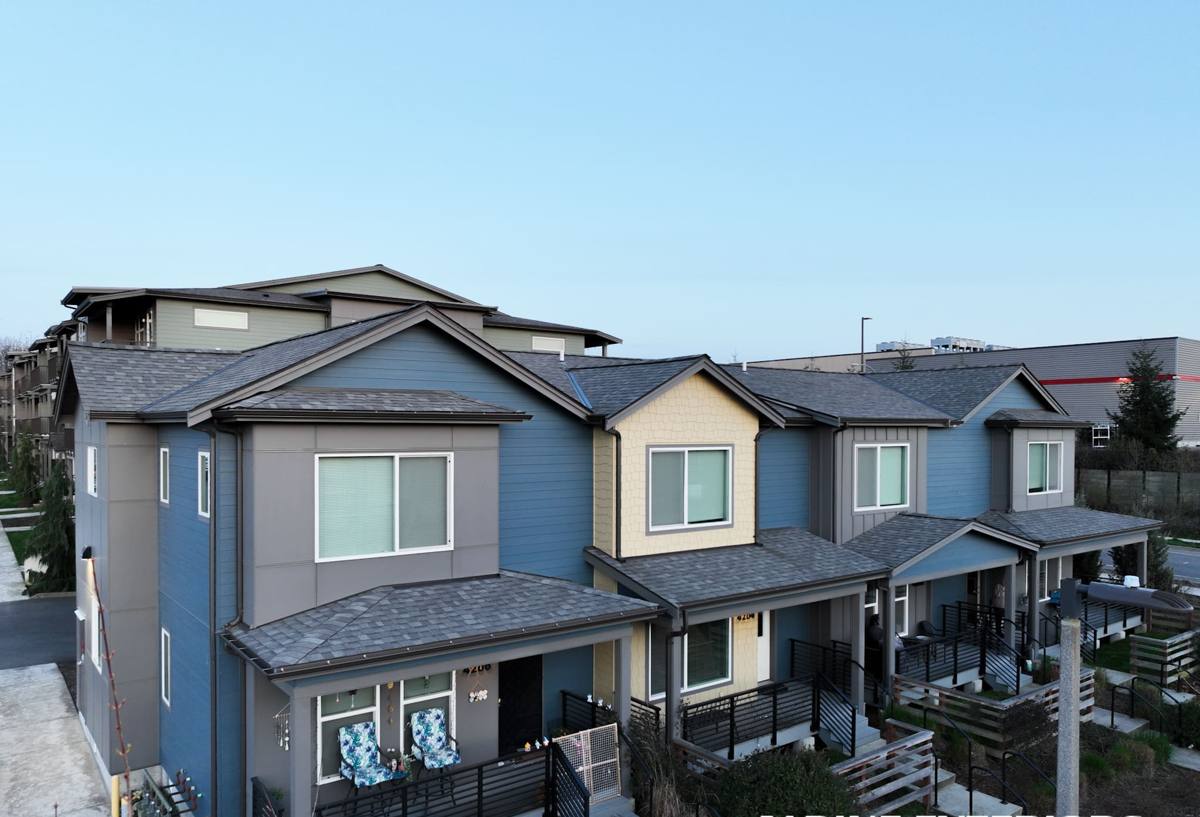
What Snohomish County's Climate Does to Board & Batten Siding
Monroe sits in a part of Snohomish County that gets the full range of Pacific Northwest weather: long stretches of steady rain, wind-driven storms that push water sideways into wall assemblies, and damp shoulder seasons where surfaces stay wet for days at a time. Add salt-laden air that reaches inland with the weather patterns off Puget Sound, and you've got a combination that's tough on any exterior material, but especially tough on siding profiles with more seams and fastener points than a flat lap board.
Board and batten has a lot of vertical seams by design — that's the look. Every one of those seams is a place water can find its way behind the cladding if the installation doesn't manage it correctly. And every batten strip is fastened through the substrate below it, which means more penetration points than a standard lap installation. None of this is a reason to avoid the style. It's a reason to be precise about how it's built.
Moss Season and Vertical Siding
Moss and algae growth on siding is mostly a maintenance and appearance issue rather than a structural one, but it behaves differently on board and batten than on lap siding. Moisture tends to sit longer on north-facing and shaded vertical runs, and battens create small ledges and shadow lines where organic growth gets a foothold faster than on a smooth horizontal board. A factory-applied finish that resists moisture absorption at the surface makes a real difference here, which is one of the reasons material choice matters as much as installation technique.
Why We Install Board & Batten Only in James Hardie Fiber Cement
We don't offer board and batten in vinyl, LP SmartSide, primed spruce, or cedar. That's a deliberate standard, not a limitation of what we know how to install. Board and batten in particular exposes the weak points of those materials because of the extra seams and fastener load described above.
Wood-based battens and panels absorb moisture at cut edges and fastener holes, which is exactly where board and batten has the most of both. Vinyl board and batten profiles look the part from a distance but are thin, panelized products that can show waviness and don't hold paint if you ever want a different color. James Hardie fiber cement is dimensionally stable when wet or dry, doesn't support rot, and comes with a factory-applied ColorPlus finish that's baked on rather than field-painted, so the color holds up under the same UV and moisture exposure that fades or peels site-applied paint.
| Factor | James Hardie Fiber Cement | Wood / Primed Spruce | Vinyl / Engineered Wood |
|---|---|---|---|
| Moisture absorption at cut edges and fasteners | Minimal; non-combustible cement composition | High; primary failure point on battens | Low absorption but prone to warping and gaps |
| Finish durability | Factory ColorPlus finish, multi-decade warranty | Field-applied paint, repaint every 5-8 years | Molded-in color fades and chalks over time |
| Dimensional stability | Very stable; minimal expansion/contraction | Swells and shrinks with moisture cycles | Expands/contracts with temperature swings |
| Fire resistance | Non-combustible | Combustible | Combustible; can deform under heat |
| Typical warranty structure | Long-term, transferable | Manufacturer warranty on primer only, not paint | Prorated after early years |
We install Hardie's engineered vertical siding system with true battens over a purpose-built panel, sized and profiled for the Pacific Northwest's HZ5 climate exposure. It's built to take the moisture cycling this region delivers year after year without the maintenance burden that comes with wood-based alternatives.
What a Correct Board & Batten Installation Involves
Drainage Plane and Rain Screen
Behind every board and batten wall we install, there's a weather-resistive barrier and a drainage gap that lets any moisture that gets past the cladding drain and dry out instead of sitting against the sheathing. This matters more on board and batten than lap siding because of the higher seam count. Skipping or shortcutting this layer is the single most common reason board and batten fails early, regardless of what material sits on top of it.
Batten Spacing and Fastening
Battens need consistent spacing, correct fastener placement into structural framing (not just sheathing), and enough clearance at the base to keep the bottom edge out of standing water and splash-back. Fastener pattern also affects how the panel handles the freeze-thaw and wet-dry cycling that's routine here for months at a stretch.
Trim, Corners, and Flashing
Window and door flashing, corner trim, and the transition points where board and batten meets a roofline or a different siding profile are where leaks actually start. These details take more time to get right on a vertical profile than on lap siding, and it's where cutting corners on labor shows up fastest as a callback.
- Weather-resistive barrier installed and lapped correctly before any cladding goes up
- Rain screen gap maintained behind the full field of panels, not just at the edges
- Battens fastened into framing at manufacturer-specified spacing
- Bottom starter strip set with proper clearance above grade and hard surfaces
- Flashing integrated at every window, door, and roofline intersection
- Factory-cut and factory-finished edges used wherever possible to limit field-cut exposure
- Fastener heads sealed or countersunk per Hardie installation specs
Our Process for Monroe Board & Batten Projects
Assessment and Measurements
We start with a walk-around of the home to look at current siding condition, water damage history, and any areas where board and batten will meet existing trim, roof lines, or a different material. We take exact measurements rather than working off rough estimates, since panel and batten layout needs to be planned in advance to avoid awkward seams.
Permitting and Prep
Depending on scope, exterior work in Monroe and the surrounding Snohomish County jurisdictions may require permitting, and we handle that as part of the job rather than leaving it to the homeowner. Prep work includes removing old siding down to the sheathing, checking for hidden moisture damage, and repairing any framing or sheathing issues before new material goes up — problems like this are far cheaper to fix before the wall is closed back up.
Installation Timeline
Most single-family board and batten projects run from several days to a couple of weeks depending on home size, weather windows, and whether we're doing a full re-side or an accent application. We plan around rain rather than working through it, since a rushed installation in wet conditions is exactly how the drainage details above get shortchanged.
Final Walkthrough
Before we call a job finished, we walk the exterior with the homeowner to review the finished siding, trim, and flashing details up close, and answer any questions about care going forward.
Cost Factors for Board & Batten Siding in Monroe
Board and batten typically costs somewhat more than standard lap siding for the same square footage, mostly due to the added labor of installing individual battens and the trim detail work involved. Exact numbers depend on your home's size, current siding condition, and how much of the exterior gets the board and batten treatment versus a lap or shingle profile elsewhere.
- Scope — full re-side versus board and batten as an accent on gables or a feature wall
- Substrate condition — sound sheathing versus repair or replacement needed underneath
- Home geometry — dormers, multiple stories, and roof intersections add trim and flashing labor
- Color and finish — factory ColorPlus finishes eliminate future painting costs, which factors into long-term value even where upfront price is comparable
- Access — steep grades, limited driveway access, or tight lot lines can affect equipment and labor time
We give homeowners a written estimate that breaks these factors down rather than a single lump number, so it's clear what's driving the cost.
Why Hiring a Crew That Already Works Monroe Matters
Board and batten done wrong doesn't usually fail in year one — it fails in year five or eight, after moisture has had time to work behind panels that were never given a proper drainage path. A crew that's worked through multiple wet seasons in this part of Snohomish County has seen how homes here actually perform over time, not just how they look on installation day. That includes knowing which orientations on a Monroe lot see the most driving rain, how much moss buildup to expect on shaded elevations, and how local permitting works before a project starts rather than after it stalls.
It also means having a crew that isn't learning the material on your house. Board and batten installed with fiber cement has specific fastening and spacing requirements that differ from lap siding, and a crew that installs it regularly in this climate makes fewer of the small errors that turn into big repairs later.
Maintenance After Installation
One of the practical advantages of a correctly installed Hardie board and batten system is how little upkeep it needs compared to wood alternatives. There's no repainting cycle to plan around, since the ColorPlus finish is factory-applied and warrantied. The main maintenance task for homeowners here is dealing with moss and algae during the wetter months — a periodic soft wash on shaded or north-facing elevations keeps growth from building up, and it's a far simpler job on a stable fiber cement surface than on a wood-based product that can be damaged by aggressive cleaning.
Beyond that, an annual look at caulking around trim and flashing points, especially after a rough winter, is enough to catch small issues before they become bigger ones.
If you're considering board and batten siding for a home in Monroe, we're happy to walk the exterior with you, talk through where it makes sense on your specific house, and put together a straightforward, no-pressure estimate. There's a form below to get that started.