 Snohomish
 Building Decks for Marysville's Marine Climate
Marysville sits close enough to Puget Sound that salt-laden air, driving rain, and a moss season that can stretch eight months or more all leave their mark on an outdoor deck. A deck framed and finished the same way you'd build one in a dry inland climate tends to show problems fast here — a soft spot at the ledger, hardware bleeding rust down the decking, black streaks and moss creeping across the boards by the second winter. A deck detailed for what Snohomish County actually throws at it holds up instead of just looking good on installation day.
What the Salt Air and Rain Actually Do to a Deck
Airborne salt from the Sound speeds up corrosion on anything metal — nails, screws, joist hangers, railing brackets. Left unaddressed, that corrosion doesn't just stain the wood around it; it weakens the connection itself over time, and a weakened connection on a deck is a safety issue, not just a cosmetic one. Combine that with the sheer volume of rain the region gets, and any spot where water can sit — a ledger board without proper flashing, a post base sunk directly into soil, decking laid tight with no drainage gap — becomes the spot where rot or corrosion starts first.
Moss Season and Why Drainage Matters More Here
Moss and algae need shade and standing moisture to get established, and a lot of Marysville lots have both — mature trees, north-facing exposures, and a stretch of fall through spring where the decking rarely fully dries out. A deck that's pitched correctly, gapped correctly, and built from a surface that doesn't hold organic debris in its grain or grooves will fight moss naturally. One that isn't becomes a yearly pressure-washing chore, and eventually a slip hazard.
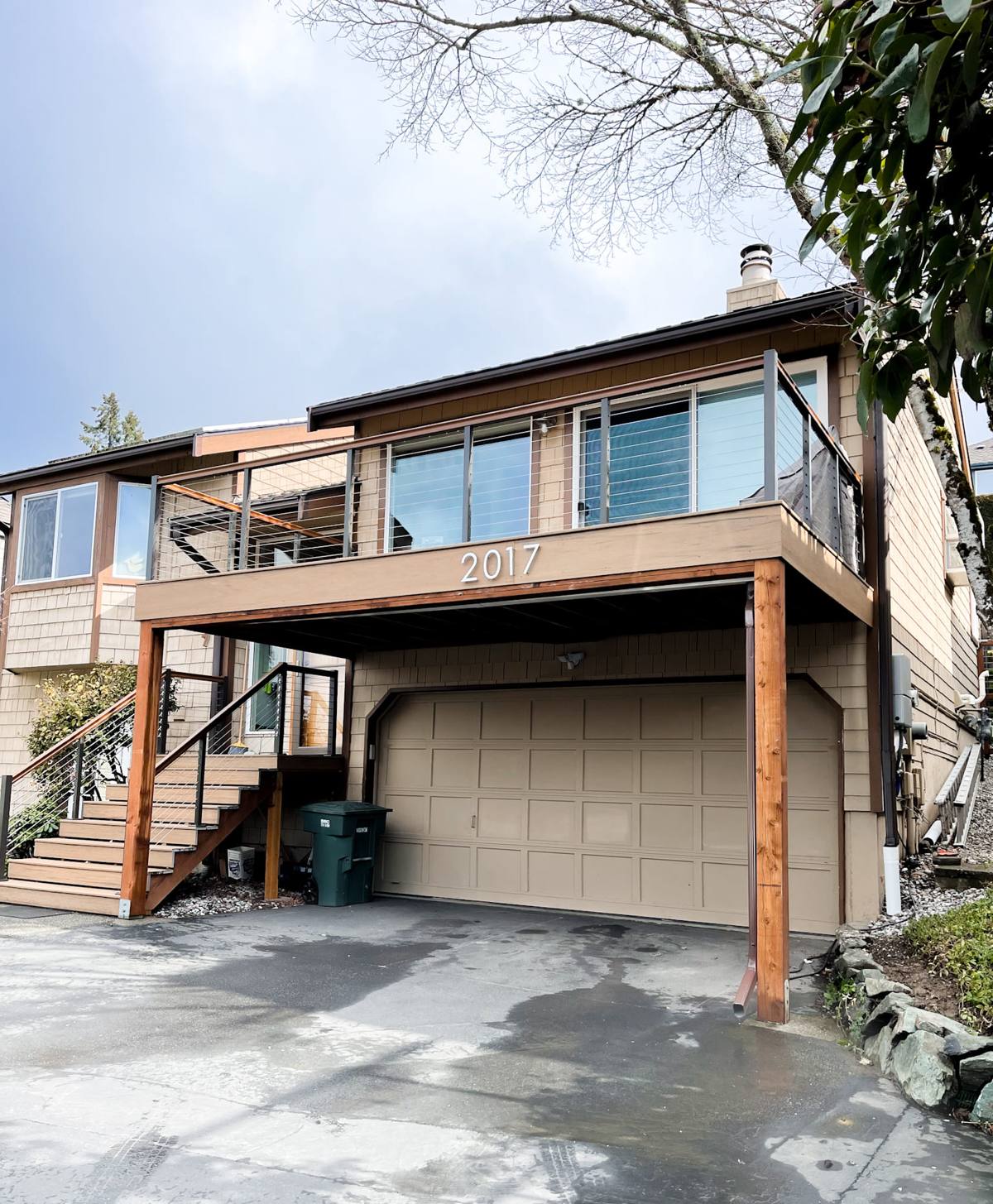
Getting the Foundation Right
Everything visible on a deck — the decking, the railing, the stairs — is cosmetic compared to what's underneath it. Footings and framing are where a deck's real lifespan gets decided, and they're also the part a homeowner can't easily inspect once the deck is built.
Footings and Post Bases
Footings need to bear below the frost depth that applies to your specific site, and posts need to sit on bases that hold the wood up off the concrete and off the soil — never buried or set directly in dirt, where moisture wicks up into the end grain year-round. In low-lying or poorly drained yards, which aren't uncommon around Marysville's flatter, slough-adjacent terrain, we also pay attention to how water moves under and around the deck after a footing is poured, not just where the footing itself sits.
Permits in Marysville and Snohomish County
Most attached decks, and any deck above a modest height, need a building permit, with plans that show footing sizes, framing spans, and railing details. Exact requirements shift from time to time, so we pull current permit and inspection requirements from the City of Marysville or Snohomish County building department for your specific project rather than relying on what applied last year. Skipping this step doesn't just risk a fine — it can complicate a home sale later when an unpermitted structure shows up in an inspection.
The Ledger Board: Where Most Deck Failures Start
The ledger is the board that attaches an elevated deck directly to the house, and it's the single most common point of failure we see on decks built without enough attention to detail — especially in a climate this wet. If the ledger isn't properly flashed and integrated with the house's existing water-resistive barrier and siding, water works its way behind the ledger, behind the siding, and into the wall framing, often for years before anyone notices.
Because we work on siding as much as we do decks, this is a detail we treat differently than a deck-only crew might. Tying the ledger flashing into the existing wall assembly correctly — rather than just caulking a gap and moving on — is the difference between a ledger connection that lasts as long as the deck and one that quietly rots the wall behind it.
Choosing Decking Material for This Climate
There's no single "right" decking material for every Marysville project — the right call depends on budget, how much upkeep you actually want to do, and how shaded or exposed the site is. Here's how the common options actually compare once you factor in salt air, rain, and moss:
| Material | Upfront Cost | Moisture/Moss Resistance | Maintenance | Typical Lifespan |
|---|---|---|---|---|
| Pressure-treated wood | Lowest | Fair — needs sealing to perform well | Annual cleaning, periodic re-sealing | 10–15 years before major repairs |
| Cedar | Moderate | Good naturally, better sealed | Regular sealing to hold color and resist moss | 15–20 years with upkeep |
| Composite decking | Higher | Very good — doesn't absorb water like wood | Occasional washing; grooved edges can trap debris | 25+ years |
| PVC decking | Highest | Excellent — fully synthetic, no organic material to feed moss | Lowest of the group | 25+ years |
Composite and PVC boards vary a lot between product lines — some have grooved edges designed for hidden fasteners that can also collect debris and moisture along the groove if they're not kept clean, while solid-edge boards shed water more easily but show fasteners on the surface. We walk through these trade-offs against your specific site — shade, slope, budget — rather than pushing one product as the default answer.
Railings, Fasteners, and Hardware That Won't Corrode
Railings on any elevated deck have to meet minimum height and baluster-spacing requirements for safety, full stop — that's not optional and not a place to cut corners for appearance. Beyond code minimums, hardware selection matters more here than it would inland. We use stainless steel or hot-dip galvanized fasteners, joist hangers, and post hardware rated for coastal exposure, because standard coated hardware corrodes noticeably faster this close to salt air, and a corroded joist hanger is a structural problem hiding in plain sight.
- Railing height and baluster spacing built to current code, not the minimum a past owner might have gotten away with
- Stainless or hot-dip galvanized fasteners and connectors throughout, not just at visible surfaces
- Post bases and joist hangers rated for exterior, coastal-adjacent exposure
- Ledger flashing integrated with the home's existing siding and water-resistive barrier
- Decking gapped and pitched for drainage, not laid tight for looks alone
Our Process for a Marysville Deck Project
We keep the process straightforward and try to front-load the decisions that are hard to change later.
Site Visit and Design
We walk the site, talk through how you'll actually use the deck, and look at drainage, shade, and how the deck will tie into the existing house — including the siding and any flashing already in place. This is also where we talk through decking material trade-offs against your budget.
Permitting and Engineering
We handle the permit submission with the City of Marysville or Snohomish County, including any engineering the span or height requires, so you're not left navigating that process alone.
Footings, Framing, and Ledger Work
Footings go in below the required depth, framing goes up to span tables (not guesswork), and the ledger connection gets flashed and tied into the house's existing water management, not just bolted on.
Decking, Railing, and Finish
Decking is installed with proper drainage gaps, railings are set to code, and any wood surfaces get sealed before we walk you through basic care for the specific material you chose.
Final Inspection
We coordinate the final building inspection and walk the finished deck with you before calling the job done.
Maintaining Your Deck Through the Wet Season
Even a well-built deck needs some seasonal attention in a climate like this. A short annual walk-around catches most problems while they're still cheap to fix:
- Check for standing water on the decking surface after a hard rain — it should drain, not pool
- Look at the ledger board area where the deck meets the house for staining, soft wood, or gaps in flashing/caulk
- Inspect visible fasteners and hardware for rust streaking or corrosion
- Clear leaves and debris from between boards and along the ledger before wet weather sets in
- Wash off moss and algae buildup before it gets slick, especially on shaded sections
- Check railings and stairs for looseness at the connection points
Why Hire a Crew That Already Works in Marysville
A deck crew that only shows up in Marysville occasionally is guessing at a lot of things a local crew already knows — how the permit process runs at the City of Marysville versus unincorporated Snohomish County, which lots tend to have drainage issues, and how fast hardware actually corrodes this close to the Sound versus what a manufacturer's spec sheet assumes for a drier climate. That local track record also means faster response if something needs a warranty check or a maintenance visit down the line, instead of waiting on a crew that has to drive in from somewhere else.
If you're planning a new deck or replacing one that's showing its age, we're happy to take a look and give you a straightforward, no-pressure estimate — just fill out the form below.