 Snohomish
 Why Machias Homes Put Windows to the Test
Machias sits in a part of Snohomish County where the weather doesn't do anything halfway. Homes here take on moisture-heavy air moving in off Puget Sound, months of low-angle rain that drives sideways more often than straight down, and a moss and mildew season that can stretch from October well into spring. None of that is dramatic on any single day. It's the accumulation — year after year of dampness working into places it shouldn't — that eventually shows up as fogged glass, soft trim, or a window that used to seal tight and now doesn't.
Windows are one of the first places that accumulation shows. They're full of seams, joints, and moving parts, and every one of those is a spot where water, salt-tinged air, or organic growth can get a foothold if the original installation or the window itself wasn't built for this climate. Energy-efficient windows done right aren't just about a lower power bill — in Machias, they're also the difference between a window that's still performing in fifteen years and one that's already letting in drafts and moisture by year eight.
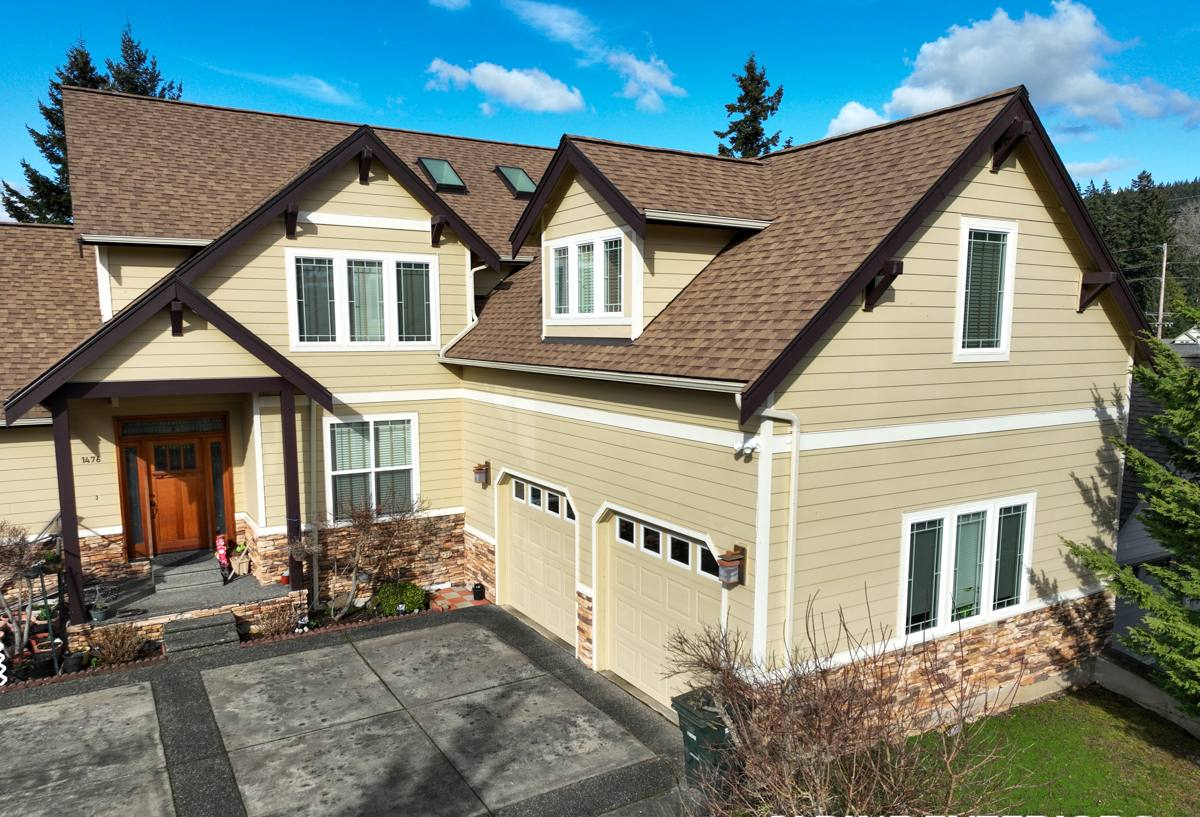
What This Climate Actually Does to a Window
Salt Air and Metal Fatigue
Air moving inland off the Sound carries a fine amount of salt with it, even well away from the water. Over years, that air accelerates corrosion on window hardware — hinges, cranks, locking mechanisms, and any exposed fasteners — especially on cheaper or mismatched hardware that wasn't rated for a marine-influenced environment. A window can look fine from ten feet away while its hardware is quietly seizing up or corroding from the inside.
Driving Rain and Water Intrusion
Wind-driven rain doesn't just hit a window head-on — it gets pushed sideways and upward into gaps that a light rain would never reach. If the flashing, sill pan, or sealant around a window wasn't detailed correctly at installation, this is exactly the kind of weather that finds the weak point. Water intrusion around windows is one of the most common sources of hidden rot in Pacific Northwest homes, and it's almost always traceable to the installation, not the window unit itself.
Moss and Extended Damp Season
A long stretch of consistently damp, shaded conditions is exactly what moss, algae, and mildew need to establish themselves. On windows, that shows up as dark streaking on sills and frames, degraded caulking, and — on wood-framed or wood-clad units that aren't properly maintained — soft spots where organic growth has been sitting against the wood for months at a time.
Signs a Machias Home Needs Window Attention
Most homeowners don't think about their windows until something is obviously wrong, but the early signs are usually visible if you know where to look. If several of these apply to your home, it's worth having windows evaluated even if nothing feels urgent yet:
- Visible fog or moisture between panes of double-pane glass (a failed seal)
- Drafts you can feel near the frame, even with the window fully latched
- Windows that are hard to open, close, or lock — often a sign of frame movement or swelling
- Soft, spongy, or discolored trim and sill areas, especially on south- and west-facing exposures
- Visible corrosion on hinges, cranks, or locking hardware
- Condensation forming on the inside of the glass regularly during colder months
- A noticeable jump in heating costs without any other explanation
- Caulk or sealant around the frame that's cracked, shrunken, or missing in sections
What "Energy-Efficient" Actually Means Here
Energy efficiency in a window comes from two things working together: the glass package and the frame. In a climate like Machias's — mild temperatures but constant moisture and wind exposure — both matter more than they would somewhere hot and dry.
The Glass Package
Most modern replacement windows use dual-pane or triple-pane glass with a low-emissivity (Low-E) coating and an inert gas fill (typically argon) between the panes. The Low-E coating reflects radiant heat while still letting visible light through, and the gas fill slows heat transfer across the airspace. Together they reduce how much heat escapes in winter and how much builds up on the rare hot afternoon. For our climate, the priority is usually a strong U-factor (how well the window resists heat flow) over an aggressive solar heat gain rating, since we're not fighting intense sun for most of the year.
The Frame Material
The frame has to hold that glass package in place and keep water out for decades, so its behavior in wet, salt-tinged, moss-prone conditions matters as much as its insulating value. We generally steer clients away from bare aluminum frames for this climate — aluminum conducts heat and cold directly through the frame and is prone to condensation, and its performance in coastal-influenced air isn't a match for its low upfront cost. That's a professional judgment based on how the material behaves here, not a knock on any manufacturer.
| Frame Type | Moisture & Salt Air Resistance | Maintenance | Relative Cost |
|---|---|---|---|
| Vinyl | Strong — won't corrode or rot; seams are the main watch point | Low — occasional cleaning | Lower |
| Fiberglass | Very strong — dimensionally stable, resists moisture well | Low | Mid to higher |
| Wood / Wood-Clad | Moderate — needs an intact exterior cladding or consistent upkeep | Higher — repainting, sealing, moss removal | Higher |
| Bare Aluminum | Weaker — prone to condensation and corrosion over time | Moderate | Lower |
What a Correct Installation Involves
The window unit itself is maybe half the equation. In this climate, the installation detailing is what actually determines whether a window stays watertight for its full service life.
Flashing and Sill Pan Detailing
Every window opening needs a properly lapped flashing system and, ideally, a sloped sill pan that directs any water that does get past the exterior seal back outside rather than into the wall cavity. This is the single most common place we find past installations cut corners, and it's invisible once the window is in and trimmed out — until it fails.
Air Sealing and Insulation
The gap between the window frame and the rough opening needs to be sealed and insulated correctly — not overpacked with rigid foam that can bow the frame, and not left with gaps that create a direct air path. Low-expansion foam or backer rod and sealant, applied correctly around the full perimeter, is what actually delivers the energy savings a new window is supposed to provide.
Exterior Sealant and Trim
The exterior caulking and trim work has to accommodate the fact that this window will be hit with driving rain repeatedly every winter. That means the right sealant for the substrate, proper backer rod where gaps are too wide for sealant alone, and trim details that shed water rather than trap it against the frame.
Choosing Windows for a Machias Home
Style choice is largely about the house and the homeowner's preference, but a few things matter more here than in a drier climate:
- Casement windows tend to seal tighter than sliders because the sash compresses against the frame when latched — a real advantage against driving rain.
- Sliding windows are convenient and often more budget-friendly, but their track-and-seal design is more exposed to wind-driven water if not detailed carefully.
- Operable hardware should be rated for coastal or high-moisture environments, not just standard-grade — this is where cheap hardware fails first.
- Screens and trim profiles that don't create a shelf for standing water or debris will hold up better and stay cleaner through moss season.
Our Process
- On-site evaluation — we look at each window opening individually, not just the glass, since existing water damage or rot changes the scope.
- Honest scoping — we tell you which windows genuinely need replacement, which could be repaired, and why, rather than defaulting to a full-house sale.
- Written estimate — clear line items for materials, labor, and any additional work (rot repair, re-flashing) discovered during evaluation.
- Installation — proper removal, flashing and sill pan work, correct air sealing, and exterior sealant detailing on every opening.
- Walkthrough — we check operation, sealing, and finish work with you before we call the job done.
Why Local Experience in Machias Matters
A crew that already works in and around Snohomish and communities like Machias has seen how homes in this specific mix of weather actually age — which frame materials hold up, which installation shortcuts show up as callbacks five years later, and which exposures on a given lot take the worst of the wind-driven rain. That's not something a crew coming from a drier region picks up on the first pass. It also means faster response if a window ever needs a service call, and familiarity with the permitting and inspection expectations for exterior work in Snohomish County.
Keeping New Windows Performing
Energy-efficient windows are a long-term investment, and a little upkeep protects that investment through our wet seasons:
- Rinse frames and sills periodically to keep salt residue and organic buildup from settling in
- Check and lightly lubricate hardware annually, especially cranks and hinges on casement windows
- Inspect exterior caulking each fall before the heavy rains set in, and touch up any cracked sections
- Clear debris from sills and tracks so water has a clean path to drain
- Watch for early moss growth on sills and trim and remove it before it establishes
If you're weighing whether your windows need replacing, repair, or just better sealing, we're happy to take a look and give you a straight answer. Reach out for a free, no-pressure estimate using the form below.