 Snohomish
 Why Lynden Siding Takes More Punishment Than It Looks Like
Siding damage in Lynden rarely announces itself. A house can look fine from the curb for years while moisture, salt-laden air, and moss quietly work behind the surface. By the time paint is visibly peeling or a board has gone soft, the underlying problem has usually been building for a season or two. Understanding what Whatcom County's climate actually does to siding is the first step to repairing it correctly instead of just patching over what shows.
Three factors do most of the damage here. Salt air moving inland off the Salish Sea accelerates corrosion on fasteners, trim, and any exposed metal flashing, which in turn lets water find its way behind the siding. Driving rain — wind-blown, not just falling straight down — pushes moisture into seams, laps, and butt joints that were never designed to be sealed tight against horizontal pressure. And a long, damp moss season means organic growth gets a foothold on north-facing walls, shaded elevations, and anywhere siding stays wet longer than it can dry.
None of that means siding here is doomed to fail. It means repairs have to account for how water actually moves and where it collects, not just cover the spot that looks bad.
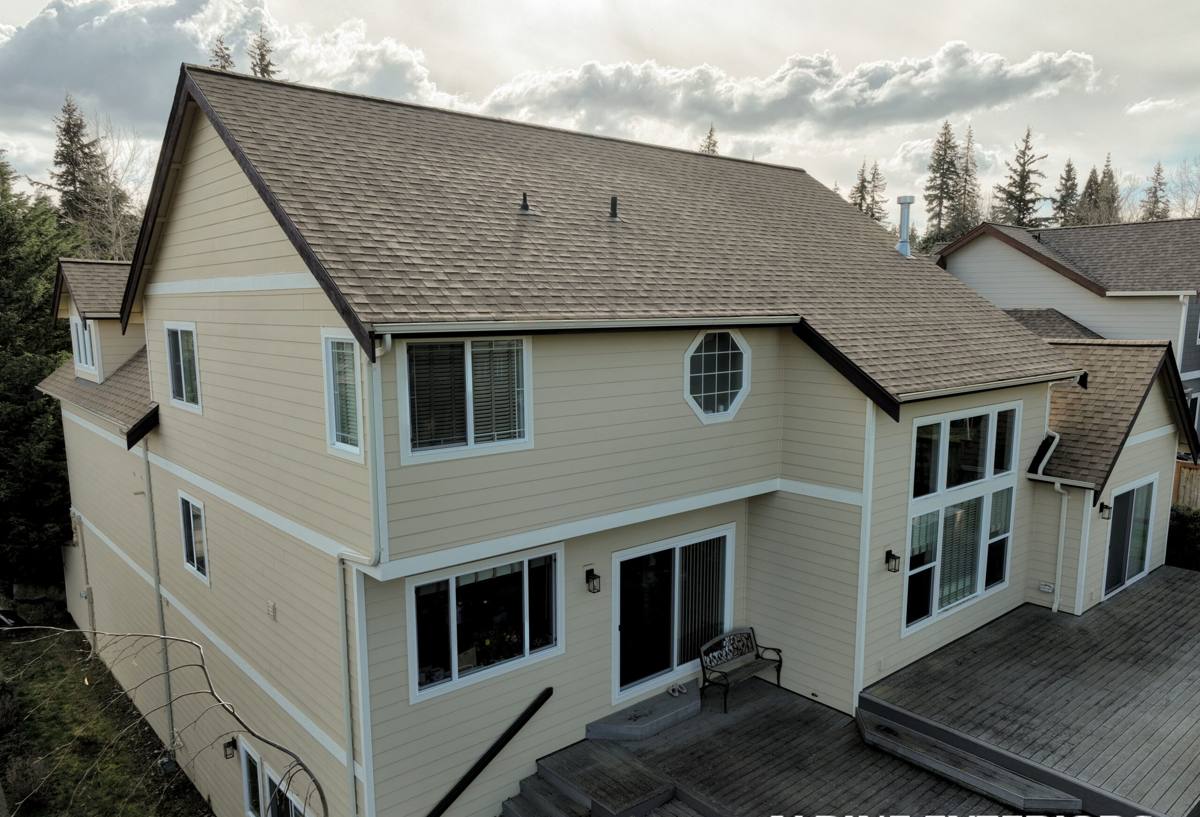
Signs a Lynden Home Needs Siding Repair
Most calls we get start with one visible symptom, but a proper inspection usually turns up two or three related issues nearby. Here's what we look for and what homeowners should watch for between inspections:
- Soft, spongy, or crumbling spots when you press on a board — a sign moisture has been sitting behind the surface
- Paint that's bubbling, peeling, or flaking in a localized area rather than evenly across a wall
- Dark streaking, green or black growth, or a persistently damp look on shaded or north-facing sections
- Gaps opening up at seams, corners, or where siding meets trim, window frames, or the foundation
- Rust staining running down from nail heads or metal flashing
- Visible warping, buckling, or boards pulling away from the wall
- A musty smell or soft drywall on interior walls that back up to an exterior wall showing damage
Any one of these on its own might be minor. Two or more together usually mean water has already found a path behind the cladding.
What a Correct Repair Actually Involves
It Starts Behind the Siding, Not On Top of It
A repair that only addresses the visible board is a temporary fix at best. Before we replace anything, we pull back the damaged section far enough to check the water-resistive barrier, flashing, and sheathing underneath. If those layers are compromised, replacing the siding without addressing them just resets the clock on the same failure.
Matching Isn't Optional
Patching a repair with a mismatched product — different thickness, different butt joint spacing, a different factory finish — creates a visible seam and, worse, a point where water behaves differently than the surrounding material expects. We match repairs to the existing siding profile and, where the original product allows it, to the same manufacturer's system so the wall performs as one assembly rather than a patchwork of parts.
Fasteners and Flashing Get the Same Attention as the Board
Given how hard salt air is on exposed metal here, we don't just swap the damaged board and reuse whatever fasteners or flashing are already in place if they show corrosion. Replacing a board over compromised flashing is one of the most common ways a "repaired" wall fails again within a year or two.
Repair or Replace: How We Make That Call
Not every damaged section needs a full re-side, and not every repair is worth doing instead of planning a replacement. The table below is how we walk homeowners through that decision.
| Factor | Favors Repair | Favors Replacement |
|---|---|---|
| Extent of damage | Isolated to one or two areas | Recurring across multiple elevations |
| Underlying sheathing | Sound once opened up | Soft, rotted, or water-stained broadly |
| Siding material and age | Product still available or closely matchable | Discontinued profile, or original material was never a good fit for this climate |
| Cause of damage | A single identifiable failure point (one bad flashing detail, one impact) | Systemic moisture intrusion or widespread moss/organic damage |
| Homeowner's timeline | Wants the immediate issue resolved | Planning ahead and open to solving it once, permanently |
We'll always give a straight answer on which side of that table your home falls on. A repair that's likely to need redoing in a couple of years isn't a good use of anyone's money, and we'll say so rather than sell a patch we don't believe in.
Why We Repair — and Replace — With James Hardie Only
We install and repair with James Hardie fiber cement exclusively. That's a deliberate standard, not a limitation. Hardie's HZ5 product line is engineered for climates like ours — freeze-thaw cycling, sustained moisture exposure, and coastal air — and its factory-applied ColorPlus finish holds up to UV and moisture far better than field-applied paint, which matters a lot when you're trying to match a repair seamlessly into existing siding.
We don't install vinyl, LP SmartSide, primed wood, or cedar, and when a repair call involves one of those materials, we'll say so honestly rather than pretend it doesn't matter. Vinyl expands and contracts with temperature swings and can crack or bow over time; engineered wood products are sensitive to moisture at cut edges and seams if not maintained precisely; cedar and primed spruce need ongoing refinishing to keep water out. Fiber cement doesn't rot, doesn't attract insects, and is non-combustible — advantages that matter more, not less, in a climate that stays damp for months at a stretch. When a repair on non-Hardie siding is beyond what a patch can reasonably fix, we'll talk through what a Hardie transition would look like rather than keep feeding money into a material that's fighting the climate every season.
How Our Repair Process Works
- Inspection. We walk the exterior, check every elevation (not just the spot you called about), and open up any suspect areas to see what's happening behind the surface.
- Diagnosis. We identify the actual cause — a flashing failure, a caulk joint that gave out, moss holding moisture against the wall — not just the symptom.
- Written scope. You get a clear explanation of what needs to happen, what's optional, and what we'd recommend versus what's strictly necessary.
- Repair. Damaged material comes out, the substrate and flashing get addressed, and new material goes in matched to the existing siding and properly fastened and sealed.
- Cleanup and check. We clear moss and debris from the surrounding area where it's contributing to the problem, not just the repaired section, so the fix isn't undone by the same conditions within a year.
What Happens If Repairs Get Put Off
Siding damage in a wet climate rarely stays contained. A small area of moisture intrusion left over a wet Whatcom County winter can spread into adjacent sheathing, framing, or insulation, turning a board-level repair into a structural one. Moss left to grow unaddressed holds moisture against the wall continuously, which speeds up exactly the kind of rot and staining described above. The honest advice is the same every time: a repair addressed early is almost always smaller, cheaper, and less disruptive than the same problem a year or two later.
Why Hiring a Crew That Already Works Lynden Matters
Siding repair isn't just a product question — it's a judgment call about how a specific building has responded to a specific climate over time. A crew that regularly works Lynden and the surrounding Whatcom County area has already seen how salt air corrodes fasteners on homes with similar exposure, which elevations take the worst of the driving rain, and where moss tends to establish itself first. That local pattern recognition shortens the diagnosis and helps avoid repairs that look right but miss the actual cause.
It also matters for accountability. A contractor who works this area regularly has a reputation to protect with neighbors, not just a single job to close. That's a meaningful difference when you're trusting someone to open up your wall, diagnose what they find, and stand behind the fix.
Get an Honest Look at Your Siding
If you're seeing soft spots, staining, moss buildup, or gaps opening up anywhere on your home's exterior, it's worth having someone look before the next wet season makes the problem bigger. We offer free, no-pressure estimates for Lynden homeowners — we'll tell you honestly whether you're looking at a repair or something bigger, and what we'd recommend either way. Fill out the form below to get started.