 Snohomish
 Why Lake Stevens Roofs Take Extra Punishment
A roof in Lake Stevens works harder than a roof almost anywhere inland. The lake itself keeps humidity high right at the roof deck, Puget Sound isn't far off as the crow flies, and the mix of marine air and near-constant tree cover through Snohomish County means moss, moisture, and driving rain all show up on the same roof, often at the same time of year. None of that is unusual for this part of Washington — but it does mean a roof here ages differently than one in a dry climate, and repairs need to account for that instead of just patching what's visible.
The pattern is fairly consistent: a long wet season from fall through spring that keeps shingles saturated and moss actively growing, followed by a short dry stretch in summer that bakes whatever moisture got trapped underneath. Add wind-driven rain off the lake and the occasional salt-tinged marine air pushing inland, and you get accelerated granule loss, softened decking under moss mats, and flashing that corrodes faster than the shingles around it. A repair that doesn't account for all three — moisture, moss, and wind-driven rain — tends to fail again within a season or two.
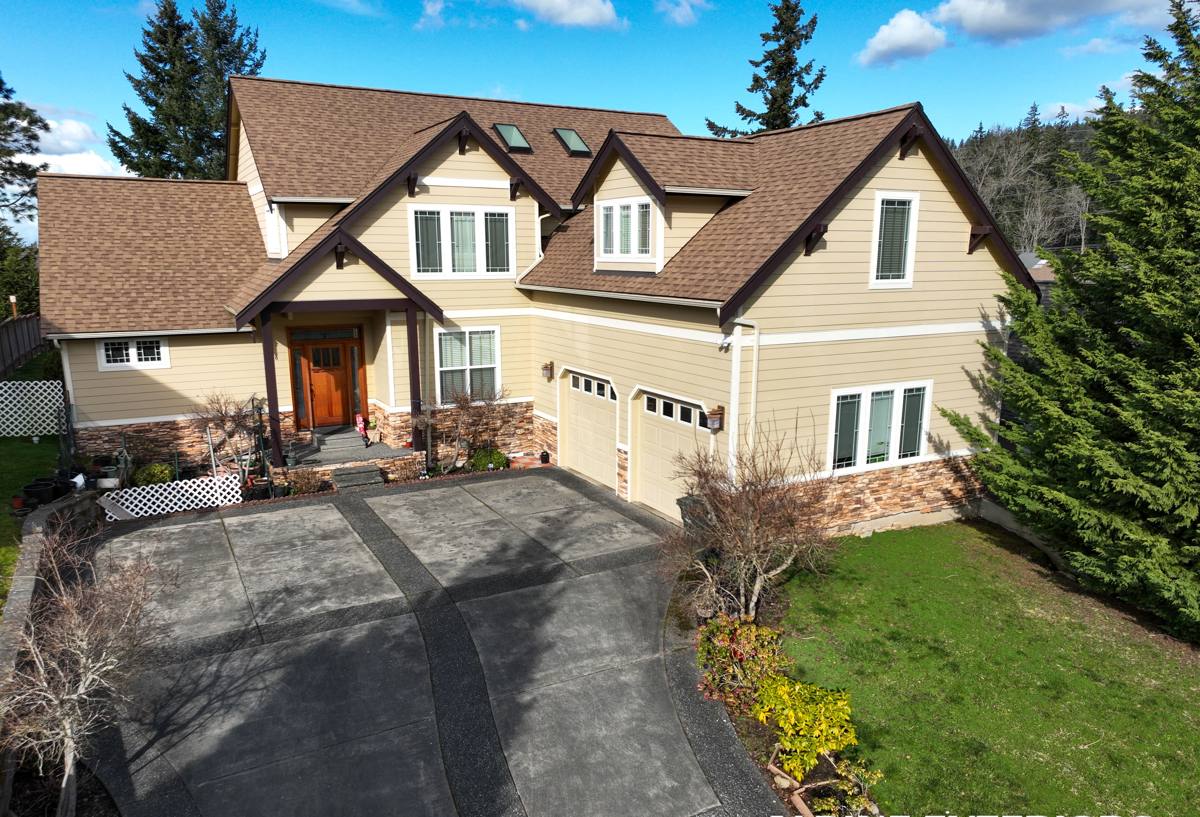
Signs You Need Roof Repair, Not a Full Tear-Off
Most roofs don't fail all at once. They show warning signs first, and catching those early is usually the difference between a repair bill and a replacement bill. Look for:
- Shingles that are curling, cracked, or missing outright, especially on slopes that face west or catch the brunt of storms off the lake
- Heavy granule buildup in gutters or at downspout outlets — a sign the shingle surface is wearing thin
- Thick moss mats, especially on north-facing or shaded slopes, that hold water against the shingle instead of letting it run off
- Dark streaking or discoloration that keeps returning even after cleaning
- Soft or spongy spots when walked on, which usually mean the decking underneath has absorbed water
- Active leaks or water staining around chimneys, skylights, vent pipes, or roof valleys
- Sagging along a valley or eave line, which points to a structural or long-term moisture problem rather than a surface one
One or two of these, caught early, is almost always a repair. Several at once, or any sign of sagging, usually means it's worth a full inspection before deciding what's realistic to fix versus what's due for replacement.
What a Correct Roof Repair Actually Involves
Finding the Real Source of the Leak
Water rarely drips straight down from where it enters. It travels along the underlayment, follows a rafter, and shows up on a ceiling feet away from the actual failure point. A repair that starts by caulking the spot where the stain appeared, without tracing the path back to the source, is a repair that comes back. Proper diagnosis means getting on the roof, checking the suspect area from above, and confirming the entry point before any material gets replaced.
Matching Materials, Not Just Patching
Shingles fade and wear unevenly over their life, so a patch using brand-new material next to ten-year-old shingles will always look and perform differently — new shingles are more flexible and seal differently in cold weather than shingles that have already cured in place for years. A correct repair pulls replacement material from as close a match as possible, ties it into the surrounding courses properly, and doesn't rely on excess sealant to make up for a poor material match.
Flashing and Transitions Get Extra Attention
Most roof leaks that aren't simple shingle wear happen at a transition: where a chimney meets the roof plane, where a dormer or wall intersects the roofline, around vent pipes, or in valleys where two slopes meet. These are also exactly the areas where roofing and siding work overlap, since a poorly flashed wall-to-roof transition can leak into both systems. We treat flashing as a repair priority, not an afterthought, because a shingle repair over failed flashing just delays the same leak.
Common Repair Issues We See Around Lake Stevens
Certain failure patterns show up again and again on roofs in this area, largely because of the climate described above. Knowing what's typical helps set expectations before we even get on the roof.
| Issue | Typical Cause | What the Fix Involves |
|---|---|---|
| Moss mats on shaded slopes | Tree cover, prolonged dampness, poor airflow across the roof plane | Careful moss removal, treatment to slow regrowth, and repair of any decking softened underneath |
| Leaking valleys | Undersized or corroded valley flashing, or debris damming water flow | Flashing replacement and confirming proper water shedding under the shingle courses |
| Leaks at chimneys or skylights | Cracked or failed step and counter-flashing, aged sealant | Re-flashing the transition rather than resealing over a failed flashing system |
| Granule loss and thinning shingles | UV exposure combined with prolonged moisture retention | Section replacement of affected shingles, or a broader assessment if wear is widespread |
| Gutter and eave staining | Wind-driven rain pushing water past the drip edge | Drip edge and eave flashing repair, sometimes paired with gutter adjustments |
Repair vs. Replacement: How to Decide
Not every roof problem needs a new roof, and not every roof problem is a quick fix either. The honest answer depends on a handful of factors, and we'll walk through all of them during an inspection rather than push toward whichever option is more profitable.
| Factor | Leans Toward Repair | Leans Toward Replacement |
|---|---|---|
| Roof age | Under roughly two-thirds of the material's expected lifespan | Near or past the shingle manufacturer's expected service life |
| Damage extent | Isolated to one slope, valley, or penetration | Spread across multiple slopes or recurring in different spots each season |
| Decking condition | Solid, no soft spots found during inspection | Soft, delaminated, or water-damaged decking in multiple areas |
| Cost outlook | Repair cost is a small fraction of what full replacement would run | Repeated repairs are starting to add up to a significant share of replacement cost |
| Typical price range | Many single-area repairs run from a few hundred dollars up to around two thousand, depending on scope and access | Full replacement is a much larger investment, priced by roof size, pitch, and material |
That table is a general guide, not a quote — every roof and every repair scope is different, which is exactly why we inspect before recommending either path.
Our Roof Repair Process
We keep the process straightforward because homeowners dealing with a leak don't need extra complexity added on top of it.
- Inspection and diagnosis — we get on the roof, trace the leak or damage back to its source, and check surrounding areas for related wear
- Written estimate — a clear explanation of what's damaged, what the repair involves, and what it will cost, before any work starts
- Scheduling around weather — shingle and flashing work needs a dry window to seal properly, so we schedule with the local forecast in mind rather than rushing a repair into the rain
- The repair itself — matched materials, proper flashing work at transitions, and decking replacement if water has gotten underneath
- Cleanup and debris check — old material, nails, and moss debris cleared from the roof and the ground around the house
- Follow-up — a final check to confirm the repair is sealing and shedding water the way it should
Materials We Use and Why
For most repairs, matching the existing shingle type and profile is the right call — it keeps the roof looking consistent and avoids mixing materials that expand, contract, or age differently. Where flashing needs replacing, we use corrosion-resistant metal rather than relying on sealant alone; sealant breaks down with UV and temperature swings faster than metal flashing does, and a repair that depends on caulk to stay watertight is one that needs redoing sooner. In vulnerable areas — valleys, low-slope transitions, around penetrations — we'll often add a self-adhering waterproof underlayment beneath the shingle line as extra protection, since those spots see the most standing water and debris buildup over a wet Pacific Northwest winter.
We're upfront when a repair isn't a good long-term investment. If a roof has multiple failure points, decking damage in several areas, or is simply near the end of its service life, patching it piecemeal usually costs more over a few years than addressing it properly once. We'd rather tell a homeowner that plainly than keep billing for repairs on a roof that's telling us it's done.
Moss, Algae, and the Wet-Climate Maintenance Reality
Moss isn't just cosmetic — it holds moisture against the shingle surface, works into the granules, and over time lifts shingle edges enough for water to get underneath. In a climate like this one, with shade, humidity, and a long wet season working together, moss isn't a matter of if but how often it needs to be addressed. Between full repairs, there's a fair amount a homeowner can do to slow it down:
- Keep overhanging branches trimmed back so more sunlight and airflow reach the roof surface
- Clear gutters and valleys of debris before the fall rains start, so water isn't sitting and feeding moss growth
- Rinse moss growth gently from the top down rather than pressure-washing, which can drive water under shingles and strip granules
- Watch for moss regrowth on the same slopes each year — it's often a sign that slope doesn't get enough sun or airflow and may need a longer-term fix, like zinc or copper strips near the ridge
- Check the attic for musty odors or damp insulation, which can signal a slow leak before it ever shows up on a ceiling
Why Hire a Crew That Already Works Lake Stevens
A roof repair crew that's already familiar with this area isn't guessing at what a Lake Stevens roof is dealing with — they've seen the same moss patterns, the same wind-driven rain angles, and the same flashing failures on roofs nearby, season after season. That familiarity shortens the diagnosis, since a lot of the guesswork about how the local climate has affected a given roof is already answered before we get on the ladder. It also means we're not learning the permitting and code requirements for Snohomish County on your project — that's groundwork already done.
There's also a practical side to being local: when a storm off the lake causes damage, a crew based nearby can get out to assess and tarp a roof faster than one traveling in from out of the area. For something as time-sensitive as an active leak, that response time matters as much as the quality of the repair itself.
Ready for a Straight Answer on Your Roof?
If you're dealing with a leak, moss buildup, or damage from a recent storm, we're happy to take a look and give you an honest read on what it actually needs — repair or otherwise. Fill out the form below for a free, no-pressure estimate, and we'll walk the roof, explain what we find in plain terms, and lay out the options.