 Snohomish
 Arlington sits in the part of Snohomish County where marine air off the Sound meets the moisture funneling down from the Cascade foothills, and siding here works harder than it does in drier parts of the state. Homes take on salt-tinged air, months of driving rain, and a moss season that can run from fall through spring. Siding installation in this kind of climate isn't just a cosmetic upgrade — it's the difference between a wall assembly that sheds water for decades and one that starts failing from the inside before the paint even looks tired.
Siding Installation Built for Arlington's Marine Climate
The Pacific Northwest's marine climate is mild, which lulls a lot of homeowners into thinking siding is a low-stakes decision. It isn't. Constant humidity keeps wood-based products damp for longer stretches than they're rated for, salt-laden air accelerates corrosion on fasteners and trim, and moss doesn't just look bad — it holds moisture against the surface and, on the wrong substrate, works its way into seams and laps over time.
None of that means Arlington homes need something exotic. It means they need a siding material that's dimensionally stable when wet, a finish that doesn't rely on the homeowner repainting every few years, and an installation that respects water management details a lot of crews skip because "it's never rained that hard while I was on the roof."
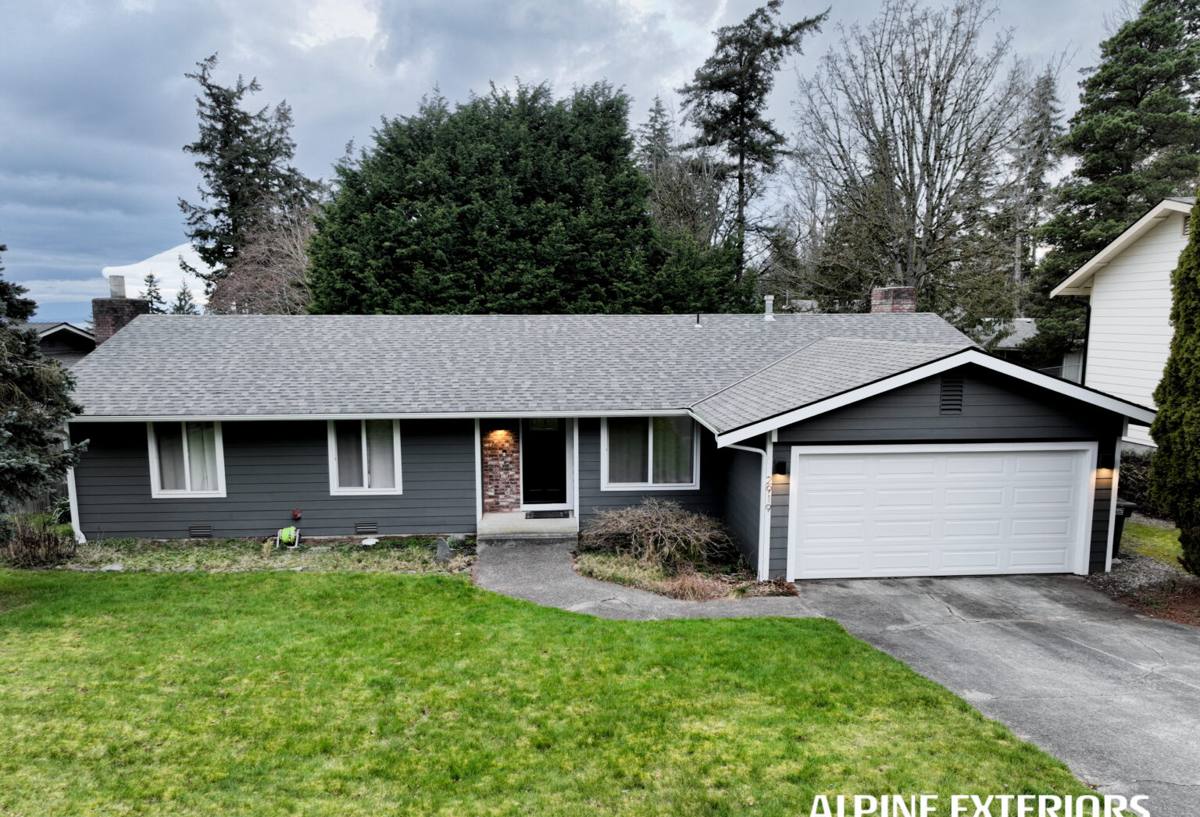
What a Correct Siding Installation Actually Involves
Siding installation is often sold as a surface-level job — pull the old material off, nail up the new stuff, caulk the seams. That approach is exactly why so many homes end up re-siding again in fifteen years instead of forty. A correct installation is really a water-management system, and the visible siding is only the last layer of it.
Water Management Starts Behind the Siding
Before a single course of siding goes up, the wall needs a continuous weather-resistive barrier, properly lapped and taped at seams, with flashing integrated at every window, door, and penetration so water is directed out and down rather than trapped behind the cladding. In a climate that sees this much rain, a gap or shortcut here is the single most common reason siding fails prematurely — and it's completely invisible once the new siding is on, which is exactly why it matters who's doing the work.
Fastening, Clearances, and Nailing Patterns Matter
Fiber cement siding has specific fastening requirements — nail placement, spacing, and depth all affect how the panels perform in wind and how well they resist water intrusion at the fastener itself. Ground clearance and clearance from roof lines, decks, and grade also matter more here than in drier regions, because splash-back and standing moisture at the base of a wall are where rot most often starts on Pacific Northwest homes.
Why We Install James Hardie Fiber Cement — and Nothing Else
We don't install vinyl, LP SmartSide, Cemplank, Allura, or primed wood siding. That's not a marketing angle — it's a standard we set because of what we've seen these products do, and not do, in this exact climate over time. Engineered wood products depend on an intact factory coating to keep moisture out of the wood strand core; once that coating is compromised at a cut edge, a fastener, or a damaged corner, moisture can wick into the substrate, and in a climate this wet, that clock starts running fast. Vinyl is inexpensive and low-maintenance in the sense that it doesn't rot, but it also isn't rigid, expands and contracts significantly with temperature swings, and can't match the factory-finished, low-maintenance color performance homeowners expect from a real siding upgrade.
James Hardie fiber cement is non-combustible, dimensionally stable, and doesn't rely on an unbroken surface coating to stay structurally sound — it's cement, sand, and cellulose fiber, engineered to resist moisture absorption at the core. Its ColorPlus factory finish is baked on under controlled conditions and backed by a real finish warranty, which matters enormously in a region where field-painted surfaces get tested by rain most of the year.
The HZ5 Climate-Engineered Line
Hardie engineers its siding by climate zone rather than selling one product everywhere. The HZ5 line is formulated for regions like ours — colder, wetter, higher moisture exposure — with a moisture barrier and formulation tuned to that reality, rather than a generic national product asked to perform in every climate at once. That's the version of Hardie we install on Arlington homes, paired with the manufacturer's transferable limited warranty.
Our Installation Process, Step by Step
The steps themselves aren't unusual, but the order and the attention to detail at each one are what separate an installation that lasts from one that doesn't.
- On-site assessment — we look at the existing siding, sheathing condition, trim, and any signs of past moisture intrusion before quoting anything.
- Tear-off and inspection — removing the old siding exposes the sheathing, which is the only real chance to catch rot or water damage before it's covered up again for another 20-plus years.
- Repair and prep — any compromised sheathing or framing gets addressed before the weather-resistive barrier goes on, not after.
- Weather barrier and flashing — installed continuous, lapped correctly, and integrated at every window, door, and penetration.
- Hardie installation — panels, planks, or shingle-style siding installed to manufacturer spec, with correct fastening, clearances, and joint treatment.
- Trim, caulking, and finish detail — the visible finish work that determines how the job looks for the next several decades, not just the next year.
- Final walkthrough and cleanup — site cleared, and we walk the job with the homeowner before calling it done.
Common Siding Problems We See on Arlington Homes
A lot of the calls we get in this area follow a similar pattern, and it's worth knowing what to watch for even if you're not ready to replace siding yet.
- Dark streaking and moss buildup at north-facing walls and anywhere shaded by trees or the roofline
- Soft or spongy siding near ground level, often where mulch or landscaping holds moisture against the wall
- Caulk-dependent seams on older siding systems that have shrunk, cracked, or pulled away
- Paint failure and chalking on field-painted wood or engineered wood siding that's past its coating's service life
- Swelling or delamination at butt joints and corners on engineered wood products where moisture found an entry point
None of these are dramatic on their own, but they're all early signals that the wall assembly is losing its water-shedding ability — and in this climate, that process rarely reverses itself without intervention.
What Siding Installation Costs in Arlington
Every home is different, and the honest answer to "what will this cost" depends on scope, but the factors below are what actually move the number up or down.
| Cost Factor | Why It Matters |
|---|---|
| Home size and wall square footage | The most direct driver of material and labor quantity |
| Number of stories | Second- and third-story work requires more staging, scaffolding, and time |
| Existing siding removal and disposal | Tear-off adds labor and hauling that new-construction installs don't have |
| Sheathing or framing repair | Hidden moisture damage found at tear-off can add scope before new siding goes on |
| Trim and architectural detail | Corners, window trim, and multiple siding profiles add labor time versus a simple flat wall |
| Siding profile chosen | Lap, shingle-style, and panel products vary in material and installation labor |
We give free, itemized estimates so you can see exactly what's driving the number for your specific home rather than a generic per-square-foot guess.
Why a Crew That Already Works in Arlington Matters
Siding installation isn't just a set of steps on a spec sheet — it's a set of steps performed correctly in the actual weather conditions the crew is working in. A crew that regularly works in and around Arlington knows how to sequence a job around Pacific Northwest rain patterns, how much lead time is realistic for materials, and what moisture and moss issues tend to show up on local homes before they even pull the old siding off. That familiarity shows up in fewer surprises mid-project and a finished product that's actually built for the climate it has to survive, not just installed to a generic national checklist.
Caring for Your New Siding After Installation
Fiber cement siding is low-maintenance compared to wood or engineered wood alternatives, but "low-maintenance" doesn't mean "no maintenance." A little attention keeps it performing the way it's designed to for the long haul.
- Rinse siding periodically to keep moss and organic buildup from establishing, especially on shaded or north-facing walls
- Keep landscaping and mulch pulled back from direct contact with the bottom of the siding
- Inspect caulking at trim and penetrations annually and touch up before gaps let water behind the siding
- Address gutter and downspout issues promptly — overflow is one of the most common causes of localized siding damage
- Repaint or touch up any field-cut edges per manufacturer guidance to keep the factory finish's protection intact
If your Arlington home's siding is showing moss staining, soft spots, or paint failure, or you're planning ahead for a replacement, we're happy to take a look and put together a free, no-pressure estimate — no obligation, just a straight answer on what your home actually needs.