 Snohomish
 Why Bellingham Siding Has a Harder Job Than Most
Bellingham sits where Puget Sound weather and the foothills of the Cascades meet, and that combination is tough on the outside of a house. Homes here deal with a long wet season, salt-laden air moving in off Bellingham Bay, and enough shade and moisture on north- and west-facing walls to keep moss and algae established for most of the year. None of that is dramatic, storm-of-the-century weather — it's a slow, steady grind. That's exactly the kind of exposure that separates siding products that look fine in a showroom from siding that actually holds up on a Whatcom County exterior wall for twenty-plus years.
Salt air accelerates corrosion on fasteners and metal trim and speeds up the breakdown of paint films. Driving rain, especially in wind-driven storms off the Sound, pushes water sideways into laps, seams, and butt joints instead of just running straight down. And a long moss season means organic growth gets a real foothold on any surface that stays damp and shaded — which, on a heavily treed Bellingham lot, can be a good part of the house.
What This Climate Demands From a Siding Material
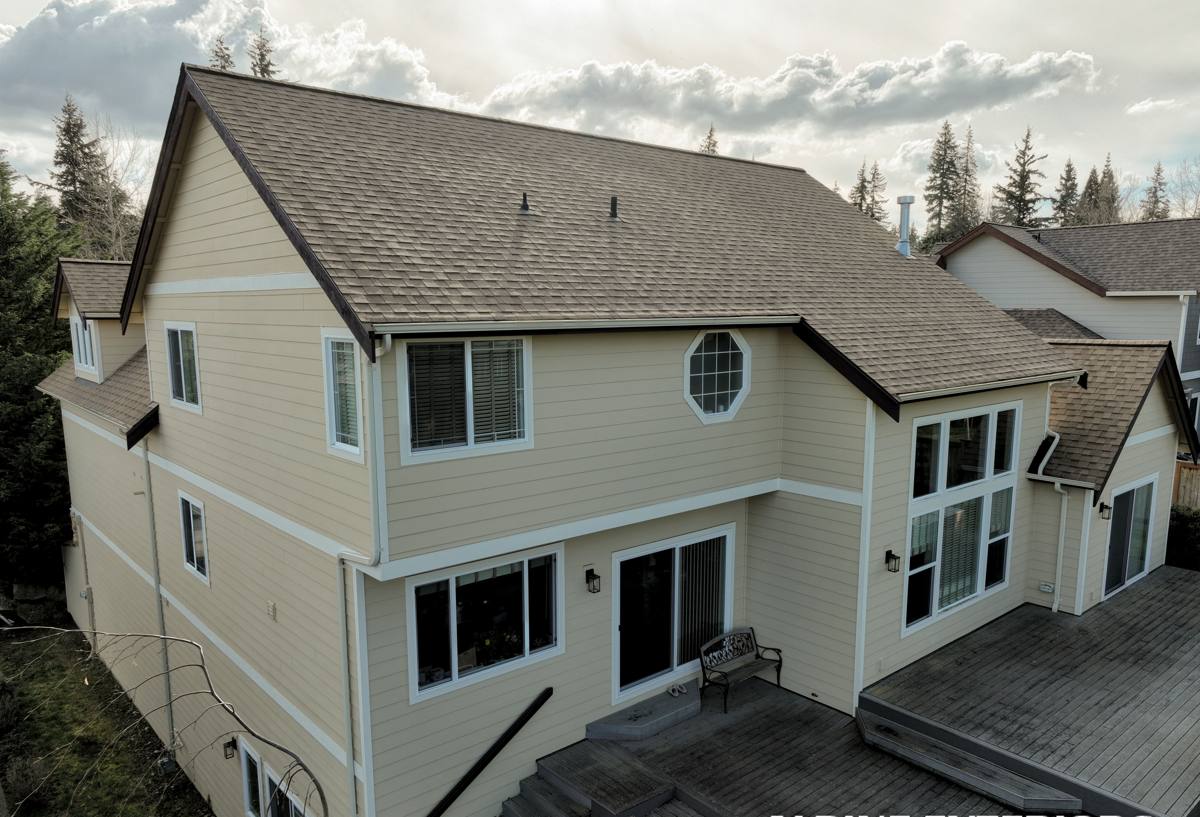
Given all that, the material itself has to do three things well: resist moisture intrusion at the board level, hold a finish without cracking or peeling as it swells and dries with the seasons, and stay dimensionally stable enough that seams and caulk lines don't open up over time. This is why we install James Hardie fiber cement exclusively and don't offer vinyl, LP SmartSide, Cemplank, Allura, or bare wood siding as alternatives on Bellingham homes.
How Hardie Fiber Cement Responds to This Environment
- Moisture behavior: Fiber cement doesn't swell, rot, or delaminate the way wood-based or engineered-wood products can when they take on repeated moisture over years of Pacific Northwest rain.
- Non-combustible: Not a climate factor specifically, but relevant anywhere homes sit close to trees and dry summer stretches do occur even in a generally wet region.
- ColorPlus factory finish: A baked-on finish applied under controlled conditions holds color and resists the fading and chalking that field-applied paint struggles with under UV and salt exposure.
- Engineered product lines: James Hardie manufactures siding tuned to different climate zones across the country, and the products specified for marine and coastal Pacific Northwest conditions reflect the moisture and temperature patterns Whatcom County actually sees, rather than a one-size-fits-all board.
Where Installation Quality Matters More Than the Product Label
Fiber cement siding is only as good as the install behind it. We've seen Hardie siding fail early on homes in wet climates like this one — and it's almost never the material. It's gaps, clearances, and flashing details that let water in and then trap it against the wall assembly.
The Details That Actually Prevent Water Damage
- Correct clearance between the bottom of the siding and grade, decks, walkways, and roof lines — Hardie's own installation instructions specify minimums, and Bellingham's rain volume makes ignoring them a real risk, not a technicality.
- Proper lap and butt joint treatment, including factory-primed or ColorPlus-matched caulking rated for exterior movement, not general-purpose caulk that shrinks and cracks within a season or two.
- Correct fastener type and placement — stainless or coated fasteners driven to the manufacturer's pattern, since salt air will find and exploit the wrong hardware over time.
- A functioning drainage plane behind the siding: house wrap or building paper, properly lapped flashing at windows and penetrations, and a rain screen gap where the assembly calls for one, so incidental moisture can actually get out instead of sitting against the sheathing.
- Careful treatment of inside and outside corners, which are the first place a rushed install shows up as a callback a few years later.
None of this is unique to Hardie — it's just that fiber cement rewards a correct install and is unforgiving of a sloppy one, which is why we treat the installation crew's experience as seriously as the product spec.
Moss, Algae, and Long-Term Exterior Maintenance
Even with the right product and a clean install, no siding is maintenance-free in a climate that supports moss growth ten or eleven months a year. What changes with Hardie is how manageable that maintenance is.
What Homeowners Should Expect to Do
- Periodic gentle washing (garden hose and soft brush, or a low-pressure rinse) on shaded, north-facing walls where moss and mildew tend to establish first.
- Keeping vegetation, gutters, and downspouts clear so water isn't sheeting or dripping directly onto siding runs.
- Inspecting caulk joints and trim every couple of years, since caulk is the one component in the assembly that wears out before the siding does.
The ColorPlus finish resists staining better than field paint, and the material itself won't soften or rot if moss holds moisture against it for a while between cleanings — which is the real long-term advantage in a climate like this one.
Comparing Material Choices for a Bellingham Exterior
| Factor | James Hardie Fiber Cement | Vinyl | Engineered Wood (LP-Type) |
|---|---|---|---|
| Moisture / rot resistance | High — non-organic, engineered core | High, but can warp/buckle with temperature swings | Moderate — vulnerable at cut edges and joints |
| Salt air / coastal durability | Strong; factory finish holds up well | Can chalk, fade, and become brittle over time | Finish and substrate both degrade faster near salt exposure |
| Fire resistance | Non-combustible | Melts/deforms under heat | Combustible |
| Finish longevity | Factory ColorPlus, long repaint interval | Color molded in, but fades and can't be easily matched | Field-applied paint, shorter repaint cycle |
| Long-term maintenance | Periodic washing, occasional caulk check | Low, but limited repair options if damaged | Requires more diligent moisture/paint upkeep |
What Drives the Cost of a Bellingham Hardie Install
| Cost Factor | Why It Matters Here |
|---|---|
| Existing siding removal | Older wood or damaged siding often reveals moisture or sheathing issues common in wet climates, adding scope |
| Wall complexity | Dormers, multiple stories, and cut-up rooflines increase flashing and trim labor |
| Product line and profile | Lap width, shingle-style panels, and trim board selections vary in material cost |
| Color and finish | Standard ColorPlus palette vs. custom color options |
| Site access | Tree-lined lots and tight setbacks common in Bellingham neighborhoods can affect staging and labor time |
We don't publish flat per-square-foot pricing because these factors shift the number meaningfully from house to house — a straightforward single-story re-side and a multi-gable two-story with moisture repairs needed underneath are very different jobs even at similar square footage.
Our Process for a Bellingham Hardie Project
- On-site assessment: We look at the existing siding, wall assembly, and any signs of moisture damage before quoting anything — especially on older homes where the sheathing condition isn't obvious from the street.
- Tear-off and inspection: Once old siding comes off, we check sheathing, house wrap, and flashing at windows and penetrations, and address anything compromised before new material goes up.
- Weather-resistive barrier and drainage plane: Properly lapped and sealed, with a rain screen gap where the wall assembly calls for one — this is the layer doing the real work in a high-rainfall climate.
- Hardie installation to spec: Correct clearances, fastening, and joint treatment, following James Hardie's published installation guidelines rather than shortcuts that might pass a casual glance.
- Trim, caulking, and final detailing: The finish work that determines how the house sheds water at corners, window returns, and transitions for years to come.
Why Local Installation Experience Matters
A crew that has installed Hardie siding on other homes in and around Bellingham already knows how the local wind-driven rain behaves against different wall orientations, which lots tend to hold moss longest, and where Whatcom County's building department tends to focus during inspection. That's not something a crew coming from a drier region picks up on the first job. Getting the flashing and drainage details right the first time matters more here than in a mild, dry climate where a minor gap might never cause a problem — in Bellingham, it usually will, eventually.
A Few Things Worth Checking Before You Hire Anyone
- Ask whether the crew is James Hardie-trained or certified, not just familiar with the product.
- Ask what clearance and flashing standards they follow, and whether they'll walk you through the drainage plane before it's covered up.
- Confirm what's included in the manufacturer's warranty versus the installer's workmanship warranty, and get both in writing.
- Ask how they handle sheathing or moisture issues discovered mid-project — a fair, honest quote should already anticipate this is possible on an older home.
- Get a clear scope of what happens at trim, corners, and transitions, since that's where most long-term problems start.
If you're weighing a siding replacement on a Bellingham home, we're happy to take a look and give you a straightforward, no-pressure assessment of what your house actually needs — no upsell, just an honest read on the work involved. Use the form below to request a free estimate.