 Snohomish
 What Lynden's Weather Does to Siding Over Time
Lynden sits in a part of Whatcom County that gets more moisture exposure than most homeowners realize until they're dealing with a siding problem. Winters bring long stretches of driving rain that hits walls sideways, not just straight down, which pushes water into laps, seams, and trim joints that a lot of siding products aren't built to handle. Add in the salt-laden air that moves inland off the Sound during storm systems, and you've got a combination that accelerates corrosion on fasteners and finishes that aren't rated for a marine-influenced climate.
Then there's moss. Whatcom County's damp, mild winters and shaded lots create a moss season that can run half the year on north-facing walls and anywhere tree cover blocks the sun. Moss holds moisture against a wall long after the rain stops, which is exactly the condition that rots wood-based siding, delaminates weak composite panels, and keeps paint from curing properly. A siding product that can't shrug off sustained dampness is going to show it here faster than it would in a drier climate.
None of this means siding is doomed in Lynden — it means the material and the installation both have to be matched to the conditions instead of picked for the lowest bid.
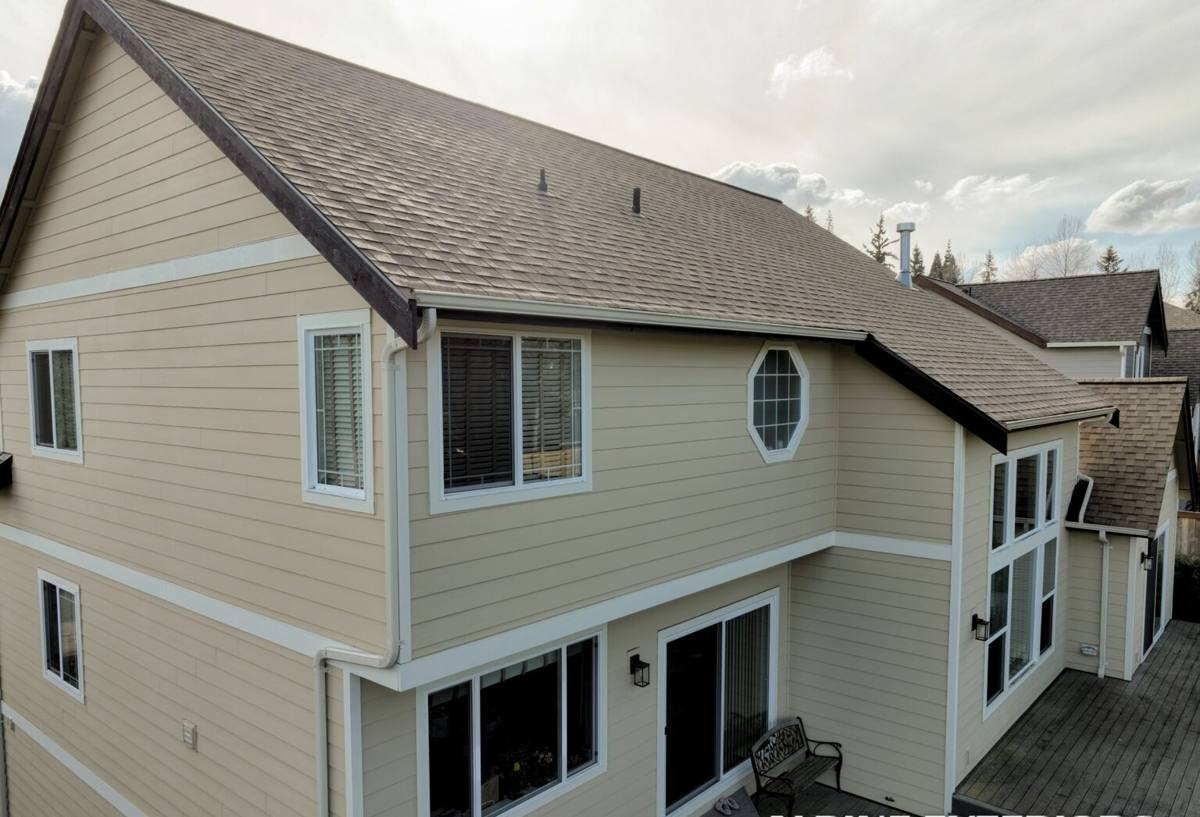
Why Fiber Cement Is the Right Call for This Climate
Fiber cement is cement, sand, and cellulose fiber pressed into a dense, stable board. It doesn't absorb water the way wood or wood-composite products do, it doesn't feed moss and mildew growth the way organic materials can, and it holds paint and factory finishes far longer because the board itself stays dimensionally stable through wet-dry cycles. For a climate that alternates between soaking rain and dry summer stretches, that stability matters more than almost any other property.
It's also non-combustible, which is a real advantage during Washington's dry summer months when wildfire smoke and ember exposure become a regional concern even for homes that aren't near timberland.
We install James Hardie fiber cement exclusively — not because it's the only fiber cement on the market, but because we've made it our standard. Hardie's HZ5 product line is engineered specifically for climates with heavy moisture and freeze-thaw cycling, and the ColorPlus factory finish is baked on under controlled conditions rather than field-applied, which means the color and the moisture barrier go on together instead of being two separate points of failure. We don't install LP SmartSide, vinyl, primed wood, or other fiber cement brands — we'd rather stand behind one system we know inside and out than offer a menu of products with different failure points and warranty terms.
What "HZ5" Actually Means
Hardie rates its siding by climate zone. HZ5 is the formulation built for regions with more moisture and cold exposure — it's engineered for enhanced resistance to moisture-related freeze-thaw damage compared to the standard product line. For a Lynden home taking on wind-driven rain most of the year, that's the correct starting point, not an upgrade.
What a Correct Fiber Cement Job Involves
Fiber cement is only as good as the installation behind it. Most of the siding failures we get called out to inspect aren't the material's fault — they're installation shortcuts that let water in behind a perfectly good board.
- Water-resistive barrier: a continuous, properly lapped weather barrier goes on the wall sheathing before any siding, with all seams taped and penetrations sealed.
- Flashing at every transition: windows, doors, deck ledgers, and roof-to-wall intersections all need step or head flashing that directs water out, not into the wall cavity.
- Correct fastening: Hardie specifies fastener type, spacing, and placement by product line and exposure — corrosion-resistant fasteners driven at the right depth, not overdriven or underdriven.
- Proper clearances: siding held above grade, decks, patios, and roof lines per Hardie's minimum clearances so it never sits in standing water or gets buried under mulch or soil.
- Gapping and caulking done per spec: factory-cut edges get sealed, field cuts get primed, and joints are caulked with a product rated for the movement and moisture involved — not just whatever's on the truck.
Skip any one of these and you can end up with water intrusion behind siding that still looks fine from the curb — which is a worse outcome than obvious damage, because it goes undetected until sheathing or framing is already compromised.
Fiber Cement vs. Other Siding Options in a Climate Like This
| Factor | Fiber Cement (James Hardie) | Vinyl | Wood / Primed Composite |
|---|---|---|---|
| Moisture resistance | High — cement-based, doesn't absorb water | Moderate — seams and gaps can trap moisture behind panels | Low to moderate — vulnerable to swelling and rot at cut edges |
| Moss/mildew resistance | High — inorganic surface doesn't feed growth | Moderate — surface can host mildew in shaded, damp areas | Low — organic material, prime moss and rot target |
| Finish durability | Factory-baked ColorPlus finish, long fade resistance | Color molded through, but can fade and chalk over time | Field-applied paint, needs recoating on a shorter cycle |
| Fire resistance | Non-combustible | Combustible, can melt/deform near heat sources | Combustible |
| Typical lifespan when installed to spec | Multiple decades | 15–25 years | Varies widely, often shorter with high moisture exposure |
This isn't a knock on every other product on the market — vinyl and wood both have legitimate uses and price points. It's why, for the moisture and moss conditions Lynden homes deal with, we've standardized on one material we can install and warranty with confidence rather than juggling several with different long-term behavior.
How We Approach a Lynden Siding Job
1. Inspection and Scope
We start by walking the exterior and checking for existing moisture damage, especially at trim, corners, and anywhere moss or algae has taken hold. This tells us whether we're dealing with a straightforward re-side or whether sheathing repair needs to happen first.
2. Prep and Weather Barrier
Old siding comes off, damaged sheathing gets replaced, and a continuous weather-resistive barrier goes on with every seam and penetration properly sealed before a single piece of Hardie board goes up.
3. Installation to Manufacturer Spec
Flashing, fastener spacing, clearances, and joint treatment all follow Hardie's published installation requirements — not a generalized "how we've always done it" approach. This is also what keeps the manufacturer's warranty intact.
4. Finish and Walkthrough
Caulking, touch-up, and a final walkthrough where we point out anything a homeowner should keep an eye on going forward — not just hand over an invoice and leave.
Why a Crew That Already Works Lynden Matters
Siding work in this area means accounting for things a crew unfamiliar with Whatcom County might not think about — scheduling around the wetter months, knowing which wall orientations on a given lot are going to hold moisture and moss the longest, and understanding that a "good enough" flashing detail in a drier climate isn't good enough here. A crew that's done this work in the area repeatedly has already made the adjustments that come from seeing how houses in this specific climate actually perform over time, rather than applying a one-size-fits-all install method.
It also matters for warranty support. If a question comes up two, five, or ten years down the line, you want a contractor who's still local, still doing this work, and still standing behind the installation — not a crew that moved on after one job.
Maintenance: What Lynden Homeowners Should Actually Check
- Rinse siding annually, focusing on north-facing and shaded walls where moss and algae build up fastest.
- Trim back vegetation and tree limbs that keep siding shaded and damp longer than the rest of the house.
- Check caulking at window and door trim yearly — this is the first place a small gap turns into a moisture path.
- Look at grade and mulch lines each spring to make sure soil or landscaping hasn't crept up over the siding's bottom clearance.
- After major windstorms, walk the exterior for any loose trim, dented corners, or gutter issues that could be directing water onto a wall it shouldn't hit.
Fiber cement done right needs far less attention than wood, but "far less" isn't "none" — a few minutes a couple times a year keeps small issues from becoming siding replacement issues.
Let's Talk About Your Project
If your Lynden home's siding is showing moss staining, cracked or peeling trim, or you're just planning ahead for a replacement, we're happy to take a look and walk you through what we'd actually recommend for your walls and exposure — no pressure, no generic sales pitch. Use the form below to request a free estimate.