 Snohomish
 Why Bellingham's Climate Is Hard on Roofs
Bellingham sits right on the water, and that proximity to Bellingham Bay and the Salish Sea shapes almost every roof problem we get called out for. Salt-laden air accelerates corrosion on exposed metal flashing, fasteners, and vent caps. Wind off the water drives rain sideways instead of straight down, which pushes moisture into laps, seams, and transitions that were never designed to handle water moving uphill. And Whatcom County's long, mild, wet winters mean moss and algae have months on end to take hold on north-facing slopes and shaded valleys.
None of this means a Bellingham roof is doomed — it means the details that get skipped on a quick patch job matter more here than they do in drier parts of the state. A repair that would hold up fine in eastern Washington can fail in two winters here if the flashing, fastener choice, or underlayment isn't suited to constant damp and salt exposure.
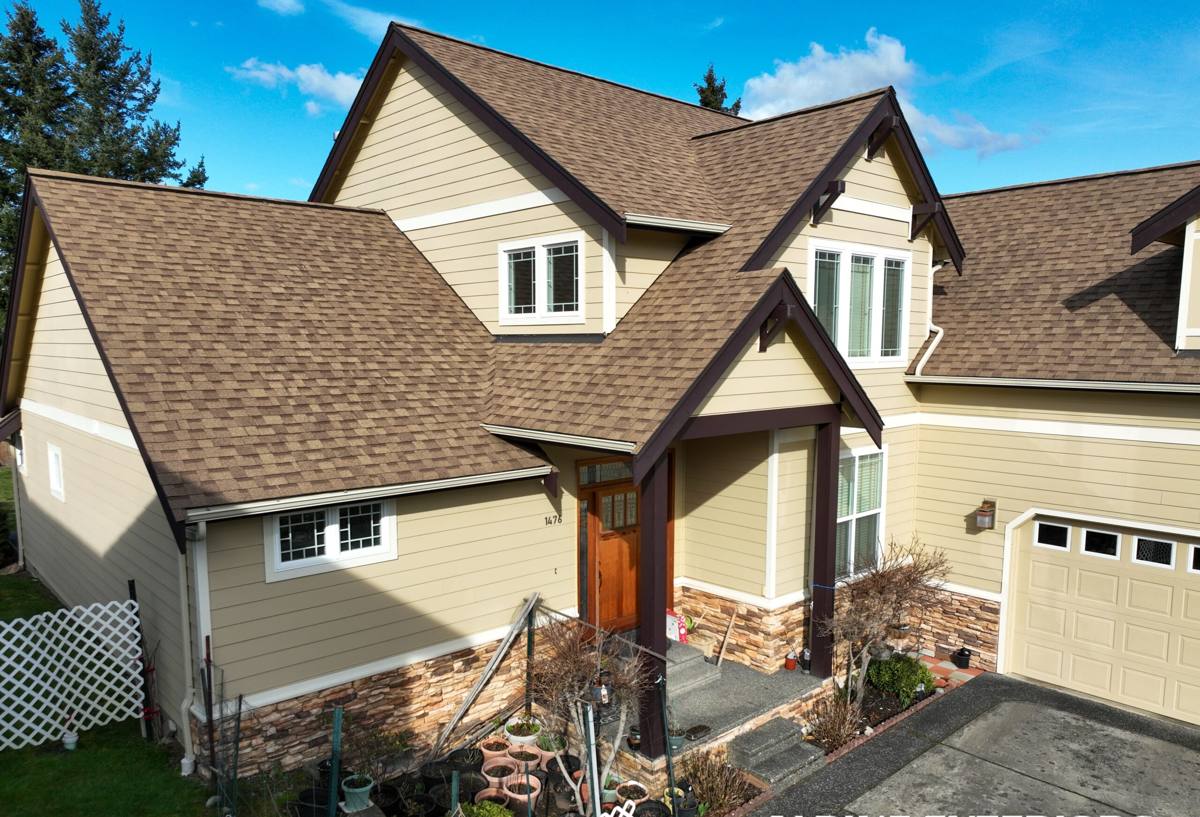
The Roof Repair Problems We See Most Often
Moss and Organic Growth
Moss doesn't just look bad — it holds moisture against the roof surface, lifts shingle edges as it grows, and works its way under laps over time. By the time you can see it from the ground, it's often been established for a season or more. Left alone long enough, moss growth turns a simple cleaning job into a repair job.
Flashing Failures
Flashing — the metal that seals roof penetrations and transitions — is the single most common source of leaks we diagnose. Chimneys, skylights, plumbing vents, and valleys all rely on flashing that's lapped correctly and sealed with materials that hold up to constant wet-dry cycling. Salt air speeds up corrosion on lower-grade metal and fasteners, so flashing that was installed without the coastal climate in mind tends to fail earlier here than inland.
Wind-Driven Rain Intrusion
Storms coming off the water don't just drop rain — they push it. Wind-driven rain finds gaps that would never leak in calm weather: under shingle tabs with weak sealant bonds, around loose ridge caps, and at wall-roof intersections where the seal has started to open up.
Attic Condensation and Ventilation
Not every "leak" is a leak. In a lot of older Bellingham homes, what looks like a roof leak is actually moisture from poor attic ventilation condensing on the underside of the roof deck and dripping down. Fixing the wrong thing — patching a roof that's actually fine — wastes money and leaves the real problem untouched.
Where Roofing and Siding Repair Overlap
Because we're a siding contractor first, we spend a lot of time at exactly the spot where roofing problems actually start: the wall-to-roof intersection. A surprising number of "roof" leaks in Bellingham trace back to siding and trim details, not the shingles themselves.
- Kickout flashing — the small diverter that redirects roof runoff away from a wall instead of behind the siding. When it's missing or undersized, water runs straight down inside the wall assembly.
- Step flashing behind siding — where a roof meets a sidewall, each course of step flashing needs to be woven correctly behind the siding, not just caulked at the surface.
- Siding cut too tight to the roofline — siding installed flush against shingles with no clearance traps water and accelerates rot at the bottom courses.
- Trim and fascia board deterioration — moisture-damaged fascia or rake trim often shows up first as a roof edge problem before it's recognized as a siding and trim issue.
A crew that only thinks in terms of shingles can fix the roof and leave the underlying wall detail exactly as broken as it was. Fixing it correctly usually means treating the roof edge and the siding as one system, not two separate trades that don't talk to each other.
What a Correct Roof Repair Actually Involves
A real repair starts with figuring out where the water is actually getting in, which is not always where it shows up inside the house. Water can travel along rafters or sheathing for several feet before it drips somewhere visible. We look at the whole assembly — decking, underlayment, flashing, and the siding-to-roof transition — before we say what needs to happen.
Once the source is confirmed, a correct repair generally includes removing the damaged material back to sound decking (not just covering over a soft spot), replacing underlayment in the affected area, installing new flashing sized and lapped correctly for the location, and matching shingles or roofing material as closely as reasonably possible. Sealant has a place in a repair, but it's a supplement to correct flashing and lapping, not a substitute for it.
Our Roof Repair Process
- Inspection and diagnosis. We look at the roof, the attic side of the deck if accessible, and the siding-to-roof transitions before quoting anything.
- Written scope. You get a clear explanation of what's actually failing, what we plan to do about it, and what it will cost — before any work starts.
- Repair. We remove damaged material back to sound substrate, correct the flashing detail, and replace roofing material to match as closely as possible.
- Cleanup and check. Debris and old material are removed, and we walk the repair area with you before we consider the job done.
Repair or Replace? How We Help You Decide
Not every roof problem needs a full replacement, and not every leak can be permanently solved with a patch. These are the factors that actually drive that decision:
| Factor | Points Toward Repair | Points Toward Replacement |
|---|---|---|
| Roof age | Well within expected lifespan | At or past the end of its service life |
| Extent of damage | Isolated to one area (a valley, a vent, a chimney) | Multiple areas failing independently |
| Decking condition | Sound, dry sheathing under the damaged spot | Soft, delaminated, or rotted decking |
| Granule loss / shingle condition | Localized wear | Widespread granule loss across the field |
| History of repairs | First or second repair on this roof | Repeated repairs in the same area |
Isolated flashing or shingle repairs on a Bellingham home are often in the low hundreds to roughly $1,500, depending on access and the extent of decking replacement needed. Larger repairs involving multiple areas or significant decking work can run higher. We'll always give you a specific number after we've actually looked at the roof — broad ranges aren't a substitute for an inspection.
Materials We Use — and the Trade-Offs We're Honest About
For repairs, matching your existing roofing material as closely as possible matters more than it might seem — mismatched shingles are one of the most common complaints we hear about other contractors' patch jobs. We use self-adhered flashing membrane at vulnerable transitions (valleys, chimneys, skylights) rather than relying on sealant alone, because membrane holds up to the wet-dry cycling of a marine climate far better than caulk does on its own over time.
Where a flashing detail was clearly undersized or the wrong profile for the location — which we see fairly often on older homes here — our standard is to correct the detail to the right size and lap, not just replace it in kind. It costs a little more up front than a like-for-like swap, but re-doing the same failure point a second time costs more in the long run.
Keeping a Bellingham Roof Healthy Between Repairs
A repair holds up longer when the roof around it is maintained. Whatcom County's long moss season rewards a bit of routine attention:
- Have moss and algae growth addressed before it visibly lifts shingle edges, not after
- Keep gutters and downspouts clear so water isn't backing up under the roof edge
- Check attic ventilation if you notice condensation, musty smells, or dark staining on the underside of the deck
- Have flashing at chimneys, skylights, and sidewalls inspected every couple of years, especially on homes over 10-15 years old
- Look at the siding-to-roof transition, not just the shingles, when checking for leak risk
Why It Matters That We Already Work in Bellingham
Roof and siding problems here follow patterns that are specific to a marine climate — which flashing details fail first, how fast moss re-establishes on a shaded slope, which wall-roof transitions leak on the housing stock common to this area. A crew that already does this work in Bellingham has seen those patterns repeatedly and knows what to check first instead of guessing. We're also close enough to come back for a warranty check or a follow-up look without treating it as a special trip.
If you've got a roof leak, moss buildup, or a spot where the siding meets the roofline that doesn't look right, we're glad to take a look. Fill out the form below for a free, no-pressure estimate.