 Snohomish
 Roofing for Clearview's Wet, Wooded Climate
Clearview sits in the kind of Snohomish County landscape that's hard on roofs: big fir and cedar canopies, long stretches of overcast drizzle, and a wet season that can run from October well into May. None of that is exotic weather, but it's relentless. A roof here doesn't fail because of one dramatic storm — it fails slowly, from months of standing moisture, shaded moss growth, and wind-driven rain finding the one seam that wasn't sealed right the first time.
Asphalt shingle roofing remains the most practical choice for the large majority of homes in this area, but "asphalt shingles" covers a wide range of quality, and installation matters as much as the product itself. This page is about what a correct asphalt shingle roof looks like specifically for a Clearview property — not a generic overview of roofing in general.
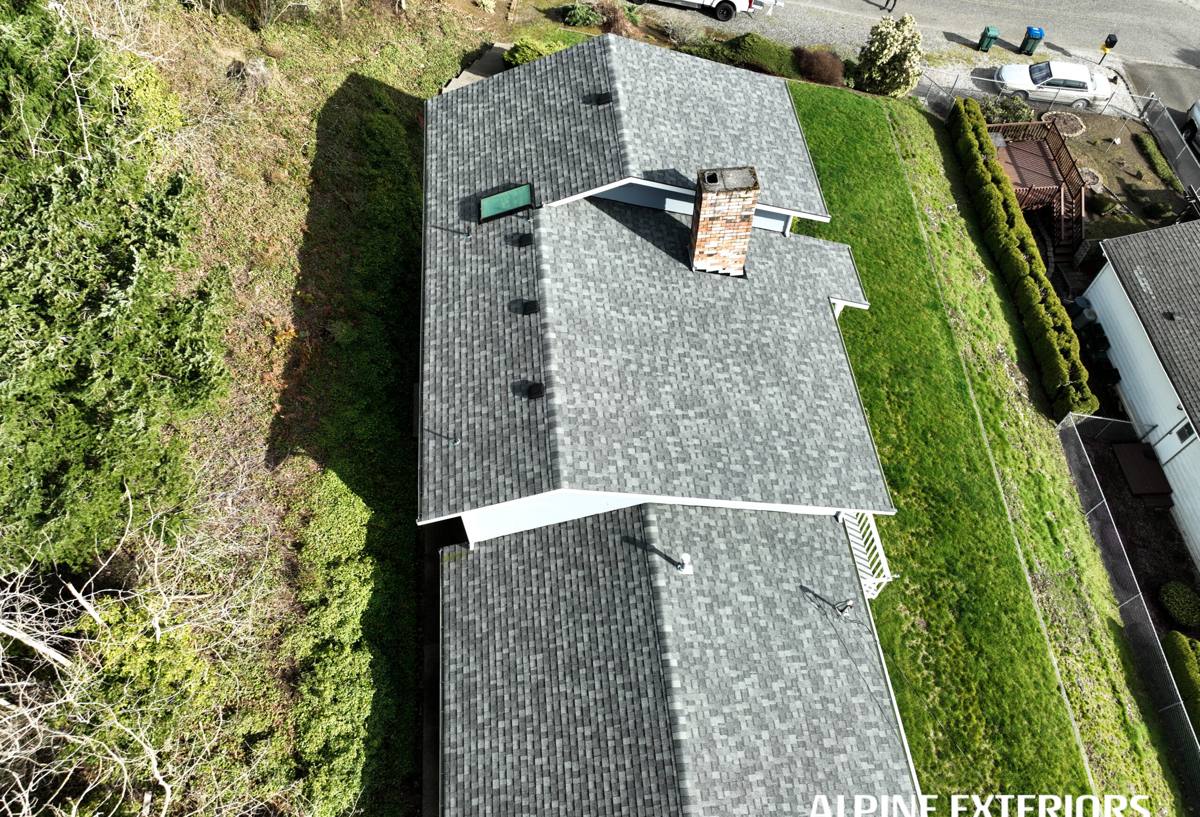
Why Asphalt Shingles Still Make Sense Here
Homeowners sometimes ask whether a different roofing material would hold up better against western Washington moisture. For most residential structures in Clearview, a well-installed architectural asphalt shingle system is the right balance of cost, durability, and repairability. It performs well in sustained rain when the underlayment and flashing are done correctly, it's compatible with the steep and moderate roof pitches common on homes out here, and if a section is ever damaged by a falling limb — not unusual under a heavy tree canopy — it can be repaired without replacing the whole roof.
The trade-off is that asphalt shingles are more installation-sensitive than some alternatives. A roof that's cut corners on ventilation or flashing will show problems within a few wet seasons, while the same shingle installed correctly can go the distance. That's the gap we focus on closing.
Where Asphalt Falls Short (and How We Handle It)
We won't tell a homeowner asphalt shingles are maintenance-free — they aren't. Shaded, moss-prone roof planes need periodic attention, and low-slope sections (below what most shingle manufacturers rate for warranty coverage) need a different approach entirely, usually a membrane transition rather than shingles pushed past their design limits. We'll tell you plainly if a section of your roof isn't a good candidate for asphalt shingles rather than installing them anyway and letting the warranty lapse quietly.
What a Correct Installation Actually Involves
A shingle roof is really a system of layers, and driving rain exposes any layer that was shortcut. Here's what we consider non-negotiable on a Clearview job.
Tear-Off and Deck Inspection
We remove the old roofing down to the deck rather than layering over it. That's the only way to actually see the sheathing, catch soft or delaminated spots (common under long-term moss growth or old flashing failures), and confirm the deck can take fasteners properly. Layering over an existing roof hides problems instead of fixing them and shortens the life of the new shingles.
Underlayment and Ice-and-Water Protection
Synthetic underlayment goes down as the primary water barrier beneath the shingles. In valleys, around roof penetrations, and at eave edges — the spots most exposed to wind-driven rain and the ponding that follows heavy moss buildup — we add a self-adhering ice-and-water membrane. Snohomish County doesn't get the hard freeze-thaw cycling that "ice and water shield" was originally named for, but the same membrane is exactly what stops driving rain from working backward under a shingle edge, which is the more relevant risk here.
Ventilation Balance
This is the step most often skipped, and it's the one that shortens shingle life the fastest in a marine climate. A roof needs balanced intake at the soffits and exhaust at the ridge so moisture-laden attic air actually moves instead of condensing against the underside of the deck. Get this wrong and you can see premature shingle deterioration and deck rot from the inside, even with a perfect exterior installation. We calculate intake and exhaust ventilation together rather than treating them as separate line items.
Flashing at Every Transition
Chimneys, skylights, sidewalls, and valleys are where roofs actually leak — rarely the open shingle field. We use new step and counter-flashing at wall intersections rather than reusing old flashing or relying on caulk, and valleys get either a metal open-valley detail or a properly woven closed-cut installation, matched to the shingle manufacturer's specification.
Shingle Installation
Correct nail placement (not staples), the manufacturer's specified nailing pattern for wind exposure, and starter strip at eaves and rakes to prevent wind lift at the edges — these are basic requirements, but they're also the details that get rushed on a crew trying to move fast. We follow the manufacturer's installation instructions to the letter, which is also what keeps the manufacturer's warranty valid if you ever need to make a claim.
Moss, Algae, and the Long Game
Under a tree canopy, moss and algae aren't a cosmetic issue — they're a moisture-retention issue. Moss holds water against the shingle surface and can work granules loose over time, and heavy growth in valleys and at butt joints can back water up under shingles during hard rain. Most shingle manufacturers now offer algae-resistant (AR) shingles with copper- or zinc-infused granules built into the product, which is worth specifying on any Clearview roof with significant shade.
AR shingles reduce algae staining and slow moss colonization, but they don't eliminate the need for maintenance. A shaded roof still benefits from periodic soft washing (never pressure washing, which strips granules) and keeping gutters and valleys clear so water isn't sitting against the shingles longer than it needs to.
Choosing the Right Shingle for a Clearview Home
Shingle products fall into a few tiers. The right one depends on your roof's exposure, pitch, and how long you plan to be in the home.
| Shingle Type | Typical Lifespan | Best Fit For | Considerations |
|---|---|---|---|
| 3-tab shingle | 15-20 years | Budget-driven projects, secondary structures | Lower wind rating; less algae resistance available; thinner profile shows roof lines more |
| Architectural / laminate | 25-30 years | Most Clearview homes | Better wind and impact rating; widely available with AR granules; dimensional look |
| Premium / designer laminate | 30+ years | Steep, highly visible rooflines | Heavier, more moss/algae-resistant options, longer manufacturer warranties; higher material cost |
For most Clearview properties under tree cover, we recommend at minimum an architectural shingle with algae-resistant granules — the marginal cost over a 3-tab shingle is small relative to the maintenance it saves over the life of the roof.
Our Process
- On-site assessment — we walk the roof (not just the ground), check the deck condition where visible, note ventilation setup, and measure exposure and pitch.
- Written estimate — a clear scope covering tear-off, underlayment, flashing, ventilation work, and shingle product, with no vague allowances.
- Scheduling around weather — we plan tear-off in manageable sections and keep the deck protected if conditions turn, rather than leaving a home exposed overnight.
- Installation — deck inspection, underlayment, flashing, ventilation, and shingles installed to manufacturer specification.
- Cleanup and walkthrough — magnetic sweep for nails, debris removal, and a final walk-through so you know what was done and what to watch for going forward.
Signs Your Clearview Roof Needs Attention
- Granules collecting in gutters or at downspout outlets
- Moss visible on north-facing or heavily shaded roof planes
- Shingles that look curled, cupped, or lifted at the edges
- Dark streaking that doesn't wash off with light rain
- Any soft spots or sagging felt when walking the attic floor beneath the roof deck
- Daylight visible through the roof deck from inside the attic
- A roof approaching or past 20 years old with no major work done
Any one of these on its own isn't necessarily an emergency, but they're worth a professional look before the next wet season rather than after a leak shows up on a ceiling.
Why Local Experience in Clearview Matters
A crew that regularly works this part of Snohomish County already knows what a heavily treed, moisture-heavy roof needs before they climb the ladder — how much shade exposure to expect, how moss tends to establish on local roof pitches, and what ventilation setups actually hold up through a full wet season rather than just looking correct on installation day. That familiarity shows up in fewer surprises mid-project and a roof that's specified correctly the first time, instead of a generic install that needs revisiting in a few years.
It also means straightforward answers. If a section of your roof doesn't need full replacement, we'll say so. If your ventilation setup is the real problem rather than the shingles themselves, we'll say that too.
If you're weighing a repair against a full replacement, or just want an honest read on how much life is left in your current roof, we're glad to take a look. Fill out the form below for a free, no-pressure estimate.