 Snohomish
 What Mill Creek's Climate Actually Does to Siding
Mill Creek sits inland from Puget Sound, but it doesn't escape the weather pattern that defines this part of Snohomish County. Long stretches of wet, mild weather from fall through spring, driving rain that comes in sideways during winter storms, and a marine air layer that keeps everything a little damp even on "dry" days — that combination is what siding here actually has to survive, not just look good against. Homes that were sided decades ago, or sided cheaply, tend to show the damage in predictable places: north-facing walls, areas under overhangs that never quite dry out, and anywhere caulk or paint has started to give.
Moisture First, Everything Else Second
Every siding decision in this region should start with moisture, not color or texture. Western Washington doesn't get brutal freezes very often, but it gets months of sustained dampness, and that's a harder test for a wall system than a hard freeze ever is. Wood-based sidings absorb moisture and swell; the swelling and drying cycle is what eventually causes cupping, splitting, and paint failure. Fiber cement doesn't absorb water the way wood or wood-composite products do, which is a big part of why it's become the standard material for homes in this climate.
Salt Air Off the Sound
Even communities set back from the waterfront get a dose of the marine air that moves through Puget Sound country. That air carries moisture and trace salt that accelerates corrosion on exposed metal — nail heads, flashing, hose bibs, light fixtures — and it's part of why fastener choice and flashing detail matter as much as the siding panel itself. A siding job that ignores this and uses the wrong fasteners will show rust streaks bleeding through the finish within a few years, regardless of how good the panel material is.
The Moss Season Nobody Talks About
Snohomish County's long wet season is also a long moss and algae season. Moss doesn't just grow on roofs — it takes hold on siding, especially in shaded areas, under trees, and on the north and west walls that stay damp longest. On wood siding, trapped moss holds moisture against the surface and speeds up rot underneath. On a properly installed fiber cement wall, moss can still grow on the surface, but it isn't feeding decay into the substrate the way it can with wood, because the material itself doesn't rot.
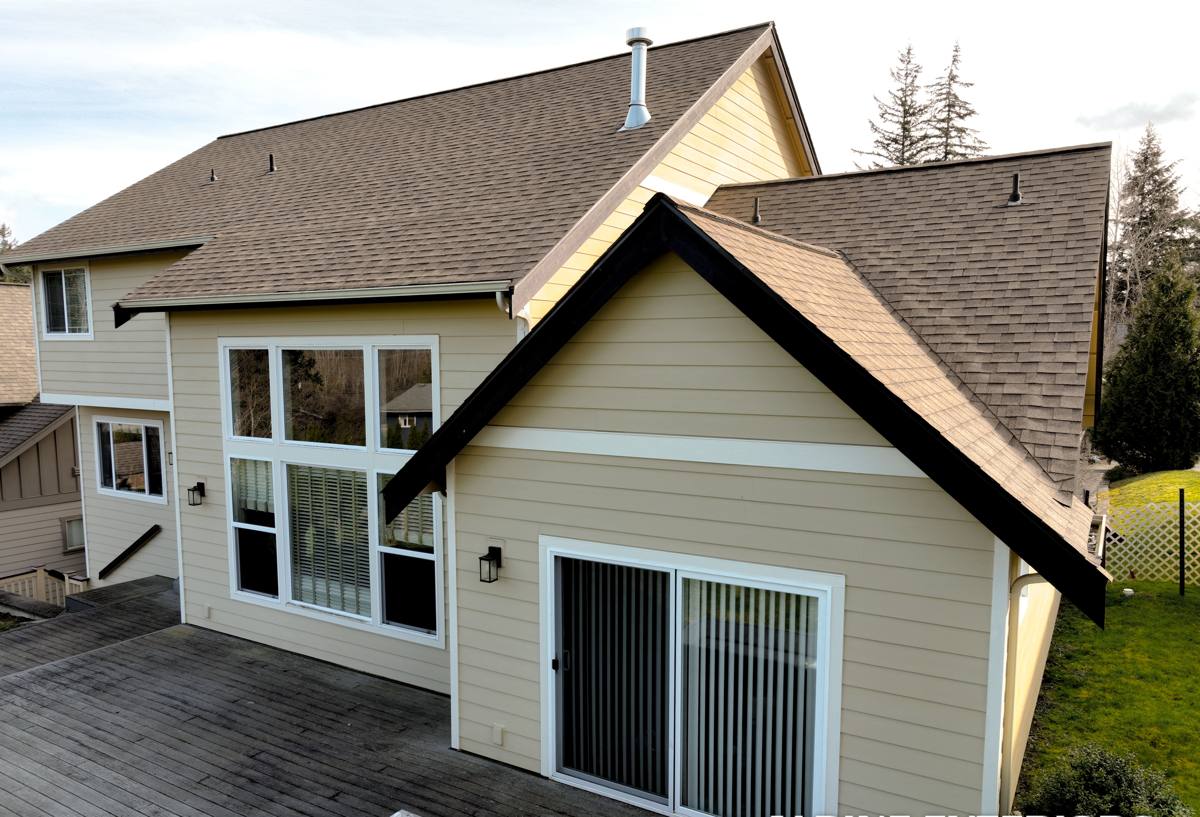
Why Fiber Cement Is the Right Material for This Area
Fiber cement is cement, sand, and cellulose fiber formed under pressure into planks and panels. It doesn't expand and contract with humidity the way wood does, it doesn't feed insects, and it doesn't burn. For a climate that stays damp for months at a time, that combination of moisture stability and rot resistance is the whole ballgame.
Dimensional Stability
Wood siding moves. It swells when it's wet and shrinks when it dries, and over years that movement works caulk joints loose, opens seams, and telegraphs through paint as hairline cracking. Fiber cement holds its dimensions through the wet-dry cycle far better, which means joints and caulk lines stay tighter for longer and paint failure at the seams is much less common.
A Factory Finish That Doesn't Depend on a Painter's Timing
A field-painted siding job is only as good as the weather window it was painted in and the prep work underneath it. James Hardie's ColorPlus factory finish is baked on under controlled conditions before the boards ever reach the jobsite, which removes that variable entirely and gives a more consistent, longer-lasting finish than most site-applied paint jobs can match in this climate.
What a Correct Fiber Cement Installation Actually Involves
Fiber cement is only as good as the wall assembly behind it. A lot of the failures people blame on "the siding" are actually failures of the water-resistive barrier, the flashing, or the fastening — not the panel material.
The Water-Resistive Barrier and Drainage Plane
Behind every Hardie installation should be a continuous, properly lapped weather-resistive barrier, and in most cases a drainage gap that lets any moisture that does get behind the siding drain and dry out instead of sitting against the sheathing. In a climate that stays wet as long as this one does, that drainage plane is doing real work, not just satisfying a code checkbox.
Fastening, Clearances, and Flashing
James Hardie publishes specific fastener types, spacing, and penetration requirements, and specific clearances from grade, roof lines, and decks. Skipping those specs is the single most common way a Hardie job fails early — not because the product is fragile, but because the installation didn't follow it. Flashing at windows, doors, and horizontal trim needs to shed water outward at every step, especially given how much horizontal, wind-driven rain this area gets in winter.
- Continuous, properly lapped weather-resistive barrier with no gaps at penetrations
- Drainage gap or rain-screen furring where the wall assembly calls for it
- Corrosion-resistant fasteners driven to Hardie's specified pattern and depth
- Correct clearance from grade, roofing, decks, and patios
- Flashing installed to shed water at every window, door, and trim transition
- Caulk only at joints Hardie specifies — not as a substitute for proper flashing
- Factory-cut and factory-primed edges maintained, field cuts sealed per spec
Why We Install Only James Hardie
We don't install LP SmartSide, vinyl, or other fiber cement brands, and that's a deliberate standard, not an oversight. James Hardie engineers its HZ5 product line specifically for climate zones like this one — the freeze-thaw and moisture exposure common to the Pacific Northwest — and backs it with a strong, transferable warranty that assumes correct installation to their spec. Standardizing on one manufacturer also means our crew isn't guessing at install details from job to job; we know this product's requirements cold, which matters more in a wet climate than in a dry one.
Fiber Cement vs. the Alternatives Homeowners Ask About
| Factor | James Hardie Fiber Cement | Vinyl Siding | Wood / Engineered Wood |
|---|---|---|---|
| Moisture behavior | Doesn't absorb or swell; stable through wet season | Doesn't absorb, but can warp or buckle in heat/cold cycling | Absorbs moisture; prone to swelling, cupping, rot |
| Finish durability | Factory-baked ColorPlus finish, long fade resistance | Color molded through, but can fade and chalk over time | Field-painted; repaint cycle every few years |
| Fire resistance | Non-combustible | Combustible, can melt or deform near heat | Combustible |
| Pest/rot resistance | Not a food source for insects or fungus | Not a food source, but trapped moisture behind it can rot sheathing | Vulnerable to rot and insect damage |
| Typical lifespan (installed to spec) | Multiple decades with proper maintenance | Multiple decades, but brittle with age | Shorter without diligent, repeated maintenance |
Our Process on a Mill Creek Job
Site Visit and Assessment
We start by looking at the whole wall system, not just the visible siding — checking for soft spots, existing moisture damage, trim condition, and how the roof and gutters are managing water around the house. That tells us whether this is a straightforward re-side or whether there's sheathing repair to price in first.
Tear-Off and Prep
Old siding comes off, any damaged sheathing gets replaced, and the weather-resistive barrier goes on correctly the first time — lapped and sealed at every seam and penetration. This is the step that's invisible once the job is done and the one that determines how the house performs in ten years, not two.
Installation and Final Inspection
Panels and trim go on to Hardie's fastening and clearance specs, flashing is set at every transition, and we walk the finished job checking joints, caulk lines, and clearances before we call it done. In a climate this wet, a rushed final inspection is how small gaps turn into callbacks two winters later.
Why Hiring a Crew That Already Works This Area Matters
A crew that installs siding across Snohomish County day in and day out already knows how the local rain moves across a wall, which orientations take the worst of it, and where moss and staining show up first. That's not something a crew based somewhere with a very different climate picks up quickly. It also means faster, more realistic scheduling around actual local weather windows instead of a generic install calendar, and a crew that's already sorted out permitting and inspection expectations with the local jurisdiction instead of learning them on your project.
Living With Fiber Cement Siding in This Climate
Fiber cement is low-maintenance, not zero-maintenance. In a climate with this much moss and moisture, a little seasonal attention protects the investment:
- Rinse siding periodically to keep moss and algae from building up, especially on shaded north and west walls
- Keep gutters clear so overflow doesn't run down the wall face repeatedly
- Keep plantings and mulch beds pulled back from the bottom clearance line
- Inspect caulk joints every couple of years and have any that have failed replaced promptly
- Address any impact damage or chipped finish quickly so moisture can't get behind the panel
None of this is heavy lifting, but skipping it in a climate this wet is how small issues turn into bigger ones.
If you're weighing a re-side in Mill Creek or elsewhere around Snohomish, we're happy to walk your home, point out what your walls are actually dealing with, and give you a straight, no-pressure estimate for doing it right the first time. There's a form below to get that conversation started.