 Snohomish
 Lynden's Weather Is Hard on a Roof — Here's Why
Lynden sits close enough to the Salish Sea and Bellingham Bay that homes here regularly catch salt-laden marine air, and the Nooksack lowlands funnel a lot of wind-driven rain through the area during fall and winter storm systems. Add in the mature conifers common on many lots, the shade they throw, and the long stretch of damp, low-sun months, and you get conditions that are genuinely tough on a roof: corrosion-friendly air, water that doesn't just fall straight down, and a moss season that can run half the year if a roof surface stays shaded and wet long enough.
None of that is unique to Lynden — it's a pattern across Whatcom County and much of Western Washington — but it does mean a roof that performs fine in a drier, inland climate can struggle here. Our crews work this region regularly, and the roofs we get called out to repair almost always show the same handful of failure points: lifted shingle edges from trapped moisture, corroded fasteners, and flashing that was never detailed for horizontal rain in the first place.
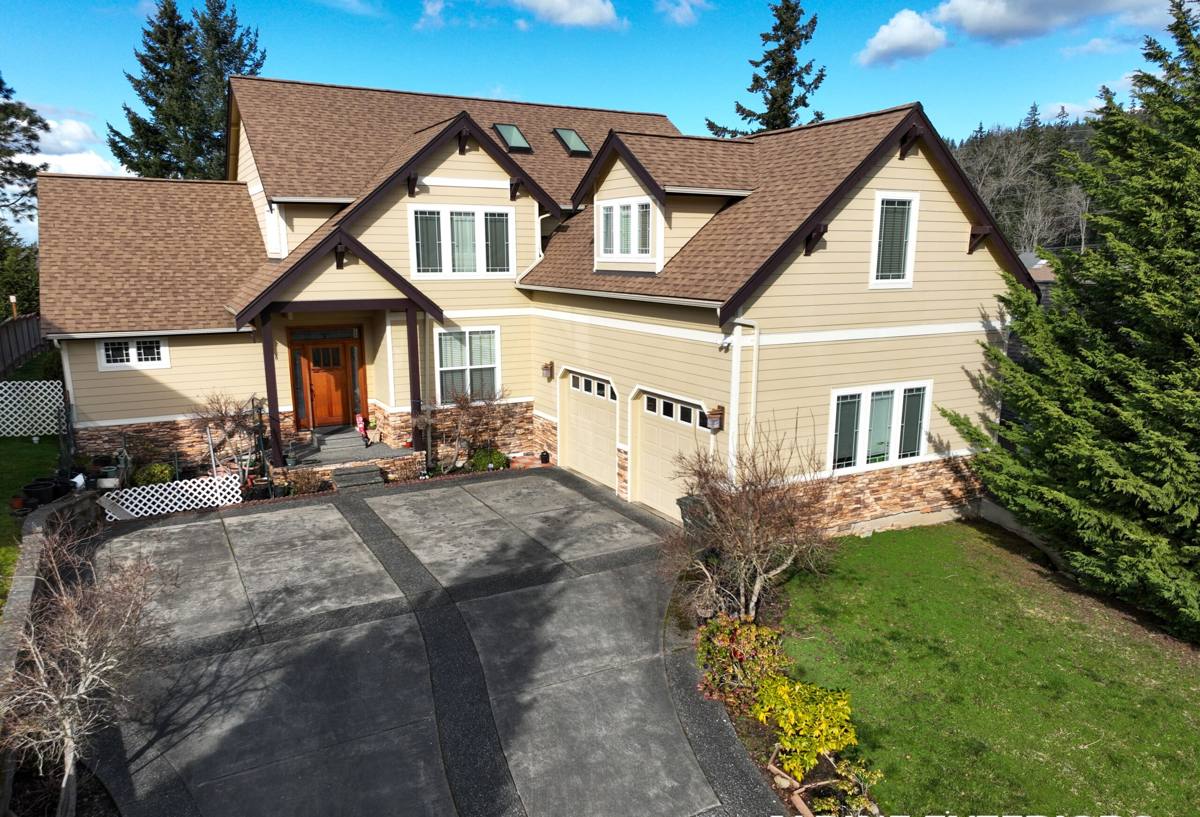
What Driving Rain, Salt Air, and Moss Actually Do to a Roof
Wind-Driven Rain
Rain that comes in at an angle behaves differently than rain falling straight down. It gets pushed up and under shingle laps, around fastener heads, and into any gap in flashing that was sized for gravity alone. A roof can look fine from the ground and still be taking on water at every storm from a detail that was never built for sideways rain.
Salt Air and Corrosion
Marine air carries fine salt that accelerates corrosion on exposed metal — fastener heads, cut panel edges, cheap coatings. The closer a home sits to open water, the more this matters, and it's one of the main reasons the choice of metal alloy and coating isn't a cosmetic decision here; it's a durability one.
Moss and Trapped Moisture
Moss needs shade and sustained dampness, and a lot of Lynden properties supply both. On shingle roofs, moss works its way under tabs, lifts edges, and holds water against the roof deck long after the storm has passed. Needle and leaf litter from nearby trees makes it worse by clogging valleys and gutters, which backs water up right where a roof is least able to shed it.
Why Metal Roofing Is a Strong Fit for This Climate
A correctly installed metal roof has real advantages for this exact combination of problems. The factory-applied finish is smooth and non-porous, so moss and algae have almost nothing to grip compared to the textured, granular surface of a shingle mat. Continuous panel runs and properly lapped seams shed wind-driven rain more predictably than a shingle field, and a well-built metal roof simply lasts longer, which means fewer tear-offs and fewer chances for water to find its way in during a roof's lifetime.
It's not automatic, though. Metal roofing is far more installation-sensitive than shingles — panel layout, fastener pattern, and flashing detail all have to be right the first time, because there's less forgiveness for shortcuts. That's the trade-off: a system that performs exceptionally well in this climate when it's done correctly, and one that shows problems fast when it isn't.
| Factor | Metal Roofing | Asphalt Shingles |
|---|---|---|
| Moss/algae resistance | High — smooth coated surface | Lower — granules trap moisture |
| Wind-driven rain performance | Strong, if laps and flashing are correct | Moderate — more failure points |
| Typical service life | Several decades with proper install | Roughly 15–25 years in this climate |
| Ongoing maintenance | Low, with periodic checks | Moss removal and repairs more frequent |
| Upfront cost | Higher | Lower |
Choosing a Metal System for a Lynden Home
Steel vs. Aluminum
Steel — usually galvanized or Galvalume-coated — is the more common and cost-effective choice, and with a good coating it holds up well across most of the area. Aluminum costs more but never rusts, which makes it worth considering for homes with heavier salt exposure closer to open water. The right call depends on how exposed a given property actually is, not a blanket rule for the whole region.
Standing Seam vs. Exposed Fastener
Standing seam panels use concealed clips with no fasteners penetrating the panel face, so there's nothing exposed to work loose, corrode, or need re-sealing over time. Exposed-fastener panels (ribbed or corrugated) cost less upfront but rely on screws with rubber washers that harden and lose their seal over 15–20 years, which means periodic re-torquing or replacement — a real maintenance item in a climate that's wet as often as this one is.
| System | Fasteners | Maintenance | Relative Cost |
|---|---|---|---|
| Standing seam | Concealed clips | Low — minimal upkeep | Higher |
| Exposed fastener | Exposed screws w/ washers | Periodic washer/screw checks | Lower |
What a Correct Metal Roof Installation Involves
Deck and Underlayment
Every job starts with inspecting the existing deck for soft spots or old water damage and repairing what's found before anything goes on top. We use a synthetic or self-adhered underlayment, with extra protection at eaves and valleys where wind-driven rain and ice concentrate — that layer is the backup plan if anything ever gets past the panels.
Flashing and Penetrations
Step flashing at walls, proper closures at ridges and eaves, and pipe boots rated for the specific panel profile all matter more than the panels themselves in a lot of failures we see. A generic flashing detail that wasn't built for the actual roof geometry is one of the most common leak points on any roof, metal or not.
Fastening and Expansion
Metal panels expand and contract with temperature swings, and standing seam systems use floating clips specifically to allow that movement without stressing the seams. Fastener spacing, screw type, and torque all have to match the panel gauge — over-driven screws crush washers and under-driven ones leak, and both are common signs of a rushed install.
How Our Process Works, Start to Finish
- On-site inspection and measurement of the existing roof and deck condition
- Written estimate outlining panel material, system type, and coating options
- Material order and scheduling once the system is selected
- Tear-off of the old roofing (if applicable) with deck inspection and any needed repair
- Underlayment and flashing installation at all eaves, valleys, and penetrations
- Panel installation with the fastening pattern matched to the system and gauge
- Final walk-through with the homeowner and full site cleanup
- Warranty paperwork and manufacturer registration where applicable
Keeping a Metal Roof Performing Through Moss Season
A properly installed metal roof needs far less attention than shingles, but "low-maintenance" isn't "no-maintenance." A few habits go a long way in this climate:
- Clear gutters and downspouts before the fall rains start, so water has somewhere to go
- Trim back overhanging branches to cut down on shade and debris buildup in valleys
- Rinse accumulated debris off the roof gently — never pressure-wash, which can strip factory coatings
- Check sealant at pipe boots and other penetrations every few years
- On exposed-fastener systems, periodically check screw and washer condition
What Affects the Cost of a Metal Roof in This Area
Costs vary enough by property that we don't quote numbers without seeing the roof, but a few factors consistently move the price:
| Factor | How It Affects Cost |
|---|---|
| Roof pitch and complexity | Steep or cut-up roofs take longer and need more flashing detail |
| Tear-off vs. overlay | Removing old roofing adds labor and disposal cost |
| Panel material | Aluminum costs more than steel but resists corrosion better |
| System type | Standing seam costs more per square than exposed-fastener panel |
| Access and staging | Tree cover, tight lots, or multiple stories add setup time |
In general, a full metal roof replacement on an average Lynden home runs into five figures, with standing seam sitting noticeably above exposed-fastener systems. We'll walk through the actual numbers for your roof once we've seen it — broad ranges aren't much use for planning a real budget.
Why Hire a Crew That Already Works in Lynden
A metal roof is only as good as the details underneath it, and those details change with the site — pitch, exposure, tree cover, how close the property sits to open water. A crew that already works throughout Whatcom County has seen the roof styles and weather patterns common here often enough to catch problems before they're built into the job, rather than learning the area on your roof. We're also familiar with local permitting expectations and can generally get materials and scheduling moving faster than a contractor working the area for the first time.
If you're weighing options for a metal roof in Lynden, we're happy to take a look and put together a straightforward, no-pressure estimate — just fill out the form below.