 Snohomish
 Why Decks in Machias Wear Out Faster Than Homeowners Expect
Machias sits in a pocket of Snohomish County where big trees, low sun angles, and moisture off the Snohomish River and nearby Puget Sound air combine to keep decks damp for long stretches of the year. A deck in a drier inland climate might go a decade before showing real wear. Around here, the same deck is often fighting driving rain for six or seven months straight, plus a moss and algae season that can run from fall through spring. That combination doesn't just make a deck look tired — it works on the wood and hardware from the inside.
Most of the failures we see aren't dramatic. They're slow: a ledger board that's been wicking moisture against the house for years, joist hangers rusting from the inside out, or decking boards that look fine on top but have gone soft and spongy underneath where sun never reaches. By the time it's obviously bad, the structure underneath has usually been compromised longer than the surface let on.
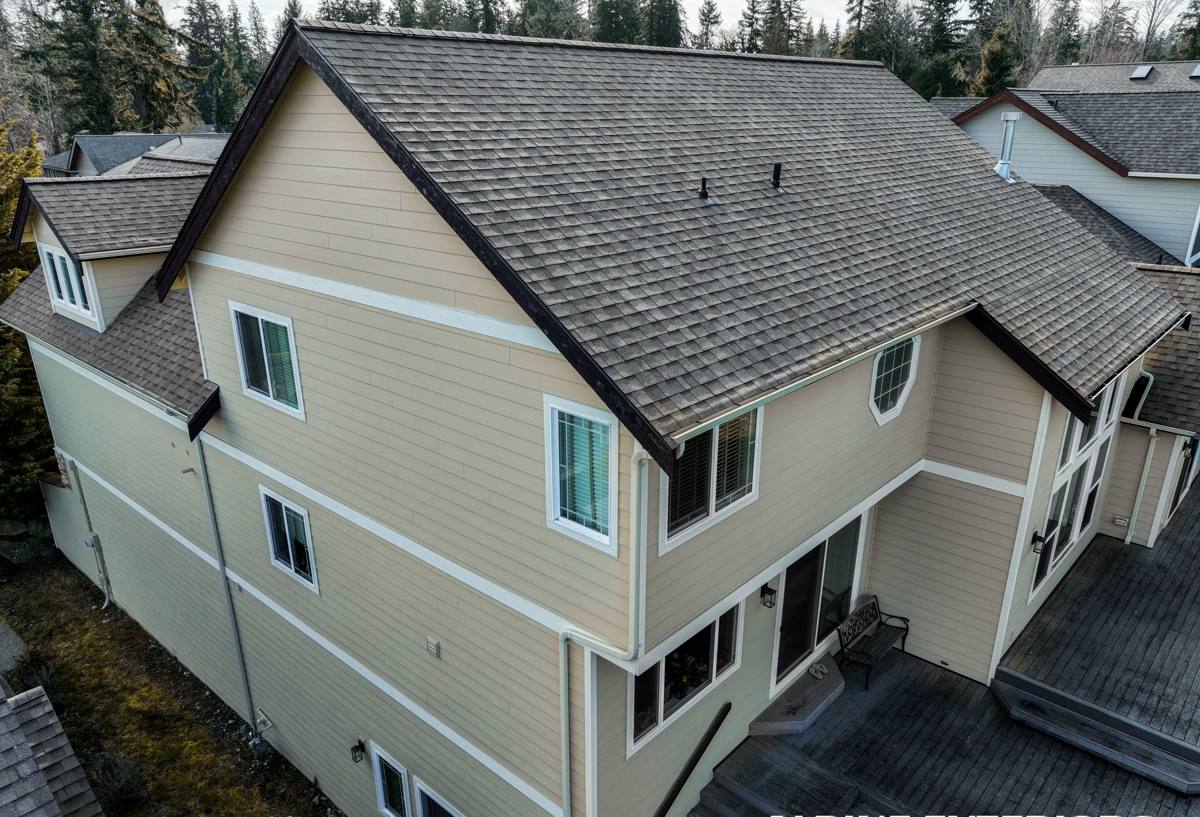
Signs a Machias Deck Needs Replacement, Not a Patch
Repair makes sense when a problem is isolated. Replacement makes sense when the damage is systemic — which, in this climate, it often is by the time someone calls us. Here's how to tell which situation you're in:
- Boards that feel spongy, bounce underfoot, or have visible cupping and splitting, especially on the shaded side of the deck
- Persistent moss or dark staining that comes back within weeks of cleaning, even after a good scrub
- Rust streaks below fasteners or joist hangers — a sign moisture has been sitting against metal for a long time
- A ledger board (where the deck attaches to the house) that's soft, discolored, or separating slightly from the siding or rim joist
- Railings or posts that wiggle more than a firm push should allow
- A deck that's more than 15–20 years old and has never had the framing inspected, only the surface boards replaced
If you're only seeing one or two of these and the deck is otherwise sound, a repair or partial re-decking may genuinely be enough. We'll tell you that if it's true — a full tear-out isn't the right call just because it's more billable work.
What a Correct Deck Replacement Actually Involves
"Deck replacement" gets used loosely. Some contractors mean pulling up the surface boards and calling it done. In our climate, that's a shortcut that leaves the part most likely to fail — the framing underneath — untouched.
Framing and Ledger Connection
Every replacement starts by exposing the frame: joists, beams, posts, and the ledger where the deck meets the house. This is where we find out whether the last builder flashed the ledger properly or just bolted it to the siding and hoped. A ledger without proper flashing is one of the most common sources of hidden rot we run into, because water gets trapped exactly where you can't see it from either side.
Decking Material
Whatever surface material you choose, it has to handle standing moisture, resist moss growth in shaded corners, and hold fastener connections without splitting over time. We'll walk through the realistic trade-offs for your specific deck's sun and shade pattern rather than pushing one product for every job.
Fasteners and Hardware
Stainless steel or heavy hot-dip galvanized fasteners and connectors are non-negotiable here. Standard coated screws and hangers can start corroding within a few wet seasons, and once a fastener fails, the board or joist it's holding is compromised even if it still looks fine.
Drainage and Grading
A deck built flush against ground that doesn't drain will stay wet longer than one with a few inches of clearance and a slight grade away from the foundation. On a lot of Machias properties, this means we adjust footing height or add drainage detail during replacement rather than just rebuilding on the old footprint.
Choosing a Decking Material for This Climate
There's no single "best" material — there's a best fit for how much sun your deck gets, how much upkeep you want to do, and your budget. Here's how the common options actually perform in a wet, moss-prone climate like ours:
| Material | Moisture & Rot Resistance | Moss/Algae Resistance | Maintenance | Realistic Lifespan Here |
|---|---|---|---|---|
| Pressure-treated fir/hem-fir | Good if sealed regularly | Needs periodic cleaning | Annual cleaning + re-sealing | 15–20 years |
| Cedar | Naturally decay-resistant, but surface wears | Moderate — still needs cleaning | Sealing every 1–2 years | 15–25 years |
| Capped composite | Excellent — won't rot or absorb water | Good, easy to clean off | Occasional washing only | 25–30+ years |
| PVC decking | Excellent — fully synthetic | Good | Occasional washing only | 25–30+ years |
Our default recommendation for shaded, moss-prone lots — which describes a lot of Machias properties tucked under tree cover — leans toward capped composite or PVC, simply because they don't give moisture a surface to soak into. That said, plenty of homeowners still prefer real wood for the look and are willing to keep up with sealing. That's a legitimate choice as long as you go in knowing the maintenance commitment.
How We Approach a Machias Deck Replacement
We work the same process every time, because skipping steps is how hidden rot gets missed:
- On-site assessment — we look at the deck from underneath, not just the surface, including the ledger connection and any posts sitting near grade
- Honest scope — we tell you whether this is a full replacement, a partial rebuild, or a repair, and why
- Written estimate — materials, framing scope, and timeline spelled out before anything is torn out
- Tear-out and framing — old decking, and any compromised joists, ledger board, or posts, come out and get rebuilt to current code
- Flashing and waterproofing — ledger flashing and any house-side waterproofing get addressed as part of the job, not treated as an add-on
- Decking, railing, and fastening — installed per manufacturer spec if using a composite or PVC product, since improper spacing or fastening voids most warranties
- Final walkthrough — we go over the finished deck with you, including basic care for whatever material you chose
Permits and Code Considerations
Most deck replacements that involve rebuilding structural framing — not just swapping surface boards — require a permit through Snohomish County or the applicable local jurisdiction, depending on where in the Machias area your property falls. Requirements can also touch on railing height, guard spacing, and stair geometry if your existing deck predates current code. We handle pulling the right permit and building to current requirements as part of the job rather than leaving it for you to sort out separately.
What Actually Drives the Cost
Deck replacement pricing varies more than people expect, and it's rarely just about square footage. The factors below are what actually move the number:
| Cost Factor | Why It Matters |
|---|---|
| Framing condition | Rotted joists, beams, or a compromised ledger add rebuild scope beyond the visible surface |
| Decking material | Pressure-treated wood costs less upfront; composite and PVC cost more but need far less upkeep |
| Height and access | A raised deck with stairs, or a hard-to-access backyard, adds labor and sometimes engineering |
| Railing style | Basic wood rail vs. cable, glass, or composite rail systems shifts cost significantly |
| Footings and drainage | Undersized or poorly placed footings may need to be redone to meet current code and grading needs |
| Permit and inspection scope | Full structural rebuilds require permitting; surface-only work usually does not |
As a broad range, straightforward deck replacements in this area tend to land somewhere between $30–$55 per square foot for pressure-treated construction and $45–$75 per square foot for composite or PVC decking with new framing — but framing condition and railing choice can move either number quite a bit. We won't know your real number until we've seen what's under the current deck, which is why the estimate starts with an actual inspection, not a phone quote.
Why It Matters to Hire a Crew That Already Works in Machias
A lot of deck problems in this area trace back to a build that was done for a drier climate's assumptions — thinner flashing, standard fasteners, decking installed tight against the house with no gap for airflow. A crew that works Machias and the surrounding Snohomish area regularly knows which shortcuts show up as callbacks in year three, not year one, and builds accordingly from the start. We're also familiar with the local permitting process and typical lot conditions in this pocket of the county — sloped yards, mature tree cover, and drainage patterns that are common here — so there are fewer surprises once we open things up.
Keeping a New Deck Ahead of the Weather
Whatever material you choose, a few habits go a long way in this climate:
- Sweep debris off the deck regularly — wet leaves trapped against boards are what starts moss and staining
- Keep gutters and downspouts clear so water isn't dumping directly onto or under the deck
- For wood decks, plan on resealing every 1–2 years; don't wait until it looks obviously dry or gray
- Check the ledger area and any spots where the deck meets the house once a year for early signs of moisture
- Trim back overhanging branches where practical to cut down shade and speed up drying after rain
If your deck is showing its age, or you're just not sure whether it's a repair or a replacement situation, we're happy to take a look and give you a straight answer. Fill out the form below for a free, no-pressure estimate.