 Snohomish
 Cathcart's Roofs Work Harder Than Most People Realize
Cathcart sits in a part of Snohomish County where big conifers, seasonal creeks, and long stretches of overcast, wet weather all combine to put steady pressure on a roof. It's not dramatic weather most of the year — no hurricanes, no hail storms every spring — but it's relentless. Rain that falls for days at a time, tree cover that keeps roofs shaded and damp longer than open lots nearby, and a moss season that can run from fall through spring. A roof out here doesn't fail from one big event. It fails slowly, from moisture that never fully dries out and organic growth that gets a foothold in shaded valleys and north-facing slopes.
That's the case for metal roofing in this specific area. It's not a trend or an upsell — it's a material that handles sustained wet exposure and sheds debris and moss better than most alternatives, which matters more in Cathcart's tree-shaded lots than it does on an open, sunny roof a few miles away.
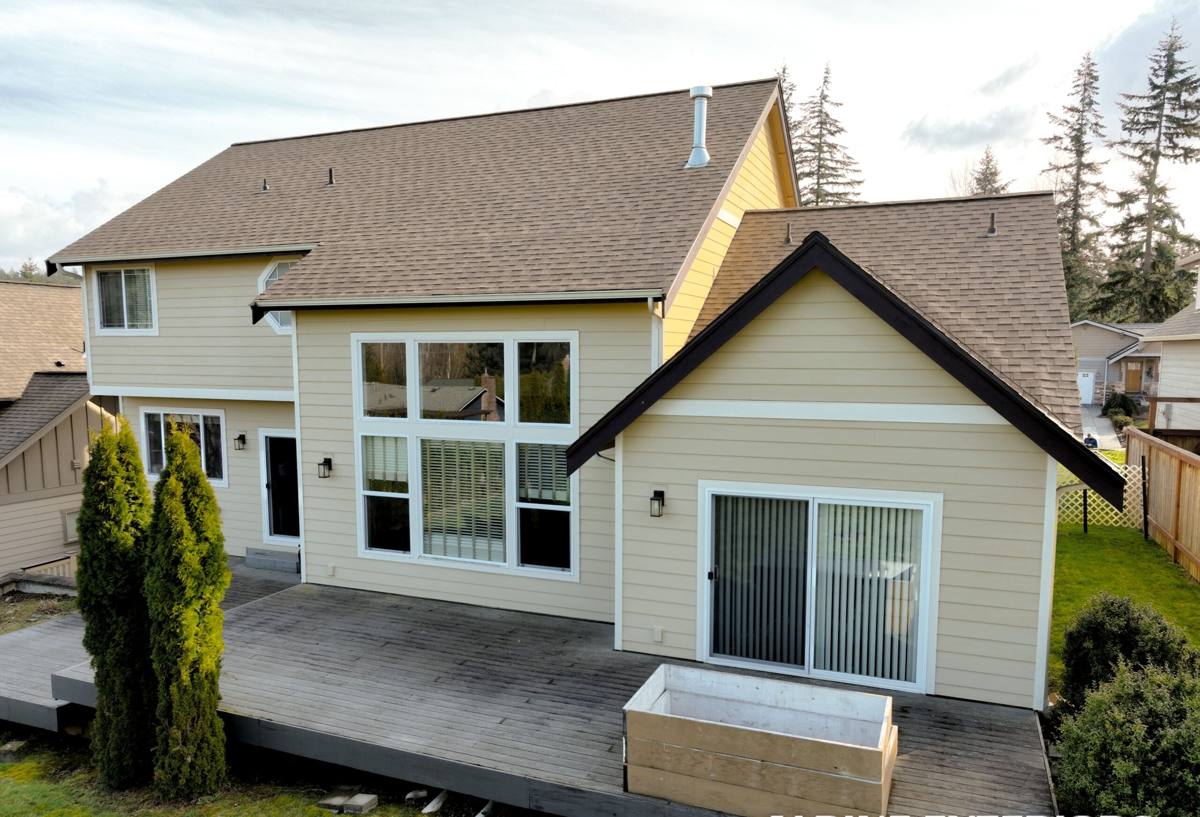
What the Local Climate Actually Does to a Roof
Snohomish County's wet season isn't just rain volume — it's duration. A roof here can stay damp for weeks at a stretch, especially under a tree canopy where sun and wind don't get a chance to dry things out between storms. A few specific effects show up again and again on roofs we look at in this area:
Moss and Organic Growth
Shaded roof sections, especially north-facing slopes and valleys where debris collects, stay wet longer and give moss and moss spores time to establish. Once moss takes hold on an asphalt shingle roof, it lifts the shingle edges and holds water against the roof deck. On a properly installed metal roof, there's far less for moss to grip onto, and the smooth, sloped surface sheds water and debris instead of trapping it.
Driving Rain and Wind-Driven Water
Storms coming off the water don't just fall straight down — wind pushes rain sideways under shingle tabs, around poorly sealed flashing, and into any gap in the roof system. This is where flashing and underlayment quality matter as much as the roofing material itself.
Salt-Influenced Air
Even well inland from the immediate coastline, Puget Sound's marine air carries some salt content, which accelerates corrosion on unprotected metal fasteners and lower-grade flashing over time. This is a real factor in material selection — not every metal roofing product or fastener is built to handle it equally well.
Needle and Leaf Debris
Conifer needles and leaf litter build up fast in valleys, around chimneys, and in any low-slope transition. Left alone, that debris holds moisture against the roof surface long after the rain has stopped, which is exactly the environment moss and rot need.
Why Metal Roofing Is a Strong Fit for Cathcart Specifically
Metal roofing isn't automatically the right choice for every home or every budget, but for the conditions common in Cathcart, it solves several problems at once:
- Its smooth, hard surface gives moss far less to grip onto compared to the textured surface of asphalt shingles.
- Steeper panel profiles shed rain and debris quickly instead of trapping it in overlapping layers.
- Properly coated steel and aluminum resist corrosion from moisture and marine air far longer than untreated fasteners or low-grade flashing.
- A correctly installed system has fewer seams and lap points where wind-driven rain can find a way in.
- Lifespan is measured in decades, which matters on a lot with heavy tree cover where roof access for frequent maintenance isn't always convenient.
None of that means metal roofing is maintenance-free — it still needs debris cleared and fasteners checked over time — but it starts from a much better position than a roofing material that's designed to shed water for a shorter service life in easier conditions.
Choosing the Right Metal Roofing System
"Metal roofing" covers a range of products, and the right one depends on the home's roof pitch, budget, and how much the homeowner wants to think about the roof after installation.
| System | Best For | Trade-Offs |
|---|---|---|
| Standing seam (concealed fasteners) | Most Cathcart homes, especially steeper or tree-shaded roofs | Higher upfront cost, but no exposed fasteners for moisture or corrosion to work into over time |
| Exposed-fastener metal panels | Budget-conscious projects, outbuildings, some lower-slope applications | Lower cost, but fasteners and gaskets need periodic inspection and eventual replacement |
| Stone-coated steel | Homeowners who want a shingle or shake appearance with metal's durability | More installation detail work around the coated surface; higher material cost |
We don't push one system on every roof. A steep, heavily shaded roof and a low-slope addition on the same property can genuinely call for different approaches, and we'll walk through that with you rather than defaulting to whatever's easiest to quote.
What a Correct Installation Actually Involves
Metal roofing performs well in this climate only when the system underneath it is done right. The panels get the attention because they're visible, but most roof failures we're called out to fix started below the surface.
Underlayment
A high-temperature, self-adhered or synthetic underlayment matters more under metal than under shingles, since metal roofs deal with condensation on the panel underside as well as rain from above. Skipping or skimping on underlayment is one of the most common shortcuts we see on roofs that develop leaks years later.
Flashing at Every Transition
Valleys, chimneys, skylights, and roof-to-wall transitions are where wind-driven rain finds its way in. Flashing needs to be sized, layered, and fastened correctly for the specific panel profile being used — generic flashing details don't hold up under Cathcart's rain volume.
Fastening and Panel Movement
Metal panels expand and contract with temperature swings. Fastening systems have to accommodate that movement without loosening seals or panels over years of freeze-thaw and wet-dry cycles.
Ventilation
A roof that traps warm, moist attic air against a cool metal underside invites condensation. Proper ridge and intake ventilation is part of a correct metal roof installation, not an optional add-on.
Living With Tree Cover: Moss and Debris Management
Cathcart's tree-shaded lots mean debris and moss exposure are an ongoing reality, even with a metal roof. The goal isn't a zero-maintenance roof — it's a roof where routine upkeep is simple instead of a constant battle.
What Actually Helps
- Clearing needles and leaves from valleys and gutters at least once or twice a year, more often under heavy tree cover.
- Trimming overhanging branches back from the roofline to cut down shade and debris drop.
- Checking flashing and fastener condition every few years, especially after major storms.
- Addressing any moss on adjacent surfaces (like a garage roof or fence) before it spreads spores onto the main roof.
A metal roof makes this easier because there's less for moss and debris to lock onto in the first place — but "easier" isn't "never," and we tell homeowners that upfront rather than overselling low maintenance.
Our Process for Cathcart Metal Roofing Projects
We work roofs in and around Snohomish regularly, so we're familiar with how tree cover, slope, and access typically play out on lots in this area. Our process is straightforward:
- On-site assessment: we look at roof pitch, shading, existing decking condition, and any moss or moisture damage already present before recommending a system.
- Honest system recommendation: we'll tell you if standing seam is worth the cost on your roof, or if a different approach makes more sense for a lower-slope section.
- Proper tear-off or overlay evaluation: metal can sometimes go over an existing roof, but only when the deck and structure genuinely support it — we won't cut that corner to save time.
- Full underlayment, flashing, and ventilation detailing: the parts that don't show are where we spend the care that prevents callbacks.
- Clear cleanup and walkthrough: you should know exactly what was done and why before we leave the job.
What to Ask Before You Hire Anyone for This Job
Metal roofing rewards good installation and punishes shortcuts more than shingle roofing does, since a poorly detailed metal roof can leak in ways that are harder to trace later. Before hiring any crew for a Cathcart metal roof, it's worth asking:
- Do you carry current liability insurance and, if required, bonding for roofing work in Washington?
- What underlayment and fastening system do you use, and why, for this specific roof pitch?
- How do you detail flashing around valleys, chimneys, and roof-to-wall transitions?
- What's the warranty structure — on the panels themselves, and separately on your installation labor?
- Have you worked on roofs in this area before, with this kind of tree cover and moisture exposure?
A contractor who answers these clearly, without vague reassurances, is usually a safer bet than one who just quotes a number.
Cost Factors Worth Understanding
Metal roofing costs more upfront than asphalt shingles, and the final number depends on several factors rather than a flat per-square rate:
| Factor | Why It Matters |
|---|---|
| Panel system chosen | Standing seam costs more than exposed-fastener panels due to labor and material |
| Roof pitch and complexity | Steep roofs, multiple valleys, and dormers all add labor time |
| Existing deck condition | Rot or damage found during tear-off adds repair cost before panels go on |
| Access and tree cover | Limited equipment access on tree-shaded or tight lots can add time |
We'd rather walk your roof and give you real numbers than throw out a broad estimate that doesn't hold up once we're actually up there.
Get a Straight Answer About Your Roof
If you're weighing a metal roof for a home in Cathcart, we're happy to take a look, walk you through what your specific roof needs given its pitch, shading, and current condition, and give you an honest recommendation — even if that means telling you a different system fits your budget better. There's no pressure and no obligation. Use the form below to request a free estimate.